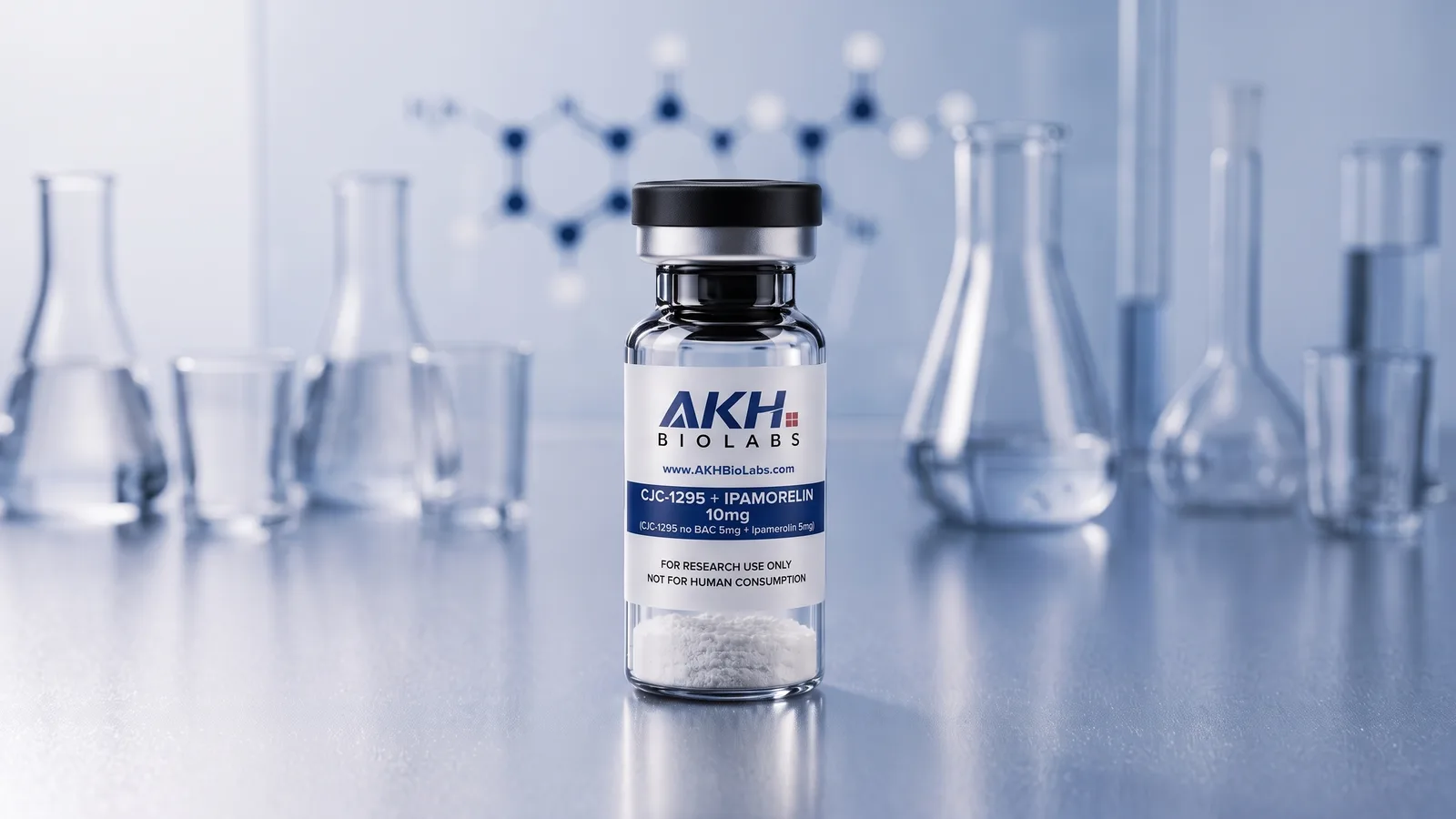
CJC-1295 DAC vs CJC-1295 no DAC
The DAC and no-DAC forms of CJC-1295 are different molecules with different published evidence, and a batch certificate of analysis is the document that states which one is in a vial.
CJC-1295 DAC is the form of the peptide carrying a drug-affinity complex that binds albumin, while CJC-1295 no DAC is the unmodified GHRH fragment without that group, and the two are treated as distinct molecules in the published literature. The difference is not cosmetic: the principal human trial of CJC-1295 used the DAC-modified analogue, and reviews of this field record that the unmodified form is frequently substituted for it under the same name.
This article is written for laboratory researchers and procurement readers who need to know which molecule a vial actually contains before designing or interpreting work around it. It covers the structural difference, what each form's evidence base consists of, how the two appear in combined research designs, and what a batch certificate of analysis can and cannot establish about form. Compound-level evidence, including the full citation list, lives on the CJC-1295 research record rather than being restated here.
Key takeaways
- The DAC group is a drug-affinity complex that binds albumin; the no-DAC form lacks it, and the two are distinct molecules rather than two strengths of one product.
- The principal human dataset for CJC-1295 comes from a 2006 trial of the DAC-modified analogue, not the unmodified fragment.
- Reviews of this literature record the frequent substitution of unmodified CJC-1295 for the DAC-modified analogue that was actually studied.
- A certificate of analysis reports identity and purity for the material tested; it is the document that states which form a batch contains.
- No peer-reviewed clinical trial administering CJC-1295 together with ipamorelin has been identified, so the combination remains component-level evidence.
What the DAC group actually is
CJC-1295 is a growth hormone-releasing hormone (GHRH) analogue, meaning a synthetic peptide modelled on the endogenous releasing hormone that acts at the pituitary GHRH receptor. The DAC suffix stands for drug-affinity complex: a chemical modification attached to the peptide that binds to albumin in circulation. Albumin binding is the mechanism behind the extended presence of the DAC form, because the peptide is carried on a serum protein rather than being cleared as a free fragment.
The no-DAC form, also written Modified GRF 1-29, is the same GHRH analogue sequence without that albumin-binding group. It is a shorter-lived molecule by construction. The two are therefore not interchangeable descriptions of one product: one carries an added functional group that changes how long the peptide persists, and the other does not.
This distinction matters for reading any published figure. A half-life, a duration of effect, or a pharmacokinetic profile measured for the DAC form does not describe the no-DAC form, and the reverse also holds. The research record for CJC-1295 sets out the component-level evidence in full; the point here is only that the two names refer to two structures.
Which form the published literature actually studies
The principal human dataset for CJC-1295 is a 2006 randomised placebo-controlled ascending-dose study in healthy adults, published in the Journal of Clinical Endocrinology and Metabolism by Teichman and colleagues. That trial used the analogue bearing a drug-affinity complex for albumin binding, and reported sustained elevations of growth hormone and IGF-I over several days. It is the DAC form.
A companion 2006 paper by Ionescu and Frohman, using frequent sampling, reported that continuous GHRH-receptor stimulation by CJC-1295 raised mean growth hormone and IGF-I concentrations while pulsatile secretion was preserved, with the increase attributed mainly to greater pulse amplitude rather than loss of pulse architecture. That work also concerns the long-acting analogue.
The consequence is straightforward: the human pharmacokinetics most often cited for CJC-1295 describe the DAC-modified molecule. Reviews of this literature record the frequent substitution of unmodified CJC-1295 for the DAC-modified analogue that was actually studied, so the published pharmacokinetics do not describe the unmodified form. A reader who assumes the two share a profile is reading one molecule's data onto another's structure.
Why CJC-1295 appears alongside ipamorelin
The pairing of a GHRH analogue with a ghrelin-receptor agonist is a standard comparator design in this literature, and it is the reason searches for cjc 1295 ipamorelin with dac return both single-compound and blend products. The two molecules reach growth hormone release through separate receptors: CJC-1295 at the pituitary GHRH receptor, ipamorelin at the ghrelin receptor GHS-R1a.
The rationale traces to human work from 1990, in which a growth hormone-releasing peptide and GHRH given together stimulated growth hormone release synergistically, with submaximal amounts of each producing more than the sum of their separate effects. Later work extended the observation to ghrelin, the endogenous GHS-R1a ligand.
Two limits apply to that rationale. First, the synergy finding is a receptor-pathway result, not a finding about any specific commercial pairing. Second, no peer-reviewed clinical trial administering CJC-1295 together with ipamorelin has been identified; a PubMed query intersecting both peptide names returned only narrative reviews, doping-control analytical methods and product-quality analyses. The combination therefore remains component-level evidence, and the CJC-1295 plus ipamorelin research record states that limitation directly.
What a batch certificate can and cannot tell you
A certificate of analysis is a test report issued by a laboratory for a specific batch of material. For a peptide, the two central measurements are chromatographic purity, usually by reversed-phase HPLC, and identity, usually by mass spectrometry. Purity is a peak-area ratio from the chromatogram; identity is a mass measurement matched against the expected value for the intended structure.
Applied to this question, the certificate is where form is stated. One published AKH batch illustrates the labelling convention: batch 26085, tested 05 Aug 2026 by the Brown Institute of Biomolecular Research, carries the results string "CJC1295(without DAC)+IPA: 10mg | Purity: 99.58%". The parenthetical is the form declaration, and it is the part of the document that answers which molecule was tested.
What the certificate does not do is resolve every question a reader might bring to it. A purity figure is not a statement of how much peptide is in the vial by weight, because lyophilised peptide is normally supplied as a salt and carries residual water; net peptide content is a separate measurement. Nor does a purity figure establish that a different, undeclared analogue is absent unless the method was set up to look for it. The certificate reports what was measured, for the batch named, by the laboratory named.
| Point of comparison | CJC-1295 DAC | CJC-1295 no DAC |
|---|---|---|
| Albumin-binding group | Present (drug-affinity complex) | Absent |
| Alternative name | Long-acting GHRH analogue | Modified GRF 1-29 |
| Principal human dataset | 2006 randomised placebo-controlled ascending-dose study in healthy adults | Not the molecule used in that trial |
| How form appears on a certificate | Stated in the identity or results line | Stated in the identity or results line, for example "without DAC" |
Checking which form a listing describes
Because the two names circulate loosely, a listing can be read against a short set of checks. The aim is not to rank suppliers but to establish whether the document trail states a form at all, and whether the stated form matches the evidence being relied on.
Where a listing describes a blend, the same checks apply to the component declaration. A blend certificate that names the no-DAC form is describing the shorter-lived molecule, and any pharmacokinetic expectation carried over from the DAC trial does not transfer to it.
- 01
Confirm the form is named
The listing or certificate should state DAC or no DAC explicitly. A product page that says only "CJC-1295" has not answered the question.
- 02
Match the form to the evidence
If the published profile being relied on comes from the 2006 healthy-adult trial, that profile belongs to the DAC-modified analogue.
- 03
Read the results string verbatim
On a certificate, the results line carries the form declaration. Read it as issued rather than as summarised.
- 04
Check the batch and laboratory are named
A certificate is checkable when it names the batch, the test date and the laboratory that issued it.
- 05
Separate purity from quantity
A purity percentage does not state peptide mass in the vial. Net peptide content is a different measurement.
What remains unresolved
Two gaps are worth stating plainly. First, the unmodified form has no comparable human pharmacokinetic dataset to the DAC analogue's 2006 trial, so statements about its duration in circulation rest on structural reasoning rather than on a matched human study. Second, the CJC-1295 plus ipamorelin combination has no identified interventional trial, which means the pairing's efficacy, safety and long-term endocrine consequences in humans remain untested.
A third, wider point comes from the analytical literature. Mass-spectrometric characterisation of illicitly distributed growth-promoting preparations has found discrepancies between declared and actual content, including incorrect peptide identity, unexpected analogues and variable amounts. That finding is about unregulated supply generally rather than about any named product, but it is the reason a batch-specific certificate matters more here than a general product description.
Common questions.
- What is the difference between CJC-1295 DAC and CJC-1295 no DAC?
CJC-1295 DAC carries a drug-affinity complex that binds albumin, which extends how long the peptide persists in circulation. CJC-1295 no DAC, also written Modified GRF 1-29, is the same GHRH analogue sequence without that group. They are distinct molecules, and a pharmacokinetic figure measured for one does not describe the other.
- Which form of CJC-1295 was used in the human trials?
The principal human dataset comes from a 2006 randomised placebo-controlled ascending-dose study in healthy adults, which used the analogue bearing a drug-affinity complex for albumin binding. That is the DAC-modified form. Reviews of this literature record the frequent substitution of unmodified CJC-1295 for the DAC-modified analogue that was actually studied.
- Does a certificate of analysis state whether a batch is DAC or no DAC?
The form appears in the identity or results line of the certificate. One published AKH batch, batch 26085 tested 05 Aug 2026 by the Brown Institute of Biomolecular Research, carries the results string "CJC1295(without DAC)+IPA: 10mg | Purity: 99.58%". The parenthetical is the form declaration for that batch.
- Has CJC-1295 with ipamorelin been tested in a clinical trial?
No peer-reviewed clinical trial administering CJC-1295 together with ipamorelin has been identified. A PubMed query intersecting both peptide names returned only narrative reviews, doping-control analytical methods and product-quality analyses. The available evidence is component-level, from separate studies of each peptide and from older human work on GHRH plus secretagogue synergy.
- Does a purity figure on a CJC-1295 certificate confirm the peptide mass in the vial?
No. Chromatographic purity is a peak-area ratio from the chromatogram, not a statement of how much peptide is present by weight. Lyophilised peptide is normally supplied as a salt and carries residual water, so the mass of powder in a vial differs from the peptide content. Net peptide content is a separate measurement.
Sources
- 01Injectable Peptide Therapy: A Primer for Orthopaedic and Sports Medicine Physicians.
- 02A new era of doping? Use of peptide and peptide-analog drugs in recreational and professional sport and bodybuilding: a critical review.
- 03Buy CJC-1295 No DAC + Ipamorelin 5mg+5mg · AKH BioLabs
- 04CJC-1295 + Ipamorelin research — published studies and evidence · AKH BioLabs
- 05Buy Ipamorelin 10mg: Batch COA · AKH BioLabs
- 06Ipamorelin research — published studies and evidence · AKH BioLabs