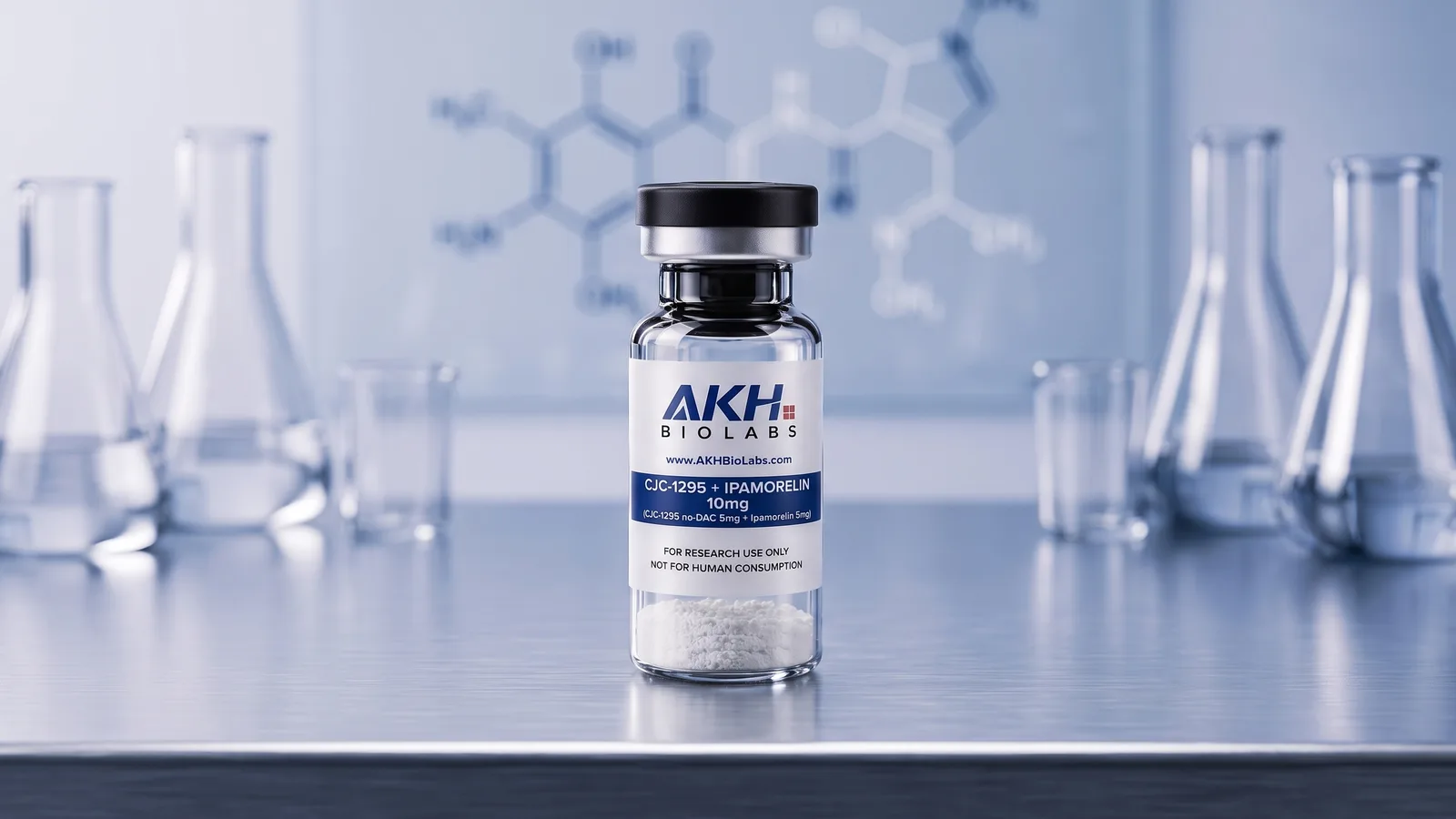
CJC-1295 without DAC and ipamorelin: what the combination is
CJC-1295 without DAC and ipamorelin are two growth-hormone secretagogues supplied as a single co-lyophilised vial, and the published literature treats them as a paired design rather than a tested combination. What the pairing is, what the evidence covers, and how one AKH batch certificate documents both components.
CJC-1295 without DAC and ipamorelin is a two-peptide pairing in which a growth hormone-releasing hormone (GHRH) receptor analogue and a ghrelin receptor agonist are supplied together, most often as a single co-lyophilised vial. The two molecules reach growth hormone release through separate receptors, and that separation is the entire reason the pairing exists in the research literature.
This article answers the plain what-is question for readers who have encountered the combination in a catalogue or a paper and want to know what it actually is. It covers the two components, the receptor logic behind pairing them, what the published evidence does and does not establish, and how a combined vial is documented on a certificate of analysis. Compound-level evidence lives at the CJC-1295 + Ipamorelin research record, which this article links to rather than restates.
Key takeaways
- CJC-1295 without DAC and ipamorelin are two distinct peptides: a GHRH receptor analogue and a ghrelin receptor (GHS-R1a) agonist.
- The pairing is studied because the two receptors act on growth hormone release through different pathways, and human work from 1990 reported that a GHRH plus secretagogue combination produced a greater response than either alone.
- No peer-reviewed clinical trial administering CJC-1295 together with ipamorelin has been identified; the evidence is component-level.
- The principal human CJC-1295 trial used the DAC-modified analogue, not the unmodified form usually paired with ipamorelin.
- A combined vial is documented on one certificate carrying a single results line that names both components, the total mass and the purity figure.
What the two components are
CJC-1295 is an analogue of growth hormone-releasing hormone, the endogenous signal that acts at the pituitary GHRH receptor. The no-DAC form, also written Modified GRF 1-29, is the GHRH analogue sequence without the drug-affinity complex that binds albumin. That complex is what extends the DAC version's persistence in circulation to a multi-day half-life; without it, the construct is cleared within hours.
Ipamorelin is a synthetic pentapeptide and a selective agonist at the growth hormone secretagogue receptor 1a (GHS-R1a), the receptor the endogenous ligand ghrelin binds. It was characterised in 1998 as the first secretagogue in its class to release growth hormone with potency comparable to GHRP-6 while not significantly elevating ACTH or cortisol above levels seen after GHRH stimulation.
The two are therefore not variants of one molecule. One is a releasing-hormone analogue acting at the GHRH receptor; the other is a secretagogue acting at the ghrelin receptor. A pharmacokinetic figure measured for one does not describe the other, and a certificate for a combined vial has to account for both.
Why cjc 1295 no dac ipamorelin appears as a paired design
The rationale traces to human work published in 1990, in which a growth hormone-releasing peptide administered to normal men stimulated growth hormone release, and its combination with growth hormone-releasing hormone produced a response greater than the sum of the individual responses. That report is the foundational human demonstration of the GHRH-plus-secretagogue synergy.
Later human work extended the finding. A low dose of ghrelin, the natural GHS-R1a ligand, combined with GHRH produced a growth hormone response substantially greater than either peptide alone. Because the two molecules engage different receptors, combined designs have remained standard comparators in this literature: a GHRH analogue supplies the releasing signal while a secretagogue amplifies the somatotroph response.
One qualification matters for reading that literature accurately. In people whose hypothalamic-pituitary connection was interrupted, the secretagogue arm failed to release growth hormone and the synergistic response to a secretagogue combined with GHRH was absent, indicating that the synergy depended on intact hypothalamic input rather than a purely pituitary mechanism.
What the published evidence covers, and what it does not
No peer-reviewed clinical trial administering CJC-1295 together with ipamorelin has been identified. A PubMed query intersecting both peptide names returned only narrative reviews, doping-control analytical methods and product-quality analyses, with no interventional study of the pair. The combination therefore remains untested for efficacy, safety, dose-response and long-term endocrine consequences in humans, and recent reviews characterise its clinical evidence base as absent rather than negative.
The available evidence is component-level. Randomised human studies exist for CJC-1295 and for ipamorelin evaluated separately, alongside the older body of human work on co-administration of GHRH with growth hormone-releasing peptides or ghrelin. A 2026 review of therapeutic peptides in orthopaedics lists ipamorelin, CJC-1295, tesamorelin, sermorelin and AOD-9604 together as growth hormone secretagogues that activate IGF-1 signalling and satellite cell repair, while stating that preclinical studies are promising and clinical trials are currently lacking.
A second 2026 review, covering peptide and peptide-analogue drugs in sport and bodybuilding, notes that most published studies examine therapeutic applications under controlled regimens rather than the combined protocols common outside them, and that the clinical evidence supporting peptide use in sport is limited. Both reviews are abstract-level sources for the compound class, not for the specific pairing.
The DAC substitution problem
The principal human CJC-1295 trial, published in 2006, used the analogue bearing a drug-affinity complex for albumin binding. Reviews of this literature record the frequent substitution of unmodified CJC-1295 for the DAC-modified analogue that was actually studied, so the published pharmacokinetics do not describe the unmodified form.
Content variability in unregulated supply
Mass-spectrometric characterisation of illicitly distributed growth-promoting preparations has found discrepancies between declared and actual content, including incorrect peptide identity, unexpected analogues and variable amounts. Label content cannot be assumed to reflect composition in that market.
No combination-level safety data
Because no controlled trial of the pair was identified, dose-response, long-term IGF-I and glucose-metabolism outcomes for the combination remain unstudied.
How a combined vial is documented on a certificate
A co-lyophilised blend is one vial containing two peptides, so its certificate has to document both in a single report. One published AKH batch illustrates the format. Batch 26085, tested 05 Aug 2026 by the Brown Institute of Biomolecular Research under task ID #1812381, carries the results string "CJC1295(without DAC)+IPA: 10mg | Purity: 99.58%" and a purity figure of 99.58 percent.
Three things in that line are worth reading carefully. The parenthetical "(without DAC)" is the form declaration for the CJC-1295 component, distinguishing it from the DAC-modified analogue. The "+IPA" names the second component in the same line rather than on a separate report. The 10mg figure is the total mass of the blend, which the product page describes as a 1:1 mass ratio of 5 mg CJC-1295 and 5 mg ipamorelin.
The certificate is a test report from a named laboratory outside AKH, ordered by the manufacturer and published unaltered. A purity figure of this kind is a chromatographic peak-area ratio from the chromatogram, not a statement of how much peptide is present by weight; lyophilised peptide is normally supplied as a salt and carries residual water, so the mass of powder in a vial differs from the peptide content. Net peptide content is a separate measurement, and the certificate's identity line is what confirms which form was tested.
| Certificate field | Value on batch 26085 |
|---|---|
| Batch | 26085 |
| Test date | 05 Aug 2026 |
| Task ID | #1812381 |
| Laboratory | Brown Institute of Biomolecular Research |
| Results string | CJC1295(without DAC)+IPA: 10mg | Purity: 99.58% |
| Purity | 99.58% |
Reading pairing claims without overreading them
The synergy finding is real and it is human, but it was established for a growth hormone-releasing peptide combined with GHRH, and extended to ghrelin combined with GHRH. Applying it to a GHRH analogue plus a GHS-R1a agonist is an analogy, not a direct measurement of that pair. The research record for this combination states the point plainly: the available evidence is component-level, and the specific combination remains untested.
A second distinction concerns which CJC-1295 the evidence describes. The sustained multi-day elevations of growth hormone and IGF-I reported in healthy adults come from the DAC-modified analogue. The no-DAC construct lacks the albumin-binding group, so those figures do not transfer. Reviews of this literature record the substitution as a recurring problem.
The practical consequence for anyone reading a product page or a certificate is that the form declaration and the component list are the checkable parts. A results line that names both components and states the form is doing the work that a generic "blend" label does not.
- 01
Confirm the form
The certificate should state whether the CJC-1295 component is the DAC or no-DAC construct, because the published pharmacokinetics differ between them.
- 02
Confirm both components appear
A combined vial's results line should name both peptides, not just the total mass.
- 03
Read the mass figure as a total
A 10mg figure on a 1:1 blend describes the combined content, not each peptide separately.
- 04
Check the laboratory name
The report should name the laboratory that issued it, so the result can be traced to a source outside the vendor.
Common questions.
- What is CJC-1295 without DAC and ipamorelin?
It is a pairing of two growth-hormone secretagogues supplied together, usually as one co-lyophilised vial. CJC-1295 without DAC is a GHRH receptor analogue lacking the albumin-binding group of the DAC version; ipamorelin is a selective agonist at the ghrelin receptor GHS-R1a. They act at different receptors, which is the basis for studying them as a pair.
- Has the CJC-1295 and ipamorelin combination been tested in a clinical trial?
No peer-reviewed clinical trial administering CJC-1295 together with ipamorelin has been identified. A PubMed query intersecting both peptide names returned only narrative reviews, doping-control analytical methods and product-quality analyses, with no interventional study of the pair. The evidence base is component-level, from separate studies of each peptide.
- Is CJC-1295 no DAC the same molecule that was studied in human trials?
Often not. The principal human trial, published in 2006, used the analogue bearing a drug-affinity complex for albumin binding, which produced sustained elevations of growth hormone and IGF-I over several days in healthy adults. Reviews of this literature record the frequent substitution of unmodified CJC-1295 for the DAC-modified analogue that was actually studied.
- How does a certificate of analysis document a two-peptide blend?
In a single results line that names both components. One published AKH batch, batch 26085 tested 05 Aug 2026 by the Brown Institute of Biomolecular Research, carries the results string "CJC1295(without DAC)+IPA: 10mg | Purity: 99.58%". The parenthetical declares the form, the "+IPA" names the second component, and the 10mg figure is the total blend mass.
- Why are CJC-1295 and ipamorelin studied together rather than separately?
They reach growth hormone release through different receptors: CJC-1295 at the GHRH receptor and ipamorelin at the ghrelin receptor GHS-R1a. Human work from 1990 reported that a growth hormone-releasing peptide and GHRH together stimulated growth hormone release synergistically, and combined designs have been standard comparators in this literature since.
Sources
- 01A new era of doping? Use of peptide and peptide-analog drugs in recreational and professional sport and bodybuilding: a critical review.
- 02Therapeutic Peptides in Orthopaedics: Applications, Challenges, and Future Directions.
- 03Buy CJC-1295 No DAC + Ipamorelin 5mg+5mg · AKH BioLabs
- 04CJC-1295 + Ipamorelin research — published studies and evidence · AKH BioLabs
- 05Buy Ipamorelin 10mg: Batch COA · AKH BioLabs
- 06Ipamorelin research — published studies and evidence · AKH BioLabs