Dihexa vendor: what to check before ordering
A dihexa vendor is judged on four checkable facts: a certificate published for that exact product, the identity and purity it reports, shipping to the destination country, and a public review record read with its volume. What each field settles, and where the AKH Dihexa page shows them.
A dihexa vendor is worth ordering from when four facts can be read from public pages before payment: a certificate published for that exact product, the identity and purity that certificate reports, shipping to the destination country, and a public review record read with its volume. The AKH BioLabs listing for Dihexa 10mg is one page where each of those fields can be checked before an order is placed.
This article is written for laboratory buyers comparing sellers of Dihexa for research use. It sets out what a certificate can and cannot establish, why the batch number matters more than the purity figure, what the published literature does and does not cover, and which claims a listing should be able to support. Nothing here is a recommendation of a compound for any human purpose, and the material discussed is supplied for research only.
Key takeaways
- A certificate is checkable only when it names the product, the batch, the laboratory and the test date.
- A chromatographic purity figure is a peak-area ratio, not the share of vial mass that is the peptide.
- The batch number is the field that ties a document to a physical container; a purity figure without it describes different material.
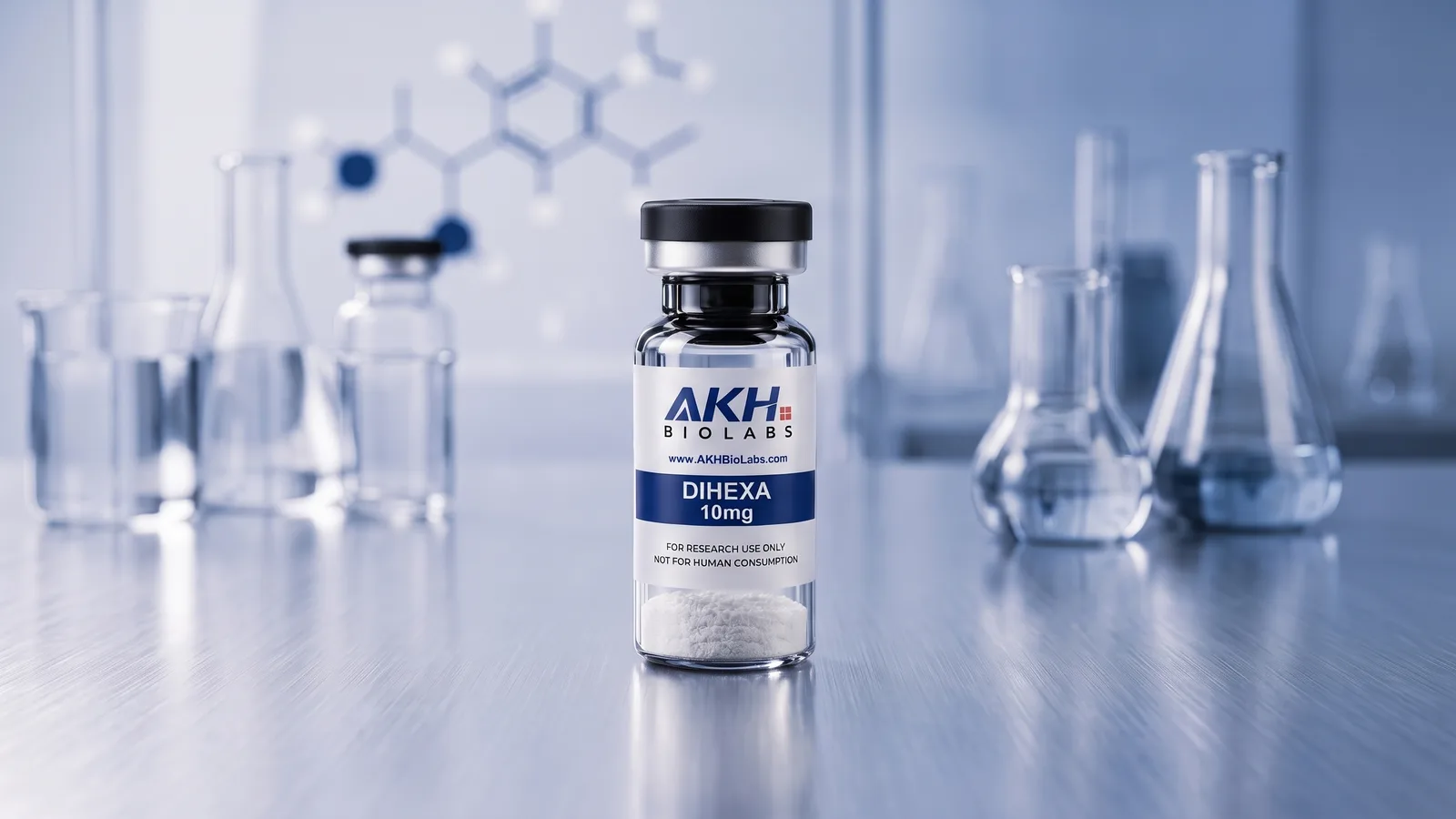
- The AKH Dihexa listing states a 10mg size, formula C27H44N4O5, and a certificate status of pending.
- The published Dihexa record is preclinical, and the research page states that no human study of dihexa has been published.
The four fields that make a dihexa vendor checkable
A buying decision rests on documents rather than on adjectives. Four fields can be read from a seller's public pages before an order is placed, and each answers a different question. A listing that is clear on one and vague on the others is only partly checkable.
The first field is a certificate published for the exact product being sold. A generic report, or one covering a different compound, does not describe the material in the container. The second is what that certificate reports: the identity line and the purity figure, both of which are measurements for one batch rather than statements about a product line.
The third field is shipping. A seller should name the destinations it serves and give a delivery window rather than a vague promise. The fourth is the public review record, read with its volume: a rating carries different weight at 28 reviews than at three, and the count is part of the fact.
- 01
Certificate published for the exact product
The report should name the compound being sold, not a related one. A certificate for a different product does not describe the vial.
- 02
Identity and purity as reported
The results line should state what was measured. A purity figure is a chromatographic result for that batch, not a mass fraction.
- 03
Batch number and test date
These two fields tie the document to a physical container and to a point in time. Without them the report cannot be matched to a vial.
- 04
Laboratory named on the report
The issuing laboratory is the party that produced the measurement. A report without a named laboratory cannot be checked against anything.
- 05
Shipping destination and window
A stated destination list and delivery window are commercial facts that can be read before ordering and confirmed on arrival.
- 06
Public review record with its volume
A rating is read alongside the number of reviews behind it. The count is part of the evidence, not a footnote.
What a certificate of analysis does and does not establish
A certificate of analysis is a report of measurements for one batch. It is not a purity assurance for a product line, and it is not a statement of intended use. The house position is that each published certificate is a report from a named laboratory outside AKH, ordered by the manufacturer, and that is the arrangement a buyer should look for on any seller's page.
The purity figure on such a report comes from liquid chromatography. It is a peak-area ratio taken from the chromatogram: it states what share of the detected material is the target peak, not what share of the vial mass is the peptide. Salt form and residual water both sit between the two, which is why net peptide content is measured separately. The glossary entry on HPLC purity sets out the distinction, and the guide on how to read a certificate of analysis walks through the fields in order.
The batch number is the field that does the linking. A report with a high purity figure but a batch that does not match the material being supplied describes a different batch. The purity figure states what was measured; the batch number states which material the measurement applies to.
What the AKH Dihexa page shows
The AKH BioLabs Dihexa listing states a 10mg size and the formula C27H44N4O5, and it carries a certificate status line that reads "Certificate pending". That is the honest state of the record: the page does not claim a published report it does not have, and the status line is the field a buyer should read first.
The listing describes the compound as N-hexanoic-Tyr-Ile-(6)-aminohexanoic amide, a blood-brain-barrier-permeable oligopeptide derived from angiotensin IV, and it states that the material is categorised as Cognitive and supplied for research purposes only. It also states worldwide delivery in a 9 to 14 day window, and it shows a public review record of 4.7 on Trustpilot with 28 reviews.
The page links down to the Dihexa research record, which is where the published studies are collected and where the limits of that evidence are set out. A buyer comparing sellers can use the same four fields on any listing: a certificate for the exact product, the identity and purity it reports, the shipping terms, and the review record with its count.
What the published Dihexa record covers
The evidence record for this compound is preclinical. The Dihexa research page states that no human study of dihexa has been published, that all efficacy data come from rodent, zebrafish and cell models, and that two foundational papers from the originating laboratory were retracted in 2025 while a third carries an expression of concern. Those are the record's own stated limits, and they belong in any buying decision.
Two of the papers cited with this article illustrate the range. One reports that a hepatocyte growth factor mimetic protected lateral line hair cells from aminoglycoside exposure in larval zebrafish, with protection attenuated by an HGF antagonist and by inhibitors of downstream targets. The other describes a small-molecule-only protocol for generating hepatic cells from human pluripotent stem cells, in which a combination of vitamin C, Dihexa and forskolin substituted for recombinant growth factors to induce hepatic specification. Neither paper is a human study, and neither supports a claim about human use.
The research record also notes that the closest human data come from fosgonimeton, a different HGF/MET positive modulator, and that those results cannot be read as evidence about dihexa itself. A listing that presents the compound as clinically established is describing something the published record does not contain.
Claims a listing should be able to support
A seller's page makes claims in three registers: identity, documentation and logistics. Identity claims name the compound and its formula. Documentation claims point to a certificate and to the fields on it. Logistics claims cover shipping destinations and windows. Each can be checked against a public page before ordering and against the vial after delivery.
The claims that cannot be checked are the ones to treat with caution. A statement that a product is the best, the purest or the most trusted is not a field. A purity figure quoted without a batch number is not tied to a container. A certificate that names no laboratory cannot be traced to a measurement. None of these is evidence of a problem; each is simply a claim that cannot be verified from the page.
The practical test is whether the same four fields appear on every product page a seller offers, or only on some. Consistency across a catalogue is itself a checkable pattern, and it is the pattern a buyer can read in a few minutes.
Identity claims
The compound name, the formula and the stated size. These should match across the listing, the certificate and the research record.
Documentation claims
A certificate for the exact product, with a named laboratory, a batch number and a test date. A pending status is a documentation claim too, and an honest one.
Logistics claims
Stated destinations and a delivery window. These are commercial facts rather than quality claims, and they are read separately from the certificate.
Checking a dihexa vendor before ordering
The check takes a few minutes and needs no contact with the seller. Open the product page and look for the certificate link or status line. If a report is published, read the compound name, the batch number, the test date and the laboratory, then compare the batch number with the one printed on the vial after delivery. If the status is pending, that is the state of the record and the page should say so.
Then read the shipping terms and the review record. A stated window and a review count are both facts that can be recorded and compared across sellers.
The same procedure applies to any seller. The fields do not change with the shop, and neither does the reason for reading them: a certificate is only useful when it can be matched to the container in hand. The Dihexa 10mg page is where the four fields for this compound are shown, and the research record at /research/dihexa is where the published studies behind the compound are collected.
Common questions.
- What should be checked on a dihexa vendor before ordering?
Four public fields: a certificate published for that exact product, the identity and purity it reports, the seller's stated shipping destination and window, and the public review record read with its volume. Each is readable from a public page before ordering, and each can be checked again after delivery against the batch printed on the vial.
- Where can Dihexa be bought for laboratory research?
From a seller that publishes a certificate for the exact product, names the laboratory, batch and test date on it, and states shipping to the destination country. The AKH BioLabs Dihexa page states a 10mg size, the formula C27H44N4O5, worldwide delivery in a 9 to 14 day window, and a certificate status of pending. The listing is supplied for research use only.
- Does a Dihexa certificate state how much peptide is in the vial?
No. A chromatographic purity figure is a peak-area ratio from the chromatogram, not a mass fraction. Lyophilised peptide is normally supplied as a salt and carries residual water, so the powder mass differs from the peptide mass. Net peptide content is a separate measurement, and the certificate reports the purity result rather than the fill quantity.
- Why does the batch number matter more than the purity figure on a Dihexa report?
The batch number is the field that ties the document to the physical vial. A report with a high purity figure but a batch that does not match the material being supplied describes a different batch. The purity figure states what was measured; the batch number states which material the measurement applies to.
- Is Dihexa an approved medicine for human use?
No. The AKH BioLabs research record states that no human study of dihexa has been published, that all efficacy data come from rodent, zebrafish and cell models, and that two foundational papers from the originating laboratory were retracted in 2025. The listing itself is supplied for research purposes only and states that it is not for human consumption, diagnosis, treatment, or prevention of any condition.
Sources
- 01Hepatocyte growth factor mimetic protects lateral line hair cells from aminoglycoside exposure.
- 02Efficiently generate functional hepatic cells from human pluripotent stem cells by complete small-molecule strategy.
- 03Buy Dihexa 10mg Research Peptide · AKH BioLabs
- 04Dihexa research: published studies · AKH BioLabs