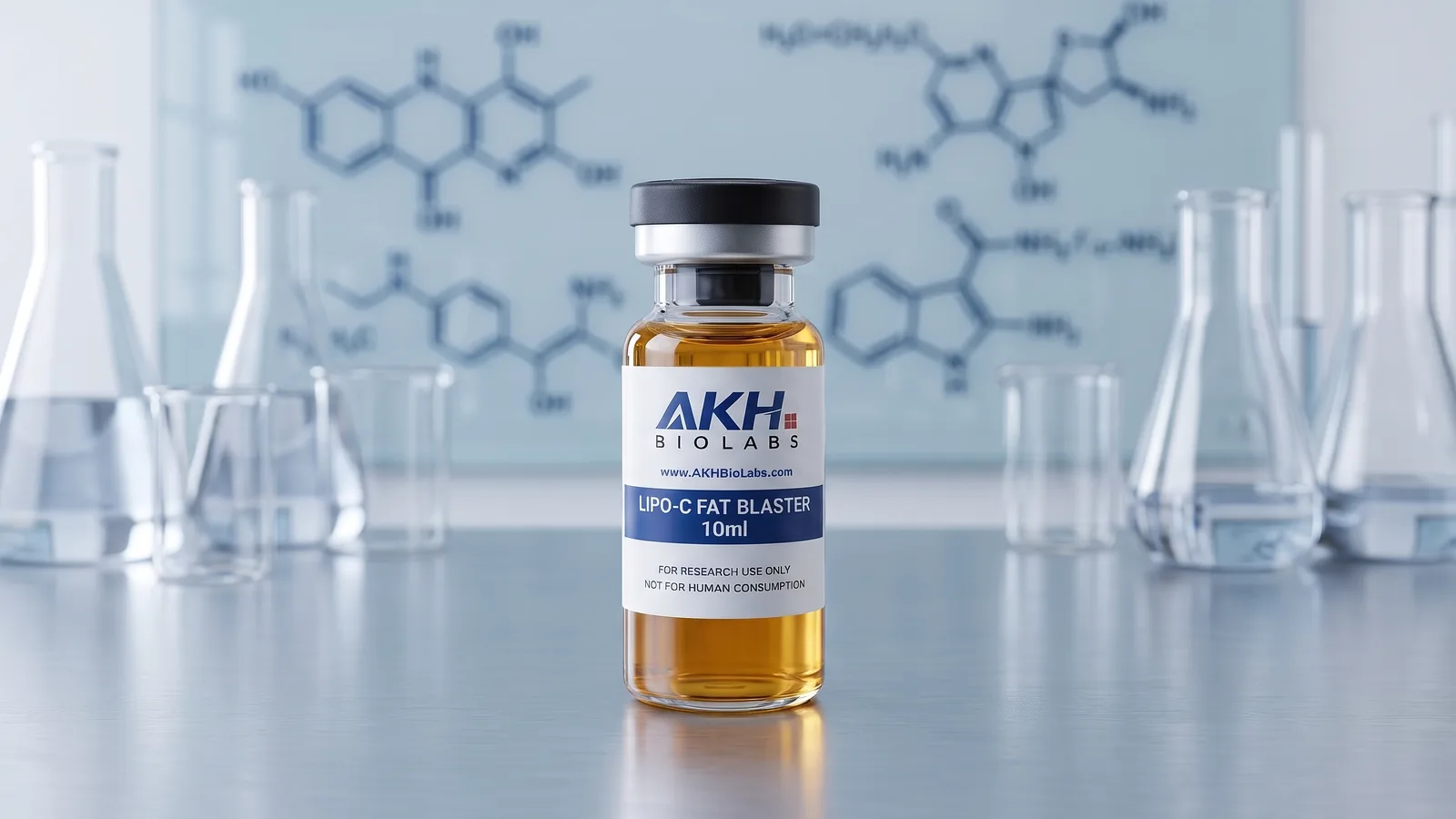
Lipo-C Fat Blaster vs Lemon Bottle for research
A buyer's comparison of Lipo-C Fat Blaster and Lemon Bottle for laboratory research: what each 10 ml liquid contains, how the two published evidence records differ in shape, and which certificate fields and batch numbers to check before ordering.
The short answer to lipo c fat blaster vs lemon bottle is that they are different kinds of research material rather than two versions of one: Lipo-C Fat Blaster is a seven-constituent lipotropic blend whose published record is component-level, while Lemon Bottle is a three-constituent lipolytic solution whose record concerns deoxycholic acid and phosphatidylcholine rather than the branded liquid itself. Neither finished formulation has published controlled-trial data, so the choice rests on which literature a study needs to sit against.
This article is written for laboratory buyers and research leads choosing between the two for a study, and it stays on composition, evidence shape and supply facts. The product pages for Lipo-C Fat Blaster and Lemon Bottle carry the compositions, stated purities and certificate links, and the full evidence records sit in the research library.
Key takeaways
- Lipo-C Fat Blaster states seven constituents with a mass for each in a 10 ml ready-mixed liquid; Lemon Bottle states three constituents and no per-constituent masses.
- The Lipo-C evidence record lists 15 studies, 11 since 2023, all component-level; the Lemon Bottle record lists 39, 15 since 2023, and none concerns the branded formulation.
- Neither liquid has been tested as supplied in a published controlled trial.
- Each product page publishes one Certificate from a named laboratory outside AKH: batch 26205 for Lipo-C Fat Blaster and batch 26116 for Lemon Bottle.
What each 10 ml vial contains
The Lipo-C Fat Blaster page states a 10 ml ready-mixed liquid containing L-carnitine 300 mg, methionine 25 mg, inositol 50 mg, choline 50 mg, vitamin B12 1 mg, vitamin B6 50 mg and NADH 50 mg, totalled on the page as 526 mg of actives. Because the liquid arrives ready-mixed, the page carries no mixing calculator. Methionine, inositol and choline are the classical lipotropic factors of the nutrition literature, and the page frames the blend in those terms.
The Lemon Bottle page states a 10 ml aqueous solution combining riboflavin, lecithin and bromelain, described as Korean-origin and studied in preclinical adipocyte models for lipid emulsification and membrane interactions. It publishes no per-constituent masses, and the research record notes that the formulation's exact composition is not standardised in the peer-reviewed literature. The page also states that the product is not approved by the EMA or MHRA.
| Field | Lipo-C Fat Blaster | Lemon Bottle |
|---|---|---|
| Form | Ready-mixed 10 ml liquid | Ready-mixed 10 ml aqueous solution |
| Named constituents | Seven: L-carnitine, methionine, inositol, choline, vitamin B12, vitamin B6, NADH | Three: riboflavin, lecithin, bromelain |
| Per-constituent masses published | Yes, each stated in mg | No |
| Stated purity | 99.92% | 99.8% |
| Regulatory note on the page | Research-use-only statement | Not approved by the EMA or MHRA |
How the two published records differ
The Lipo-C record lists 15 published studies, 11 since 2023, with the newest dated 2026 and a last review in October 2026. Each entry concerns a single constituent, and most of the evidence comes from supplementation trials and observational nutrition work covering L-carnitine, choline, myo-inositol, dietary methionine restriction and vitamin B12 status. The record states that findings for one component do not transfer to a multi-ingredient preparation.
The Lemon Bottle record is larger at 39 entries, 15 since 2023, split into 30 human studies, one animal study, two in vitro studies and six reviews. Its subject is deoxycholic acid (ATX-101), supported by two phase 3 randomised placebo-controlled trials, and compounded phosphatidylcholine with sodium deoxycholate, which the record states was never approved for this use. It adds that preclinical work attributed most of the adipocytolytic activity to the deoxycholate detergent rather than the phospholipid, and that the branded Lemon Bottle product was not identified in any peer-reviewed clinical or mechanistic study.
What neither record establishes
Neither record supports the claim that the liquid in the vial has been studied as a finished formulation. The Lipo-C record states that the combined mixture has not been evaluated in any controlled trial and that no published study has assessed its behaviour as a mixture. The Lemon Bottle record states that no peer-reviewed clinical trial, case report or mechanistic study of the branded formulation was identified, so its composition and potency are not independently characterised.
The Lemon Bottle record also notes that the only human report it located is a 2026 preprint that has not been peer reviewed, so it carries little weight as evidence about the branded product.
The consequence for a design is that neither name works as shorthand for a studied molecule. Deoxycholic acid is not phosphatidylcholine, and the Lipo-C blend is not any one of its seven constituents. Citing the deoxycholic acid trials for a phosphatidylcholine solution, or the L-carnitine meta-analyses for a seven-part liquid, cites a different material.
Reading the two certificates
Each product page publishes one Certificate from a named laboratory outside AKH, ordered by the manufacturer, and the COA archive holds one row per Certificate.
Lipo-C Fat Blaster: batch 26205, tested 05 Aug 2026 by the Brown Institute of Biomolecular Research, purity 99.92%. The product page gives the presentation as a ready-mixed 10 ml liquid, listed as 10ml / 5260mg in total.
Lemon Bottle: batch 26116, tested 12 Aug 2026 by the Brown Institute of Biomolecular Research, purity 99.8%, and the product page gives the size as 10 ml.
Both figures are chromatographic peak-area ratios rather than mass fractions, so neither states how much of the vial mass is the named material, and the small gap between 99.92% and 99.8% does not rank the two. Matching the batch number on the report to the batch on the container is the check that ties a measurement to the material in hand.
How to pick between them, and where to buy each
The decision follows the research question rather than the label. A study of lipotropic cofactors and hepatic lipid handling has a component-level literature to cite for Lipo-C; a study of phospholipid and detergent membrane interaction has the deoxycholic acid and phosphatidylcholine-deoxycholate literature, but not the branded solution.
Both are supplied as ready-mixed 10 ml liquids for laboratory research only, and each page states a worldwide delivery window of 9 to 14 days. The Lipo-C Fat Blaster page publishes the seven-constituent composition, the 99.92% purity figure and the certificate for batch 26205, and the Lemon Bottle page publishes the three-constituent description, the 99.8% purity figure and the certificate for batch 26116. Each certificate is a report from a named laboratory outside AKH, ordered by the manufacturer, and each can be checked against the container on arrival by batch number, laboratory and test date.
- 01
Name the question first
Lipotropic cofactors and hepatic lipid handling point to the Lipo-C constituents; adipocyte membrane interaction points to the phosphatidylcholine literature, with the caveat that it concerns different molecules.
- 02
Decide whether per-constituent masses are needed
The Lipo-C page publishes seven masses. The Lemon Bottle page publishes none.
- 03
Decide whether a standardised composition is required
The Lemon Bottle record states that its composition is not standardised in the peer-reviewed literature, and the Lipo-C record states that the mixture was never tested as a mixture.
- 04
Confirm the batch record
Batch 26205 for Lipo-C Fat Blaster and batch 26116 for Lemon Bottle, each tested in August 2026 by the Brown Institute of Biomolecular Research.
Common questions.
- Do Lipo-C Fat Blaster and Lemon Bottle have human trial data?
Neither finished liquid does. The Lipo-C record states that the combined formulation has not been evaluated in any controlled trial, and its 15 entries concern single constituents. The Lemon Bottle record states that no peer-reviewed clinical trial, case report or mechanistic study of the branded formulation was identified, so its human entries concern deoxycholic acid and phosphatidylcholine-deoxycholate preparations rather than the branded solution.
- Is Lemon Bottle the same as deoxycholic acid?
No. Deoxycholic acid (ATX-101) is a distinct compound supported by two phase 3 randomised placebo-controlled trials, while the Lemon Bottle page names riboflavin, lecithin and bromelain as its constituents. The record adds that preclinical work attributed most of the adipocytolytic activity of phosphatidylcholine-deoxycholate preparations to the deoxycholate detergent rather than the phospholipid, a further reason the two should not be treated as interchangeable in a design.
- What is the difference between a lipotropic blend and a lipolytic solution?
A lipotropic blend is built around the classical lipotropic factors, the compounds the nutrition literature associates with hepatic phospholipid synthesis and lipid export, which is how the Lipo-C page frames its methionine, inositol and choline. A lipolytic solution is framed around lipid breakdown and membrane interaction, which is how the Lemon Bottle page describes its use in preclinical adipocyte models. The two labels describe different research framings rather than a ranking.
- Does a higher purity figure make one of the two a better research choice?
No. The Lipo-C certificate records 99.92% for batch 26205 and the Lemon Bottle certificate records 99.8% for batch 26116, and both are chromatographic peak-area ratios rather than mass fractions. Neither states how much of the vial mass is the named constituents, so a small difference between the two figures says nothing about which liquid suits a study.