LL 37 peptide price: what to check before ordering
The ll 37 peptide price sits on the product page, and the checks that make an LL-37 order verifiable are a published Certificate from a named laboratory outside the seller, the identity and purity it reports, delivery to the destination country and a public review record read with its count.
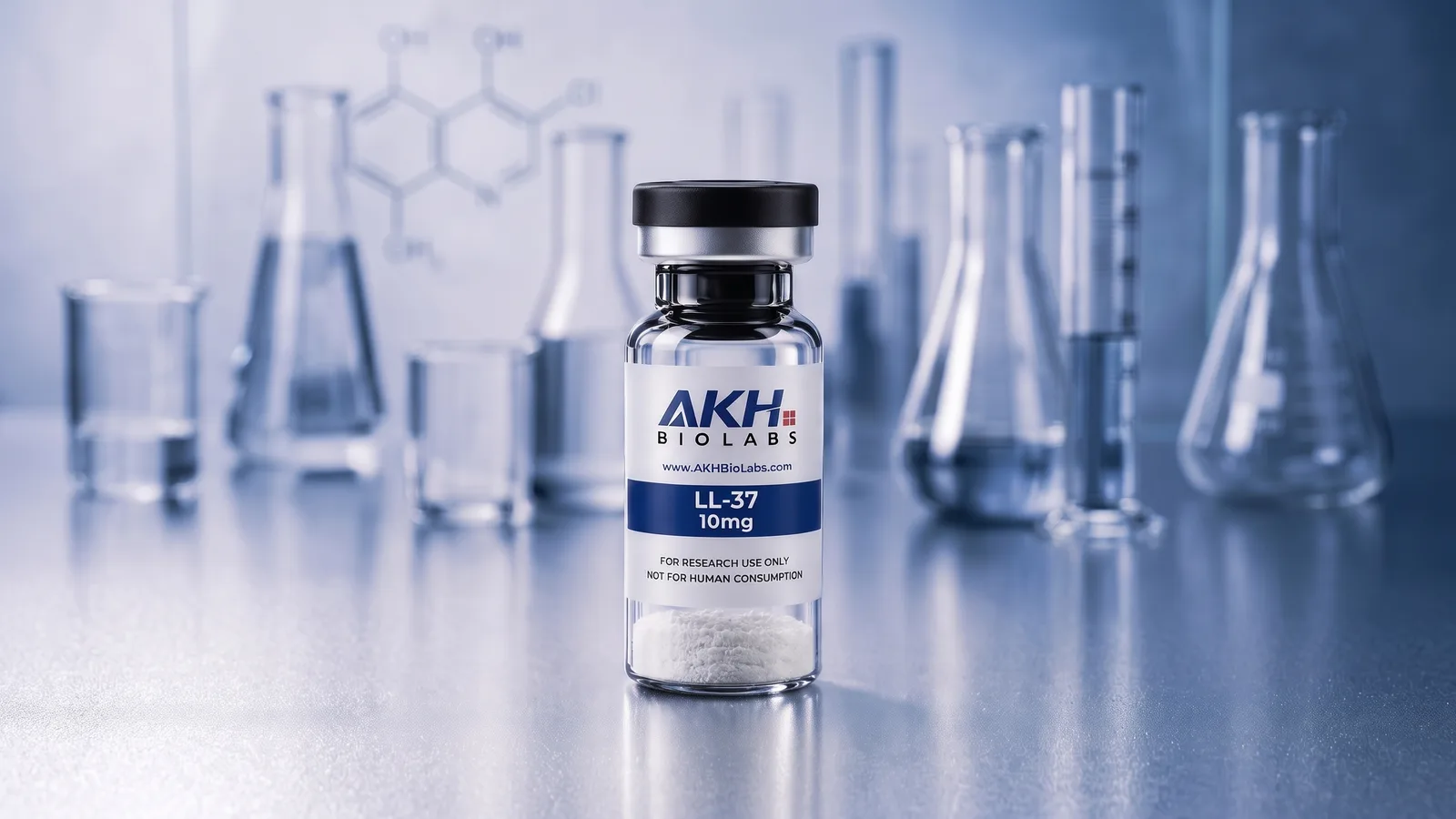
The ll 37 peptide price is shown on the product page rather than in this article, and the checks that make an LL-37 order verifiable are a published Certificate from a named laboratory outside the seller for that exact product, the identity and purity that report states, delivery to the destination country and a public review record read with its count. The LL-37 10mg page is where AKH BioLabs sets out its own presentation: the identity fields, the delivery window and the review record are readable there, while the certificate status reads pending.
This article is written for laboratory buyers comparing LL-37 listings for research use. It sets out what each check verifies, what the LL-37 page answers, and which question stays open until a report is published.
Key takeaways
- LL-37 is the sole human cathelicidin, a 37-residue amphipathic peptide released by cleavage of the hCAP18 precursor and expressed by neutrophils, monocytes and epithelial cells.
- The AKH BioLabs listing states a 10mg presentation and the formula C205H340N60O53, and shows the certificate status as pending rather than printing a purity figure.
- A stated fill mass and a chromatographic purity figure describe different quantities, and salt form plus residual water sit between them.
- The published record lists 21 studies, 13 of them since 2023, and states that no LL-37 product is approved.
What the best place to buy ll 37 has to publish
Four checks do most of the work when comparing LL-37 listings, and each can be read from a public page before payment.
The first is a Certificate published for that exact product, issued by a named laboratory outside the seller. The second is the identity and purity that report states. The third is delivery to the destination country. The fourth is a public review record read with its count, because a score without the number of reviews behind it says very little.
A Certificate for that exact product
The LL-37 page shows the certificate status as pending, so this is the field that is not yet answered for that product. A published report is the document that would carry the measurement.
The identity the report states
Identity is a formula and a set of registry identifiers rather than a percentage. The LL-37 research record gives formula C205H340N60O53, CAS number 154947-66-7 and PubChem CID 16198951, which is what allows one compound to be recognised across listings that spell the name differently or use an alternative writing such as ropocamptide.
Delivery to the destination country
A stated scope and window is checkable. AKH states worldwide delivery in 9 to 14 days. That is a commercial term about reach and timing, and it says nothing about the material in the vial.
A public review record with its count
The LL-37 page displays 4.7 on Trustpilot from 28 reviews. The count matters as much as the score, and neither describes the batch: a review record describes service across past orders, while a certificate describes a measurement.
What the LL-37 page shows, and what the ll 37 price covers
The page states a 10mg presentation and the formula C205H340N60O53, and it shows the certificate status as pending rather than printing a purity figure. The research record adds a molecular weight of 4493 g/mol, CAS 154947-66-7 and PubChem CID 16198951, and notes that those figures come from the PubChem record for the compound and describe the free base.
The ll 37 price is displayed on the product page beside the stated size. It covers the presentation offered and the seller's commercial terms, which the same page sets out: shipping terms that include a free-shipping threshold, a lower price for five or more vials, and a reshipment or full refund policy. It is a commercial figure rather than a batch measurement, so it does not describe the material in the vial.
The page also carries a research-use-only statement: the material is supplied for laboratory research and is not for human consumption.
Why a purity figure and a fill mass answer different questions
The stated 10mg is a fill mass, not a peptide mass. The research record notes that lyophilised peptide is normally supplied as an acetate or trifluoroacetate salt and carries residual water, so the mass of powder in a vial is not the same quantity as the free-base figures suggest.
Chromatographic purity does not resolve that difference either. The research record states plainly that a purity result on a certificate of analysis does not bridge the gap between powder mass and peptide mass. On the LL-37 page the purity field reads pending, so neither figure is available for that product yet.
That leaves two separate questions for a buyer: which compound identity the batch carries, and how much peptide the vial holds by mass. The identity fields answer the first. The second needs a measurement the page does not yet publish.
What the published LL-37 record covers, and what it does not
LL-37 is the sole human cathelicidin, a 37-residue amphipathic peptide released by proteolytic cleavage of the hCAP18 precursor and expressed by neutrophils, monocytes and epithelial cells. A 2016 review describes chemotactic and immunomodulatory properties alongside antimicrobial activity, and discusses the peptide across immunological, respiratory, gastrointestinal and skin systems.
The record at /research/ll-37 lists 21 published studies, 13 of them published since 2023, with the newest dated 2026 and a last review in October 2026. The great majority is in vitro or animal work. A 2022 review of murine rosacea models notes that a model built on LL-37 has become the most intensively used in rosacea research, and that no single model reproduces the full picture of the condition.
The record also states its limits. There is no approved LL-37 product, human interventional data are limited to a small number of formulations, and the largest controlled trial, a phase IIb study in hard-to-heal venous leg ulcers, was negative on its primary analysis. The same peptide is implicated in inflammatory skin and vascular contexts, so its behaviour is treated as concentration and context dependent rather than settled.
Before ordering LL-37 for research
Four fields are worth reading in order before an order is placed, and the LL-37 page answers three of them while leaving the fourth open.
The LL-37 page is where those fields sit for the 10mg presentation: the formula, the stated size, the pending certificate status, the worldwide delivery window and the review record. Reading them in that order gives a buyer a record of what the listing does and does not answer before an order is placed.
- 01
Read the certificate status first
On the LL-37 page the purity field reads pending. A pending status leaves the purity question open, and it should be recorded as open rather than filled with an assumed figure.
- 02
Match the batch, not the name
The LL-37 page shows the certificate status as pending and prints no batch number. Until a report is published there is no batch to match, which is itself the answer to the check.
- 03
Separate identity from quantity
The formula and registry identifiers confirm which compound is offered. The research record notes that those figures describe the free base, and that salt form and residual water sit between the powder mass and the peptide mass. A purity result answers neither question.
- 04
Confirm the delivery scope
AKH states worldwide delivery in a 9 to 14 day window. A destination outside that scope is a reason to ask before ordering rather than after.
- 05
Read the review record with its count
The listing displays 4.7 on Trustpilot from 28 reviews, which describes service across past orders rather than the material in the vial.
Common questions.
- Does a pending certificate mean an LL-37 batch has not been tested?
The LL-37 page shows the certificate status as pending and prints no purity figure, so the document is not on the page. That leaves the purity question open rather than answered. The identity fields, the stated 10mg size, the delivery window and the review record remain readable in the meantime.
- What does the 4.7 Trustpilot score on the LL-37 page measure?
The page displays 4.7 on Trustpilot from 28 reviews. That is a review score with its count, and it describes buyers' experience of ordering rather than the identity or purity of any batch. It is read beside the certificate field, not in place of it.
- Does the LL-37 listing state a shipping window and a reshipment policy?
Yes. The page states worldwide delivery in a 9 to 14 day window and a reshipment or full refund policy. Both are commercial terms about reach, timing and remedy. Neither describes the material in the vial, so both sit beside the certificate and identity fields rather than replacing them.