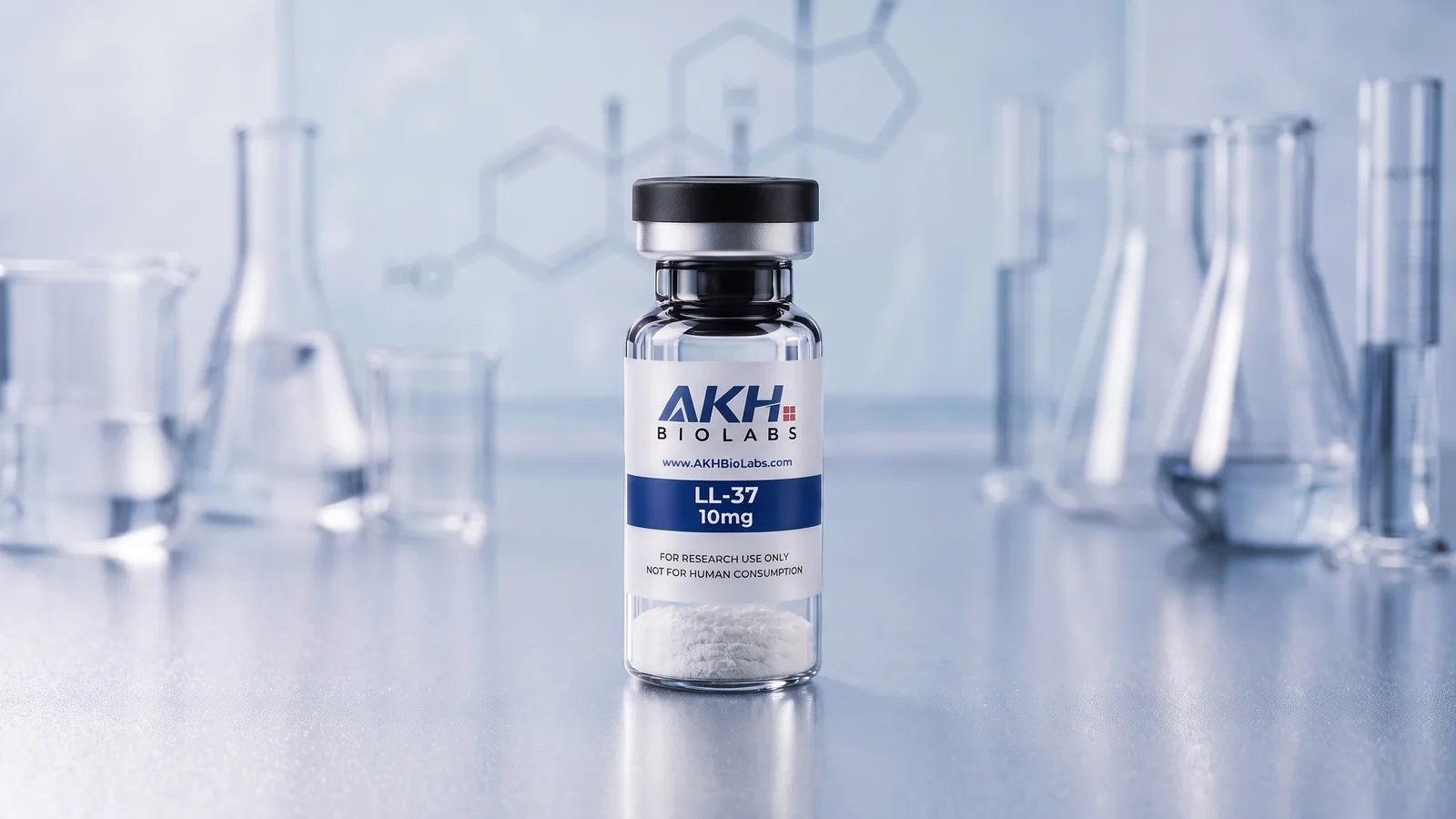
LL 37 supplier: what to check before ordering
A supplier listing can be checked against a Certificate published for that exact product, the identity it reports, stated shipping to the destination country and a public review record. This article sets out those checks and what the AKH BioLabs LL-37 page currently shows.
A supplier listing can be checked against a Certificate published for that exact product, the identity that document reports, stated shipping to the destination country, and a public review record read with its volume. The AKH BioLabs listing for LL-37 10mg shows some of those fields and not others, and this article separates the two.
LL-37 is the only human cathelicidin antimicrobial peptide, a 37-amino-acid amphipathic helix released from the hCAP18 precursor by neutrophils and epithelial cells. The published literature belongs on the research record, which lists 21 studies and states the limits of the evidence. This article is written for laboratory buyers comparing suppliers of research material, and it makes no case for any human use.
Key takeaways
- Four fields can be checked on a listing: a product-specific Certificate, a named laboratory with a batch number and test date, stated shipping, and a public review record with its count.
- Chromatographic purity on a certificate of analysis does not resolve the difference between powder mass and peptide mass.
- The batch number is one of the fields a buyer can check on a report.
- The AKH BioLabs LL-37 listing carries a certificate status of pending, so no purity figure is published for that product.
- Identity is a separate question from purity, and mass spectrometry is the method used to answer it.
The four checks that make an ll 37 supplier listing checkable
Supplier pages can be read by checking the same set of fields. Four fields can be checked, each answers a different question, and a listing that is clear on one while silent on the others is only partly checkable.
The checks address different questions. A published report addresses identity and measurement, stated shipping addresses delivery, and a review record read with its count addresses what other buyers have reported. Each check addresses a different question.
A Certificate for the exact product
The document should name the compound it covers. A report covering a product family, or a general quality statement, does not describe the specific material being ordered.
A named laboratory, batch number and test date
Those fields together make a measurement traceable to a batch. A report with no batch number cannot be matched to a specific batch.
Stated shipping destination and window
A seller can state the destinations it ships to and give a delivery window. The AKH listing states worldwide delivery in a 9-14 day window.
A public review record with its volume
A rating can be read together with the number of reviews behind it. The LL-37 page shows a 4.7 rating on Trustpilot with 28 reviews, which a buyer can read directly.
What a Certificate from an outside laboratory has to carry
A certificate of analysis is a test report for a batch of material. On this site the certificate status for the LL-37 listing is pending. That status is a checkable fact in its own right.
The fields around the number include the compound name, the batch identifier, the test date, the laboratory that ran the work, and a results line stating what was measured. The batch number is one of the fields on the document. A report whose batch does not match the material being supplied describes a different batch.
The LL-37 listing currently carries a certificate status of pending rather than a published purity figure, and a buyer should treat that as a checkable fact in its own right. It means no measurement is claimed for this product on the page, so the remaining fields, identity, size, delivery terms and review record, are what a buyer can actually verify before ordering. A published report would appear on the product page.
Purity, identity and quantity are three different questions
Chromatographic purity on a certificate of analysis does not resolve the difference between powder mass and peptide mass. It does not state what share of the vial mass is the peptide. Lyophilised peptide is normally supplied as an acetate or trifluoroacetate salt and carries residual water, so powder mass and peptide mass diverge.
Identity is a different measurement again, and it is the one a buyer can check against published identifiers. The research record for this compound gives the molecular formula C205H340N60O53, a molecular weight of 4493 g/mol, CAS number 154947-66-7 and PubChem CID 16198951, with ropocamptide, Cap-18 and cathelicidin LL-37 listed as alternative names. A listing that states the formula and size is stating an identity. A listing that states a percentage is stating a measurement.
The analytical literature describes what an analytical method can resolve. A published method paper reports high-throughput de novo sequencing of synthetic peptide mixtures by nanoliquid chromatography with tandem mass spectrometry, decoding up to 600 peptide sequences per hour at greater than 85% sequence identification rates in most cases, which is a statement about sequence confirmation rather than purity. A second method paper describes a two-dimensional liquid chromatography and mass spectrometry platform that identified and quantified low-level protein impurities in a therapeutic fusion protein, with most impurities present at 13±4 ppm identified to within a two-fold quantitative error. Both describe what an analytical method can resolve; neither replaces the batch-specific report a buyer is checking.
Delivery terms, review record and the research-use-only statement
Two of the checks concern delivery and payment terms. The AKH listing states worldwide delivery in a 9-14 day window, a reshipment or full-refund policy, and payment by card or cryptocurrency. Those terms are readable before ordering, and they answer a different question from the certificate.
The listing also carries the intended-use statement: supplied for research purposes only, not for human consumption, diagnosis, treatment or prevention of any condition. That statement sets the category of supply. That statement sets the category of supply.
Price appears on the product page. The batch record and the laboratory named on it are fields worth checking.
Where to buy ll 37 once the checks pass
The practical sequence before an order is placed: read the product page for the exact compound and size, look for a Certificate naming a laboratory, a batch and a test date, confirm delivery to the destination country, and read the review record with its count. The listing for LL-37 10mg states the size as 10mg, the formula as C205H340N60O53, and the delivery window, while its certificate status remains pending.
That pending status is a checkable fact in its own right. A buyer who needs a published purity figure for the exact batch will find it on a page that carries one. A buyer who needs the identity fields, the delivery terms and a review record can check all three here, and can read the compound evidence at the research record before deciding.
Common questions.
- How is an LL-37 certificate checked against the vial that arrives?
By matching the batch number on the published report with the batch number on the material, then reading the test date and the laboratory name on the same document. The batch number is one of the fields on the document, so a report whose batch differs describes a different batch.
- Does the LL-37 listing publish a purity figure?
No. The AKH BioLabs LL-37 page carries a certificate status of pending rather than a published purity figure, and states the size as 10mg with the formula C205H340N60O53. A buyer comparing suppliers can treat that absence as information, because the remaining checkable fields are identity, delivery terms and the review record.
- What does a chromatographic purity figure leave out?
It leaves out the difference between powder mass and peptide mass. Salt form and residual water sit between powder mass and peptide mass. A high purity result and a stated fill size describe two different quantities.
- Has any LL-37 product been approved for human use?
No. The research record states that there is no approved LL-37 product, that human interventional data are limited to a small number of formulations, and that the largest of those trials was negative on its primary analysis. The catalogue listing is supplied for research purposes only.
- Does a research-use-only label replace a certificate of analysis?
No. A research-use-only statement describes the intended use of the material. A certificate is a report for a batch of material. The two documents answer different questions.
Sources
- 01Identification and quantification of host cell protein impurities in biotherapeutics using mass spectrometry.
- 02Library Design-Facilitated High-Throughput Sequencing of Synthetic Peptide Libraries.
- 03Buy LL-37 10mg (Cathelicidin Peptide) · AKH BioLabs
- 04LL-37 research: published studies · AKH BioLabs