MOTS-C half-life and how it compares with SS-31
No published MOTS-C half-life figure exists, and the two supplied papers do not measure one. What the record does support is a stability and evidence-tier comparison with SS-31, plus a plain answer on why MOTS-c is not a supplement ingredient.
There is no published MOTS-C half-life figure, and the two papers supplied with this article do not report one. The MOTS-C research record states that no randomised controlled trial has administered exogenous MOTS-c to humans, so no human pharmacokinetic parameter for the compound has been measured; the half-life question is therefore answered by an absence, not by a number.
This article is for laboratory researchers and procurement readers who want the stability and evidence-tier picture for MOTS-C and SS-31 (elamipretide) side by side, and who want a plain answer on why the phrase "MOTS c supplement" describes a category the compound does not belong to. Mechanism-level comparison already lives on the MOTS-c vs SS-31 evidence page; this post covers half-life, stability and category, and links down to that record rather than restating it.
Key takeaways
- No half-life figure for MOTS-C appears in the supplied sources, and the MOTS-C research record states that no controlled trial has administered the peptide to humans.
- The two PubMed papers supplied here are analytical-methods papers: one on NMR solution behaviour of therapeutic peptides, one on mass balance in peptide development. Neither measures MOTS-C or SS-31 clearance.
- SS-31 has published human pharmacokinetic data from randomised trials; MOTS-C does not.
- MOTS-c is a research-use-only peptide, not a dietary supplement ingredient, and the two categories are governed differently.
- Batch-level purity is documented on a certificate of analysis; half-life is not a certificate measurement.
What the record says about MOTS-C half-life
A half-life is a pharmacokinetic parameter: it describes how quickly a compound is cleared from a living system after it has been introduced. Measuring one requires a study in which the compound is administered and then sampled over time. The MOTS-C research record states that no randomised controlled trial has administered exogenous MOTS-c to humans, and that human data are limited to observational biomarker associations and one mitochondrial genotype association. Without an administration study, there is no clearance curve to fit, and therefore no half-life figure.
The two papers supplied with this article do not fill that gap. The NMR paper characterises the solution behaviour of therapeutic peptides and proteins using rotational and translational diffusion measurements, correlating proton transverse relaxation with hydrodynamic radius to distinguish intermolecular from intramolecular interactions. It reports that peptide behaviour in the study was consistent with multimer self-assembly. That is a statement about how peptides behave in solution, not about how long any specific peptide persists in circulation.
The mass balance paper is a development-strategy paper. It argues that mass balance, calculated from other critical quality attribute tests, offers little value as a formalised quality acceptance criterion and may create more deviations and potential batch failures, and that it should instead be demonstrated during method development and through forced degradation experiments. It is about analytical control strategy, not pharmacokinetics.
The honest summary is that the supplied evidence supports a statement about the absence of a half-life figure, and about the analytical context in which peptide stability is measured. It does not support a number.
SS-31 and MOTS-C: where the two compounds diverge
SS-31 and MOTS-C are both studied in mitochondrial research, which is why they are frequently discussed together, but they are different molecules with different evidence tiers. SS-31, also called elamipretide, is a synthetic four-amino-acid peptide built on the Szeto-Schiller alternating aromatic-cationic motif. Its molecular target is cardiolipin, the signature anionic phospholipid of the inner mitochondrial membrane, and published mechanistic work describes selective binding through combined electrostatic and hydrophobic interactions.
MOTS-c is a 16-amino-acid peptide encoded inside the mitochondrial 12S rRNA gene. The MOTS-C research record describes it as a retrograde signalling molecule with reported effects on AMPK signalling, folate-methionine one-carbon metabolism and nuclear stress-response gene expression. The two compounds share a research neighbourhood, not a mechanism.
The evidence tiers differ sharply. The SS-31 research record states that elamipretide has been studied in randomised controlled trials in Barth syndrome, primary mitochondrial myopathy, heart failure with reduced ejection fraction, Leber hereditary optic neuropathy and ischaemia-reperfusion settings, and that on 19 September 2025 the FDA granted accelerated approval to elamipretide (FORZINITY, NDA 215244, Stealth BioTherapeutics) to improve muscle strength in adults and children with Barth syndrome weighing at least 30 kg. The MOTS-C record states that no controlled clinical trial has tested exogenous MOTS-c administration in humans.
That difference is the practical answer to how the two relate. SS-31 has human pharmacokinetic and tolerability data from trials; MOTS-C has observational human data only. A clearance figure measured for one compound cannot be read onto the other, and neither compound's record supplies a MOTS-C half-life.
| Attribute | MOTS-C | SS-31 (elamipretide) |
|---|---|---|
| Class | 16-amino-acid mitochondrial-derived peptide | Synthetic mitochondria-targeted tetrapeptide |
| Reported target | AMPK signalling, folate-methionine one-carbon metabolism, nuclear stress-response gene expression | Cardiolipin in the inner mitochondrial membrane |
| Human administration data | None; the research record states no controlled trial has administered exogenous MOTS-c to humans | Randomised controlled trials in Barth syndrome, primary mitochondrial myopathy, heart failure and other settings |
| Regulatory position | No approval; a July 2026 FDA advisory committee recommended 503A Bulks List addition on a divided vote, which is not an approval | Accelerated approval on 19 September 2025 for Barth syndrome, contingent on confirmatory trials |
| Half-life figure in the supplied sources | Not reported | Not reported in the two papers supplied here |
Stability, storage and what a certificate can document
Half-life and shelf life are different quantities that are often conflated. Half-life describes clearance from a living system. Shelf life describes how long a material retains its specified attributes in storage. A certificate of analysis reports the second kind of information for a specific batch, and it cannot report the first.
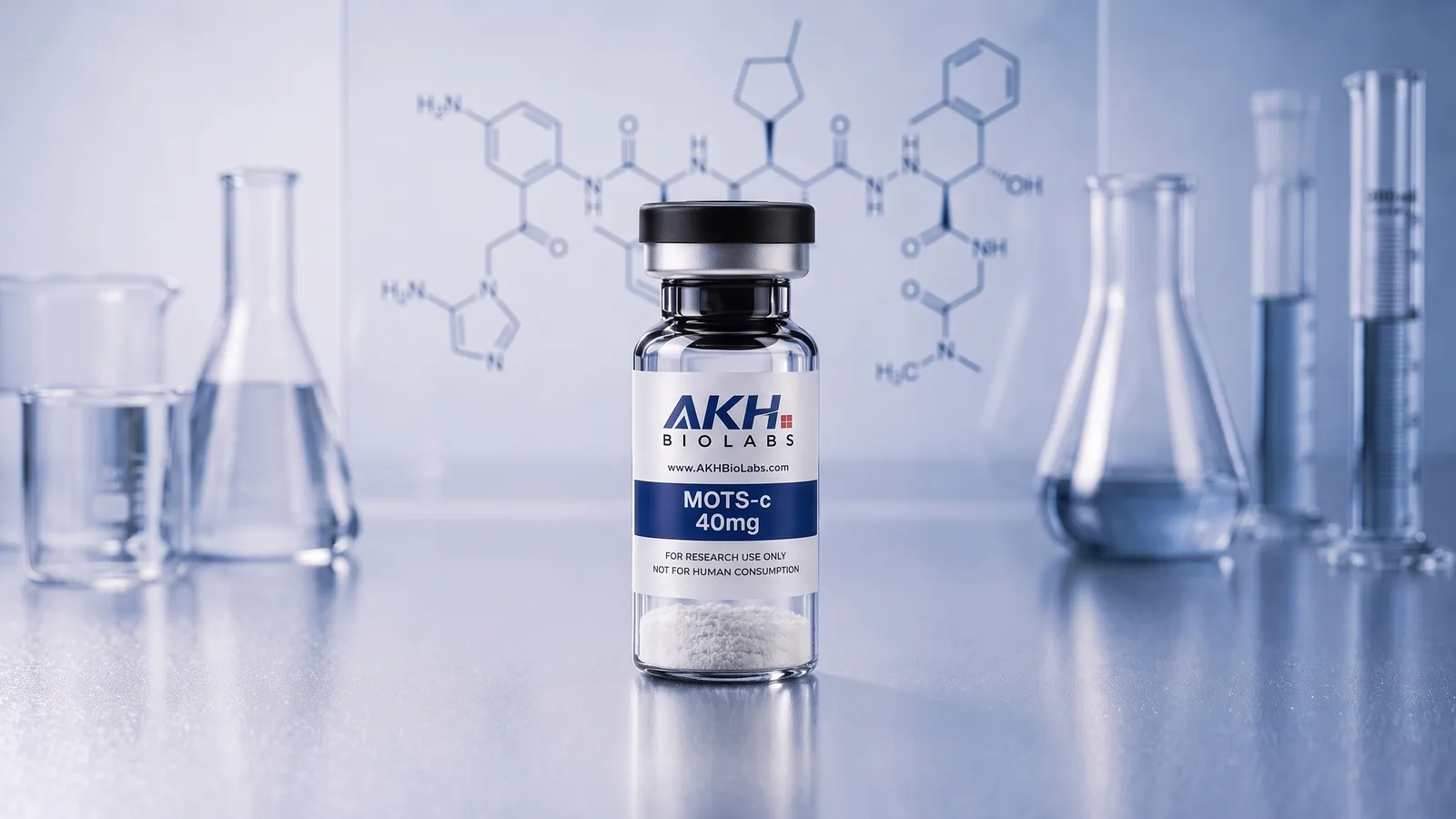
The MOTS-c product record describes the material as 40mg lyophilised powder for laboratory research, with a certificate from a named outside laboratory published on the page. Lyophilisation, the process of freezing a solution and removing the ice under vacuum, is what produces that powder. The product page states storage at minus 20 degrees Celsius for the lyophilised form and 2 to 8 degrees Celsius for the reconstituted solution, with a 28-day window once in solution.
The published certificate for the MOTS-c batch carries the results string "MOTS-C: 40mg | Purity: 99.79%". The SS-31 certificate carries "SS-31: 50mg | Purity: 99.82%". Both are chromatographic purity figures for a named batch, and neither is a statement about how long the compound persists in any biological system.
The mass balance paper is relevant here for a different reason. It argues that mass balance should be demonstrated during method development and through forced degradation experiments rather than used as a specification test, because analytical method variability propagates into the calculated result. That is a statement about how much weight a single derived figure can carry, and it applies to stability characterisation as much as to release testing.
Certificate of analysis
A test report from a named laboratory outside AKH, ordered by the manufacturer, documenting measurements for one batch. It reports identity and purity attributes, not pharmacokinetics.
Lyophilised powder
The dry solid left after a solution is frozen and the ice removed under vacuum. It is the standard shipping form because a dry solid is more stable in storage than the same peptide in solution.
Half-life
A pharmacokinetic parameter describing clearance from a living system over time. It requires an administration study to measure, which is why a vial certificate cannot supply one.
Why "MOTS c supplement" describes the wrong category
A dietary supplement is a product intended to supplement the diet, and the category carries a specific regulatory meaning in the markets where it exists. MOTS-c is not sold or studied in that category. The MOTS-c product record states that the material is supplied as 40mg lyophilised powder for laboratory research and that it is not for human or veterinary use. The research record carries the same framing: for research purposes only, not for human consumption, diagnosis, treatment or prevention of any condition.
The distinction is not a matter of labelling preference. A supplement ingredient is regulated on the basis that it is consumed; a research-use-only peptide is supplied on the basis that it is not. The two categories carry different documentation expectations, different handling assumptions and different regulatory routes. Searching for a MOTS-c supplement therefore points at a product class the compound does not occupy.
There is a second reason the supplement framing misleads. Supplement ingredients are commonly described in terms of what they do for the person taking them. The MOTS-C evidence record states that no controlled clinical trial has tested exogenous MOTS-c administration in humans, so efficacy and safety in people are not established. A category label that implies a consumer benefit is not supported by the underlying record.
The regulatory position is sometimes misread in the other direction as well. On 23 and 24 July 2026 the FDA's Pharmacy Compounding Advisory Committee considered MOTS-C for the 503A Bulks List and recommended its addition on a reported vote of 7 to 5 with two abstentions. The research record is explicit that this is not an approval: the committee advises and does not decide, the recommendation is not binding, the FDA has not completed the rulemaking that would formally change anything, and the list governs pharmacy compounding, which is a separate activity from research-use-only supply.
Reading the two evidence records without overreading them
Both compounds have a full evidence record on this site, and both records state their limits. The MOTS-C record lists 15 published studies, 12 of them published since 2023, and notes that circulating MOTS-c moves in opposite directions across conditions, lower in diabetes and higher in obesity and acute coronary syndrome, so its interpretation as a marker is not settled. Assay standardisation between studies is also inconsistent.
The SS-31 record lists 16 published studies and states that elamipretide's only approved indication is Barth syndrome, granted under accelerated approval on a muscle-strength surrogate endpoint in a very small cohort, with confirmatory clinical benefit not yet demonstrated. The largest randomised trial in primary mitochondrial myopathy, MMPOWER-3 with 218 participants, missed its primary endpoints, as did the phase 2 heart failure and Leber hereditary optic neuropathy trials.
Neither record supplies a half-life figure for MOTS-C. The practical reading is that the half-life question has a documented answer, which is that the measurement has not been made, and that the more useful comparison between the two compounds is the evidence tier rather than a clearance number.
- 01
Check whether a half-life figure is being quoted for a compound with human administration data
A clearance parameter requires an administration study. Where the record states that no controlled trial has administered the compound to humans, no half-life figure can exist.
- 02
Check whether the figure belongs to the same molecule
SS-31 and MOTS-C are different molecules with different targets. A parameter measured for one does not describe the other.
- 03
Check whether the source is a batch certificate or a study
A certificate reports batch measurements such as identity and purity. Pharmacokinetic parameters come from studies, not from certificates.
- 04
Check the category label against the supply framing
Research-use-only supply and dietary supplement supply are different categories with different documentation and regulatory routes.
Common questions.
- What is the MOTS-C half-life?
No half-life figure for MOTS-C appears in the supplied sources. The MOTS-C research record states that no randomised controlled trial has administered exogenous MOTS-c to humans, so no human clearance parameter has been measured. The two papers supplied with this article are analytical-methods papers and do not report one either.
- How do SS-31 and MOTS-C compare?
They are different molecules in different evidence tiers. SS-31 (elamipretide) is a synthetic mitochondria-targeted tetrapeptide that binds cardiolipin, and it has randomised trial data plus an accelerated approval for Barth syndrome granted on 19 September 2025. MOTS-C is a 16-amino-acid mitochondrial-derived peptide studied through AMPK and one-carbon metabolism signalling, with no controlled human administration study.
- Is MOTS c supplement a real product category?
No. The MOTS-c product record states that the material is supplied as 40mg lyophilised powder for laboratory research and is not for human or veterinary use. A dietary supplement is regulated on the basis that it is consumed, while a research-use-only peptide is supplied on the basis that it is not. The two categories carry different documentation and regulatory routes.
- Why is there no published half-life for MOTS-C when SS-31 has human trial data?
Because the two compounds sit at different stages of research. The SS-31 record describes randomised controlled trials in Barth syndrome, primary mitochondrial myopathy, heart failure and other settings, which is where human pharmacokinetic data come from. The MOTS-C record states that human data are limited to observational biomarker associations and one mitochondrial genotype association.
Sources
- 01NMR Assessment of Therapeutic Peptides and Proteins: Correlations That Reveal Interactions and Motions.
- 02Mass balance analysis for therapeutic peptides: Case studies, applications, and perspectives.
- 03Buy MOTS-c 40mg: Batch COA · AKH BioLabs
- 04MOTS-C research — published studies and evidence · AKH BioLabs
- 05SS-31 — Elamipretide · AKH BioLabs
- 06SS-31 research — published studies and evidence · AKH BioLabs