Bestseller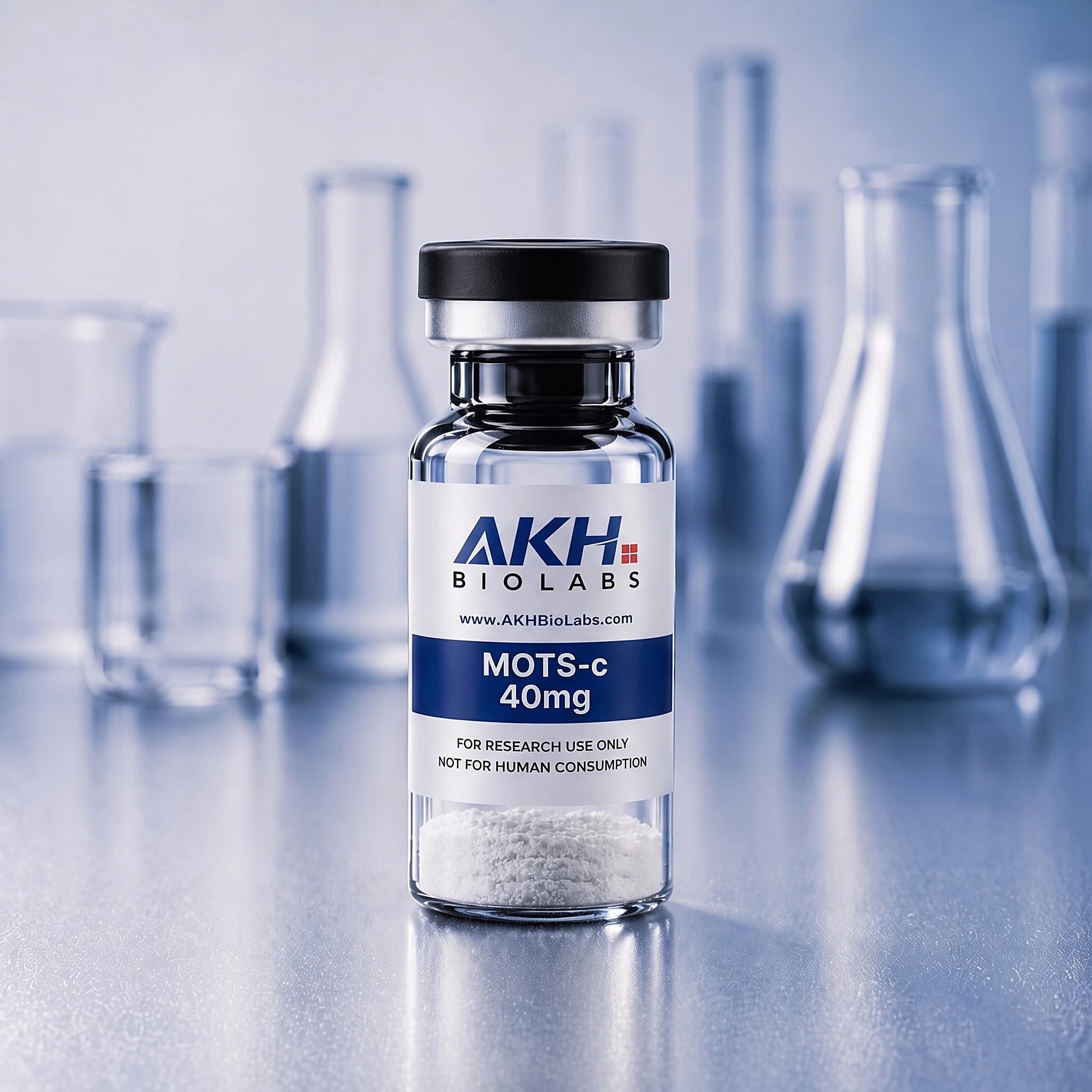
Performance· Bestseller
In stockMOTS-c
Mitochondrial Open Reading Frame
MOTS-c is supplied as 40mg lyophilised powder for laboratory research. Price is shown in your currency, and its Certificate from a named outside laboratory is published on this page. Not for human or veterinary use.
Size40mgPurity99.79%FormulaC100H168N34O29
MOTS-c is a 16-amino-acid peptide encoded inside the mitochondrial 12S rRNA gene — one of the first peptides ever discovered to be written into mitochondrial rather than nuclear DNA. It is researched for its activation of the AMPK pathway, a master metabolic switch that influences glucose uptake, fat oxidation and exercise adaptation in skeletal muscle models.
€94
Quantity
HPLC verified
9–14 day shipping
Full COA
Worldwide delivery
About this compound
The research profile.
MOTS-c (mitochondrial open reading frame of the 12S rRNA type-c) is a 16-amino-acid peptide encoded not by nuclear DNA but by a short open reading frame within the mitochondrial 12S ribosomal RNA gene. It belongs to the mitochondrial-derived peptide family, and its discovery paper identified skeletal muscle as its apparent primary target tissue.
Mechanistically, the published work describes inhibition of the folate cycle and the de novo purine biosynthesis tethered to it, causing accumulation of the intermediate AICAR and consequent activation of AMP-activated protein kinase. Follow-up studies report that under metabolic stress MOTS-c translocates from the mitochondrion to the nucleus, where it associates with stress-responsive transcription factors and regulates a nuclear gene programme — an unusual retrograde signalling arrangement for a mitochondrially encoded peptide.
The peptide is also described as exercise-responsive: endogenous MOTS-c expression in skeletal muscle and circulation rises with exercise in humans, and rodent work has examined intermittent administration in young, middle-aged, and old animals against physical-capacity end points.
Published research
15 peer-reviewed studies on MOTS-C are summarised in our research library, including 12 published since 2023 — with study designs, reported findings and what the evidence does not establish.
Read the MOTS-C evidence baseFor research purposes only. Not for human consumption, diagnosis, treatment, or prevention of any condition.
Categorised as Performance — Mitochondrial and cellular-energy research compounds.
Dosing at a glance
What the literature reports.
For research and laboratory use only. Not for human consumption.
Route
Subcutaneous
Frequency
1–3x weekly (study protocols)
Reported range
5–10 mg
Protocol duration
4–8 weeks
5 mgper administration10 mg
Rodent protocols are reported on a per-kilogram basis — commonly in the region of 5–15 mg per kg, administered intraperitoneally on daily or intermittent schedules. The 5–10 mg per-administration figures shown here reflect the amounts described in research-community protocol documentation rather than a direct conversion of the animal data.
Ranges reflect protocols reported in the published literature on MOTS-C — see research citations.
Calculate a dilutionReconstitution & storage
From powder to solution.
- Step 01
Add 2 ml bacteriostatic water
Aim the stream at the vial wall rather than the powder.
- Step 02
Swirl gently — never shake
Rotate the vial until the solution runs clear. Agitation degrades the peptide.
- Step 03
Refrigerate at 2–8 °C
Reconstituted vials belong in the fridge, protected from direct light.
- Step 04
Use within 28 days
Discard any remainder once the stability window closes.
Lyophilised · −20 °CReconstituted · 2–8 °C, 28 days
A 40 mg vial in 2 ml of bacteriostatic water yields a 20 mg/ml solution, in which a 5 mg aliquot measures 0.25 ml — 25 units on a U-100 syringe.
Reconstitution calculator
40 mg vialmg
ml
mg
5 mg = 5000 mcg
Draw
25units · U-100 insulin syringe
- Concentration
- 20 mg/ml
- Draws per vial
- 8
- Cost per draw
- €11.75
For research and laboratory use only. Not for human consumption.
Laboratory arithmetic for MOTS-c — enter the COA-verified vial content for exact figures. Not medical advice.
Effect timeline
Observed across the research window.
Milestones summarise findings reported in the cited studies. Outcomes vary across models and protocols.
Start
AMPK activation
The discovery work describes folate-cycle inhibition, AICAR accumulation, and downstream AMPK activation as the acute cellular response in skeletal muscle models.
Week 2
Nuclear gene programme
Follow-up studies report translocation of the peptide to the nucleus under metabolic stress, with regulation of nuclear genes relating to metabolism and proteostasis described over repeated administration.
Week 4
Physical-capacity end points in rodents
Intermittent administration in young, middle-aged, and old mice has been assessed against running and physical-capacity measures at roughly the one-month mark.
Week 8
Protocol end points
Metabolic protocols in diet-induced and age-related insulin-resistance models typically run 4–8 weeks before treated and control groups are compared.
For research and laboratory use only. Not for human consumption.
Scientific research
The published evidence.
The dosing ranges and timeline milestones on this page summarise the peer-reviewed publications below.
References
- 01
The mitochondrial-derived peptide MOTS-c promotes metabolic homeostasis and reduces obesity and insulin resistance. Cell Metab (2015). PubMed · 25738459
- 02
MOTS-c is an exercise-induced mitochondrial-encoded regulator of age-dependent physical decline and muscle homeostasis. Nat Commun (2021). PubMed · 33473109
- 03
MOTS-c: A promising mitochondrial-derived peptide for therapeutic exploitation. Front Endocrinol (Lausanne) (2023). PubMed · 36761202
- 04
Mitochondria-derived peptide MOTS-c: effects and mechanisms related to stress, metabolism and aging. J Transl Med (2023). PubMed · 36670507
Laboratory verification
One Certificate, published unaltered.
The Certificate is a test report from a named laboratory outside AKH, ordered by our manufacturer and shown here exactly as the laboratory issued it. A printed copy ships in every parcel.
- Batch
- 26158
- Test date
- 06 Aug 2026
- Task ID
- #1812454
- Purity
- 99.79%
Results
MOTS-C: 40mg | Purity: 99.79%
Verified by Brown Institute of Biomolecular Research. Scan the full report for every measurement.
Product FAQ
Questions researchers ask.
Pairs well with
Frequently co-studied.
Compounds that appear alongside MOTS-c in the research literature.
For research and laboratory use only. Not for human consumption.
Performance