NAC and glutathione: one tripeptide, one precursor
NAC and glutathione are separate materials, and the published glutathione batch record documents a tripeptide batch rather than an N-acetylcysteine one: what each name denotes, which chemistry they share, and which claims the certificate supports.
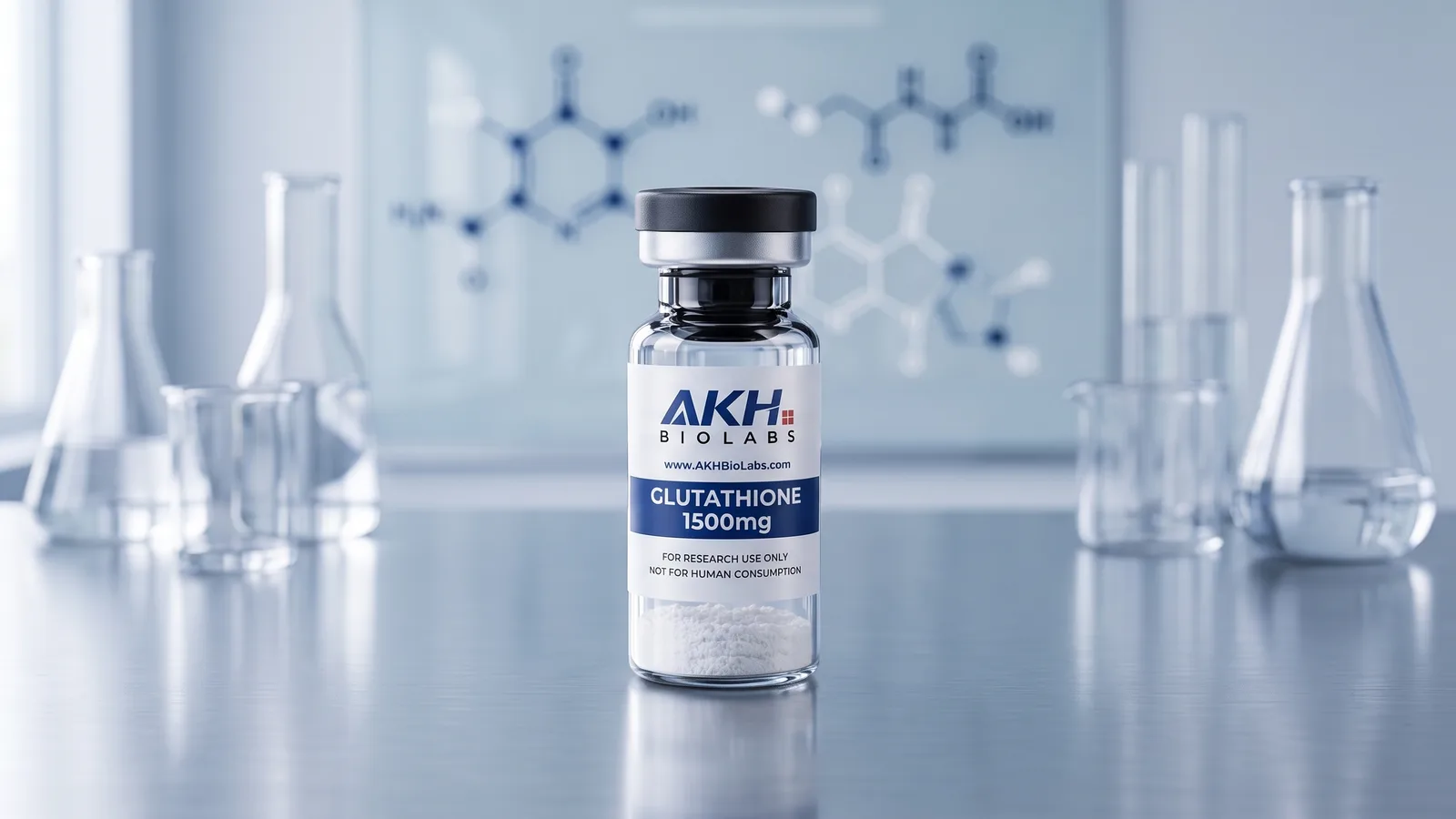
NAC and glutathione are not the same substance, and no certificate issued for one of them documents the other. The glutathione research record lists N-acetylcysteine among precursor materials, while glutathione itself is the tripeptide gamma-L-glutamyl-L-cysteinyl-glycine, supplied in the catalogue as a 1500 mg lyophilised powder.
It sets out what each name denotes, where the shared chemistry actually sits, and what the published glutathione batch record supports, for laboratory readers and buyers who have to check a label or a report against a compound name.
The overlap is real but narrow: both names appear in the same redox discussion, and both involve cysteine. That overlap is where the useful distinction starts rather than ends.
Key takeaways
- Glutathione is a tripeptide of glutamate, cysteine and glycine, with formula C10H17N3O6S and CAS number 70-18-8; N-acetylcysteine appears in the glutathione research record as a precursor material, not as the peptide.
- The reactive part of glutathione is the thiol on its cysteine residue, and precursor supply through N-acetylcysteine is a separate strand of the same literature rather than a second name for the molecule.
- The published glutathione report covers batch 26112, tested 08 Aug 2026 by the Brown Institute of Biomolecular Research at 99.72% purity.
- The 99.72% figure is a chromatographic purity result for that batch, not the share of the vial mass that is glutathione, and it says nothing about any other compound.
What NAC and glutathione each name
Glutathione is a tripeptide, meaning three amino acids joined by peptide bonds: glutamate, cysteine and glycine. The research record gives the molecular formula C10H17N3O6S, the molecular weight 307.33 g/mol, the CAS number 70-18-8 and the PubChem identifier 124886, and it points to the gamma-linkage between glutamate and cysteine as the feature that makes the molecule resistant to ordinary peptidases. The reduced form, written GSH, carries a free thiol on its cysteine residue; oxidised to the disulfide dimer GSSG, it is converted back by glutathione reductase using NADPH.
N-acetylcysteine is not described in those terms anywhere in the supplied record. The glutathione research page groups it with glycine under precursor-based strategies, naming the combination GlyNAC, and it treats precursor supply via N-acetylcysteine as its own strand of the literature. The name itself is the clue: N-acetylcysteine is cysteine carrying an acetyl group, a single amino acid derivative rather than a three-residue chain. A precursor and the molecule it supplies are different materials, and the identifiers listed for one say nothing about the other.
| Item | Glutathione | N-acetylcysteine |
|---|---|---|
| What the record calls it | the tripeptide gamma-L-glutamyl-L-cysteinyl-glycine | a precursor material, named with glycine as GlyNAC |
| Chemical identifiers given | formula C10H17N3O6S, CAS 70-18-8, PubChem CID 124886 | none in the supplied glutathione record |
| Published AKH batch | batch 26112, 99.72%, 08 Aug 2026 | not covered by the glutathione certificate |
Glutathione versus NAC: where the cysteine thiol connects them
Both names involve sulfur, and that is the whole of the overlap. The thiol, a sulfur-hydrogen group on the cysteine residue, is the reactive part of glutathione, described in the product record as the chemical basis of what the molecule does. N-acetylcysteine supplies cysteine, so the precursor strand and the tripeptide strand meet in one discussion of cysteine availability. Meeting in a discussion is not the same as being one compound.
The glutathione literature on that thiol is specific to glutathione. Only S-nitroglutathione among the reaction products caused proMMP activation, and mass spectrometry showed modification of the synthetic peptide PRCGVPD at m/z 1064, which the authors attributed to glutathione disulfide S-oxide formation. The study has no N-acetylcysteine arm and draws no comparison between the two materials; its subject is what glutathione does.
What the glutathione batch certificate documents
The archive is where the checkable part of the record sits. Its page states the rule the table runs on: each row is one certificate of analysis, one batch, tested once, by a named third-party laboratory. The glutathione row reads batch 26112, purity 99.72%, test date 08 Aug 2026, laboratory Brown Institute of Biomolecular Research. The product page for the same material adds the form, L-Glutathione (Reduced), the fill, 1500mg, the formula, C10H17N3O6S, and the method note "HPLC verified".
- 01
One material
Glutathione, named in the results line. The report is not a statement about thiol compounds as a class, and it does not name N-acetylcysteine.
- 02
One batch
Batch 26112. A different batch number would carry its own report and its own result.
- 03
One test date and one laboratory
08 Aug 2026, Brown Institute of Biomolecular Research, a named laboratory outside AKH.
What that certificate does not establish
The purity figure is not a mass fraction. The research record explains why: lyophilised peptide is normally supplied as an acetate or trifluoroacetate salt and carries residual water, so the powder mass in a vial is not the same quantity the molecular weight implies, and chromatographic purity does not resolve that difference. A reader who needs peptide mass rather than chromatogram purity is asking a different measurement question.
Nor does the report travel. It names one compound, one batch, one date and one laboratory, and all four fields point at glutathione. Nothing on it can be read across to N-acetylcysteine. Nothing on it describes enzyme kinetics, receptor activity or any effect in a biological system either, because those are measured in experiments rather than on a batch.
Matching a glutathione listing to its report
Two naming details decide whether a listing matches the archive. The L- in L-glutathione belongs to the residue names in the chemical name, gamma-L-glutamyl and L-cysteinyl, so it is part of the molecule's name rather than a grade. The "(Reduced)" tag identifies the free-thiol form GSH rather than the disulfide dimer GSSG, and the research record treats those as two states of one molecule.
Verification then becomes a matching exercise: the compound named on the report against the compound on the listing, the batch number against the archive row, the test date and laboratory against the same row, and the stated fill against the product page. A label that treats NAC as a synonym for glutathione fails at the first check, because the report names the material that was tested and, for the published glutathione batch, that material is the tripeptide.
Where the glutathione literature is recorded
The published studies sit on the glutathione research record rather than in this article. That page lists 15 published studies, 9 published since 2023 and the newest from 2026, ordered by strength of study design and then by recency, with a section on what the evidence does not establish and a last-reviewed date of August 2026. It also carries the precursor strand in which N-acetylcysteine is named, so both names can be followed to their separate descriptions from one page.
Common questions.
- Are NAC and glutathione the same thing?
No. Glutathione is the tripeptide gamma-L-glutamyl-L-cysteinyl-glycine, with formula C10H17N3O6S and CAS number 70-18-8. N-acetylcysteine is treated in the glutathione research record as a precursor material, named with glycine in the GlyNAC combination. A precursor and the molecule it supplies are separate materials, and the identifiers listed for one do not describe the other.
- Does a glutathione batch certificate say anything about NAC?
No. The published report covers batch 26112, tested 08 Aug 2026 by the Brown Institute of Biomolecular Research at 99.72% purity. A certificate documents one batch of one material, so a different compound needs its own report.
- Why does NAC appear in glutathione research?
Because the record treats it as a precursor route. The glutathione research page groups N-acetylcysteine with glycine under precursor-based strategies and describes precursor supply through N-acetylcysteine as a strand distinct from glutathione itself. Being named in the same record is a statement about how the literature is organised, not a statement that the two materials are interchangeable.
- What does the 99.72% figure on the glutathione certificate measure?
A chromatographic purity result for batch 26112, produced by the method the product page labels HPLC. It is not the proportion of the vial mass that is glutathione: the research record notes that lyophilised peptide is supplied as a salt with residual water and that chromatographic purity does not resolve the gap between powder mass and peptide mass.