Pinealon vendor: what to check before ordering
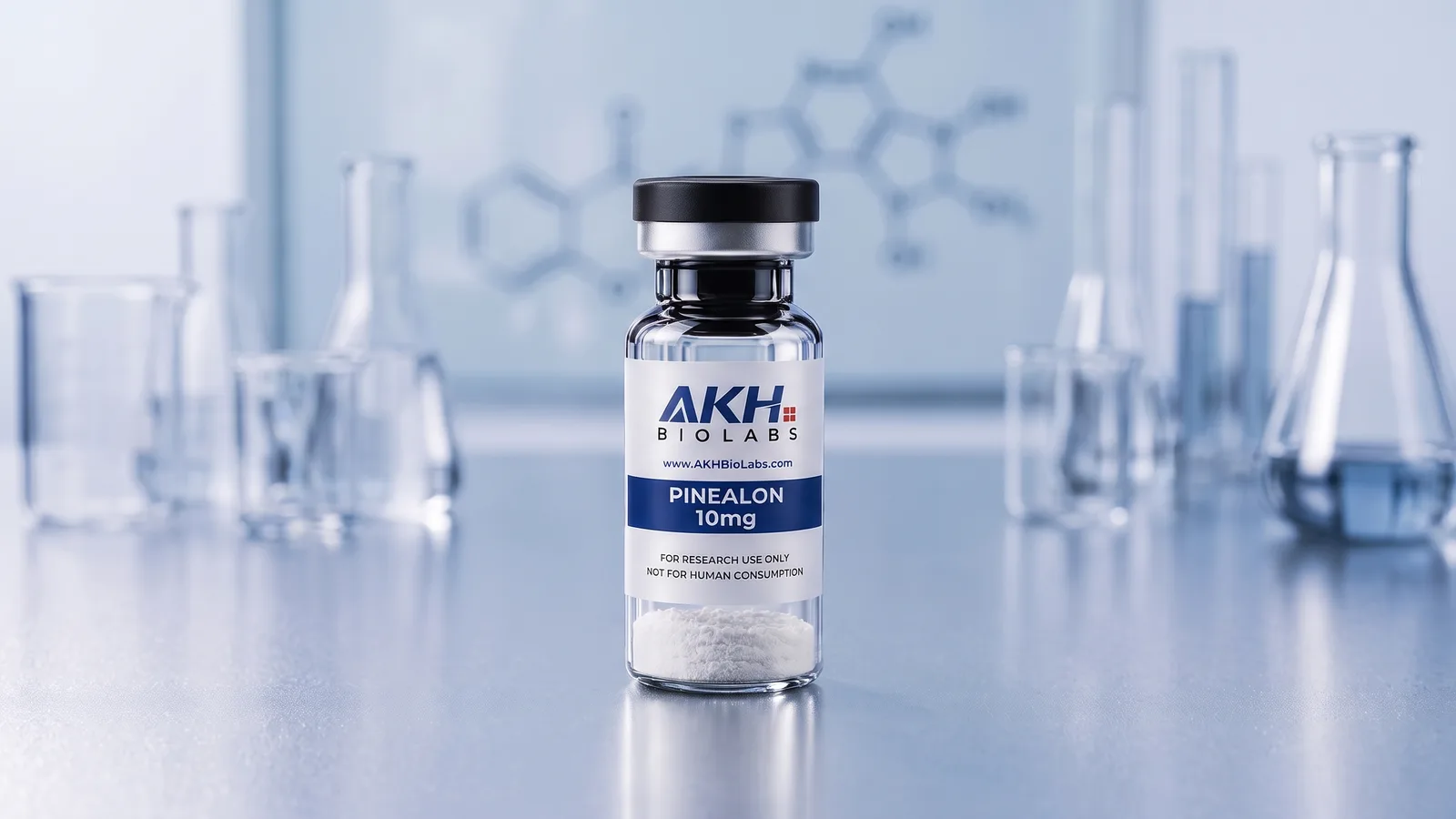
A pinealon vendor is judged on four public fields, a product-specific certificate from a named outside laboratory, the identity that report states, stated delivery and a review count, and the AKH BioLabs Pinealon page publishes the identity record and supply terms while disclosing a certificate status of pending.
A trustworthy pinealon vendor is one whose claims can be checked before payment: a certificate from a named laboratory outside the seller for that exact product, the identity and purity that report states, stated delivery to the destination country, and a public review record read with its review count. Pinealon is supplied for laboratory research, and a listing that publishes those four fields is where an order can be checked before it is placed; the Pinealon 10mg product page shows the identity record, the 10mg presentation, a worldwide 9 to 14 day window and a 4.7 score from 29 reviews, and it discloses a certificate status of pending.
The checks below apply to any research-use-only listing, and they are set out for laboratory buyers comparing sellers rather than for anyone seeking a medicine. Each field can be read from a public page before an order is placed and compared again with the material that arrives. No price is quoted in this article, because the price of a presentation belongs to the listing that offers it.
Key takeaways
- A certificate is checkable only when it names the compound, a batch number, a test date, the issuing laboratory and a results line.
- Pinealon's page discloses a pending certificate, so the identity record and the supply terms carry the verification weight.
- A chromatographic purity figure and a stated fill size measure different things and cannot be read as one number.
- Delivery scope and review count describe reach and past service, never the identity of the material.
The four fields a pinealon vendor has to publish
Four fields decide whether a listing can be checked at all, and each answers a different question. A certificate says what was measured and for which batch. The identity record says which molecule the seller claims to supply. The delivery statement says where the seller will send material and how long that takes. The review record says how past orders went, read with the number of reviews behind the score.
A certificate is checkable only when it is specific. It has to name the compound, the presentation, a batch number, a test date, the laboratory that produced the measurement and a results line. A report with no batch number cannot be tied to a container, and a report issued for a different product or a different fill describes different material. Batch, test date and laboratory are the three fields that make the rest of the document usable.
The identity record can be read without any certificate. Pinealon is the tripeptide Glu-Asp-Arg, abbreviated EDR, and the research record gives a molecular formula of C15H26N6O8, a free-base molecular weight of 418.40 g/mol, CAS 175175-23-2 and PubChem CID 10273502. Those identifiers come from the compound's PubChem entry and describe the free base, so they say nothing about the mass of powder in a vial.
Delivery and reviews are commercial fields. They describe reach, timing and service across past orders. Neither establishes identity, purity or quantity, and neither can be compared against a laboratory report.
What the AKH BioLabs Pinealon page currently shows
The Pinealon page publishes the identity record, the presentation, the delivery window, the review record and the intended-use statement, and it shows the certificate as pending rather than published. That disclosure matters more than it looks: a reader can see that no purity figure is being claimed for the product, and can weigh that gap against a listing that carries a completed report for its batch.
What the page does not show is a purity figure, a batch number, a test date or a laboratory name for Pinealon. Those four fields are exactly what a certificate supplies, and their absence is recorded here as an absence rather than filled in from another page.
| Check | What the Pinealon page shows |
|---|---|
| Certificate status | Pending, with no purity figure displayed for the product |
| Presentation | 10mg |
| Identity record | Glu-Asp-Arg (EDR); formula C15H26N6O8; free-base molecular weight 418.40 g/mol; CAS 175175-23-2; PubChem CID 10273502 |
| Delivery | Worldwide, 9 to 14 days |
| Review record | 4.7 on Trustpilot from 29 reviews |
| Stated policy | Reshipment or full refund |
| Intended use | Laboratory research; not for human or veterinary use |
Reading a certificate of analysis when one is published
A certificate of analysis is a report on one batch, issued by a named laboratory outside the seller and ordered by the manufacturer of the material, then published as the laboratory issued it. Reading one takes a fixed order: the compound and fill named at the top, the batch number, the test date, the issuing laboratory, and the results line beneath.
The results line is where most misreading happens. A chromatographic purity figure is a peak-area ratio taken from the chromatogram, so it states what share of the detected material is the target peak. It is not the share of vial mass that is peptide. Lyophilised peptide is normally supplied as an acetate or trifluoroacetate salt and carries residual water, and both sit between the powder mass and the peptide mass. Net peptide content is measured separately, and many reports do not include it.
Two figures on one line therefore answer two questions. The fill, such as 10mg, states what the presentation contains by the seller's account. The purity figure states what the laboratory measured in the sample it was given. Comparing one against the other, or treating the second as a quantity, misreads both.
Delivery, the review record and the intended-use statement
The page states worldwide delivery in a 9 to 14 day window. That is a statement of scope and timing, and the useful check is whether the destination falls inside the scope before payment is made. It is not a statement about the material.
The review record is displayed as 4.7 on Trustpilot from 29 reviews. A score is read with the number of reviews behind it, because the count is what tells a reader how much service history the score represents. The record describes how past orders went; it cannot describe a batch.
The intended-use statement is separate again. The listing describes Pinealon as supplied for laboratory research and states that it is not for human or veterinary use. That describes the category of supply, not the identity of the compound and not the quality of a batch.
A reshipment or full-refund policy is also stated on the page. That is a commercial term offered by the seller, and it belongs beside the delivery statement rather than among the laboratory fields.
What the published Pinealon research record contains
The Pinealon research record lists 21 published studies, 3 of them from 2023 onward, with the newest dated 2024. It states that the work is almost entirely in vitro or rodent research from a single research group, and that independent replication outside that group is scarce.
The record is explicit about the gaps: no randomised, placebo-controlled trial of Pinealon or EDR alone in humans, no pharmacokinetic data, and no demonstration that EDR given to participants reaches brain tissue intact.
A 2026 review indexed on PubMed groups pinealon with agents the authors describe as targeting circadian and mitochondrial regulators, and states that preclinical studies are promising while clinical trials are currently lacking. That sentence describes the state of the literature, and it is the kind of statement that can be checked against the record rather than against a listing.
For a purchase decision, the evidence tier sets how much weight the identity and certificate fields have to carry. A documented batch answers a question about material, not about pharmacology. The study list and its limits sit on the Pinealon research record rather than on this page.
Before ordering Pinealon for research
The sequence that settles a purchase runs from the certificate question to the container. On the AKH BioLabs Pinealon listing, the identity record and the supply terms can be read now, and the certificate is shown as pending rather than presented as a completed report.
The Pinealon 10mg product page is where that sequence ends: the presentation, the identity fields, the delivery window, the review count and the intended-use statement all sit on the one page, and the pending certificate is disclosed rather than left blank. Nothing on a listing turns the compound into a medicine, and the research record sets out how thin the published evidence is.
- 01
Read the certificate status first
The status reads pending, so no purity figure is claimed for the product. Recording that as a gap is more useful than assuming a report exists.
- 02
Match the presentation
The listing states 10mg. Any report published later has to name the same product and the same presentation, because a report for a different fill describes different material.
- 03
Check the destination against the delivery window
Delivery is stated as worldwide in 9 to 14 days. The check is whether the destination sits inside that scope before payment, not what the window says about the material.
- 04
Read the review count with the score
The score is 4.7 from 29 reviews. The count is what shows how much service history stands behind the figure, and service history is not a batch measurement.
- 05
Confirm the intended-use statement
The listing states laboratory research and not for human or veterinary use. That is the category of supply, which sits apart from identity and purity.
Common questions.
- What does a pending purity certificate mean on a peptide listing?
It means the certificate is shown as pending rather than published, so no purity figure appears for the product. On the AKH BioLabs Pinealon page the identity record, the 10mg presentation, the worldwide 9 to 14 day window and the 4.7 score from 29 reviews all remain readable, while the purity question is left open rather than answered.
- How does a batch number connect a certificate to a vial?
The batch number is the field that ties a report to specific material. A document that names a compound, a purity figure and a date but no batch cannot be matched to a container, and a report whose batch differs from the batch on the material describes different material. Batch, test date and issuing laboratory are read before the results line.
- Which identity fields identify Pinealon on a vendor page?
The research record gives the sequence Glu-Asp-Arg (EDR), the molecular formula C15H26N6O8, a free-base molecular weight of 418.40 g/mol, CAS 175175-23-2 and PubChem CID 10273502. Those figures describe the free base as recorded in PubChem, not the mass of powder in a vial, and a listing that offers only a trade name is not supplying an identity record.
- Is Pinealon an approved medicine for human use?
No. The research record states that no randomised, placebo-controlled trial of Pinealon or EDR alone exists in humans and that there are no pharmacokinetic data, and the listing states that the material is for laboratory research and not for human or veterinary use. A certificate records measurements for a batch and does not confer a regulatory status.