AKH Signature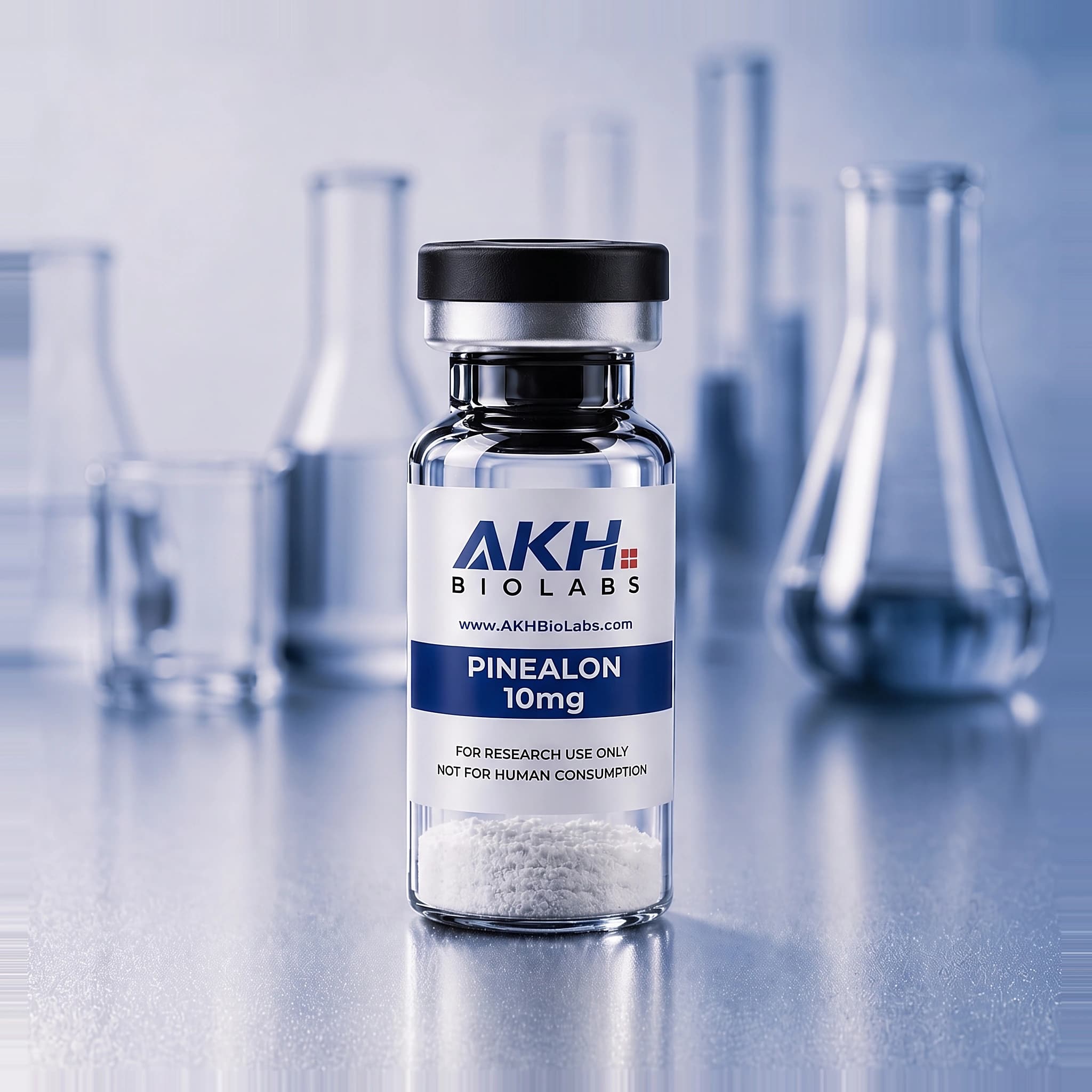
Cognitive· AKH Signature
In stockPinealon
EDR Tripeptide Bioregulator
Size10mgPurityCertificate pending
Pinealon is a synthetic tripeptide bioregulator (Glu-Asp-Arg, EDR) from the Khavinson peptide family. In preclinical research it is studied for neuroprotective effects, regulation of neuronal cell metabolism, and resistance to oxidative and hypoxic stress in brain tissue models.
€55
Quantity
9–14 day shipping
Certificate pending
Worldwide delivery
About this compound
The research profile.
Pinealon is the tripeptide Glu-Asp-Arg (EDR), one of the short peptide bioregulators developed by the Khavinson school at the St Petersburg Institute of Bioregulation and Gerontology. The proposed mechanism in that literature is epigenetic: short peptides are described as entering the nucleus and interacting with specific double-stranded DNA sequences, thereby influencing transcription rather than acting on a cell-surface receptor.
The direct experimental support is limited but specific. Fluorescence-labelled short peptides have been shown to penetrate the nucleus in HeLa cells and to interact in vitro with deoxyribooligonucleotides and DNA. Separate cell work reports that Pinealon increases viability under stress by suppressing free-radical levels, and an animal study describes protective effects in the offspring of rats subjected to prenatal hyperhomocysteinemia.
This is a thin evidence base by any standard. Most of it originates from a single research school, sample sizes are small, independent replication outside that group is scarce, and the human reports are observational rather than randomised. Any reading of Pinealon's pharmacology should be heavily qualified on those grounds.
Published research
18 peer-reviewed studies on Pinealon are summarised in our research library, including 3 published since 2023 — with study designs, reported findings and what the evidence does not establish.
Read the Pinealon evidence baseFor research purposes only. Not for human consumption, diagnosis, treatment, or prevention of any condition.
Categorised as Cognitive — Neuropeptides for neuroscience research.
Dosing at a glance
What the literature reports.
For research and laboratory use only. Not for human consumption.
Route
Subcutaneous
Frequency
Once daily
Reported range
1–2 mg
Protocol duration
10–20 days
1 mgper administration2 mg
Intramuscular · Once daily (study protocols) · 1–2 mg per administration · 10–20 days
Published courses in the bioregulator literature describe roughly 1–2 mg per administration over short courses of ten to twenty days, typically repeated a few times per year. The reporting in these papers is often incomplete, so the figures should be read as approximate descriptions of study protocols rather than defined ranges.
Ranges reflect protocols reported in the published literature on Pinealon — see research citations.
Calculate a dilutionReconstitution & storage
From powder to solution.
- Step 01
Add 2 ml bacteriostatic water
Aim the stream at the vial wall rather than the powder.
- Step 02
Swirl gently — never shake
Rotate the vial until the solution runs clear. Agitation degrades the peptide.
- Step 03
Refrigerate at 2–8 °C
Reconstituted vials belong in the fridge, protected from direct light.
- Step 04
Use within 28 days
Discard any remainder once the stability window closes.
Lyophilised · −20 °CReconstituted · 2–8 °C, 28 days
A 10 mg vial in 2 ml of bacteriostatic water gives a 5 mg/ml solution, in which 1 mg occupies 0.2 ml — a comfortable volume for the milligram-scale amounts described in the literature.
Reconstitution calculator
10 mg vialmg
ml
mg
1 mg = 1000 mcg
Draw
20units · U-100 insulin syringe
- Concentration
- 5 mg/ml
- Draws per vial
- 10
- Cost per draw
- €5.50
For research and laboratory use only. Not for human consumption.
Laboratory arithmetic for Pinealon — enter the COA-verified vial content for exact figures. Not medical advice.
Effect timeline
Observed across the research window.
Milestones summarise findings reported in the cited studies. Outcomes vary across models and protocols.
Start
Cellular uptake observations
In vitro work with fluorescence-labelled short peptides reports nuclear penetration within hours of exposure, alongside evidence of sequence-specific interaction with DNA in cell-free assays. Whether this translates to intact tissue is not established.
Days 1–10
Cell viability under stress
Cell-culture studies describe increased viability and reduced free-radical levels over repeated exposure. These are culture-model findings only.
Weeks 2–3
Animal course end points
The rat prenatal hyperhomocysteinemia study administered the peptide across a defined gestational window and assessed offspring outcomes afterwards, which is the outer extent of the controlled animal evidence.
Course end
Observational human reports
The human reports from this research school are small observational studies across age groups rather than randomised trials, and should be weighted accordingly.
For research and laboratory use only. Not for human consumption.
Scientific research
The published evidence.
The dosing ranges and timeline milestones on this page summarise the peer-reviewed publications below.
References
- 01
Penetration of short fluorescence-labeled peptides into the nucleus in HeLa cells and in vitro specific interaction of the peptides with deoxyribooligonucleotides and DNA. Biochemistry (Mosc) (2011). PubMed · 22117547
- 02
Pinealon increases cell viability by suppression of free radical levels and activating proliferative processes. Rejuvenation Res (2011). PubMed · 21978084
- 03
Pinealon protects the rat offspring from prenatal hyperhomocysteinemia. Int J Clin Exp Med (2012). PubMed · 22567179
- 04
[Neuroprotective effects of peptides bioregulators in people of various age]. Adv Gerontol (2013). PubMed · 24738258
Laboratory verification
Certificate pending.
The Certificate is a test report from a named laboratory outside AKH, ordered by our manufacturer and shown here exactly as the laboratory issued it. A printed copy ships in every parcel.
No matching report from an outside laboratory has been published for this product yet, so no purity figure is claimed. The Certificate will appear here unaltered once it is.
Product FAQ
Questions researchers ask.
Cognitive