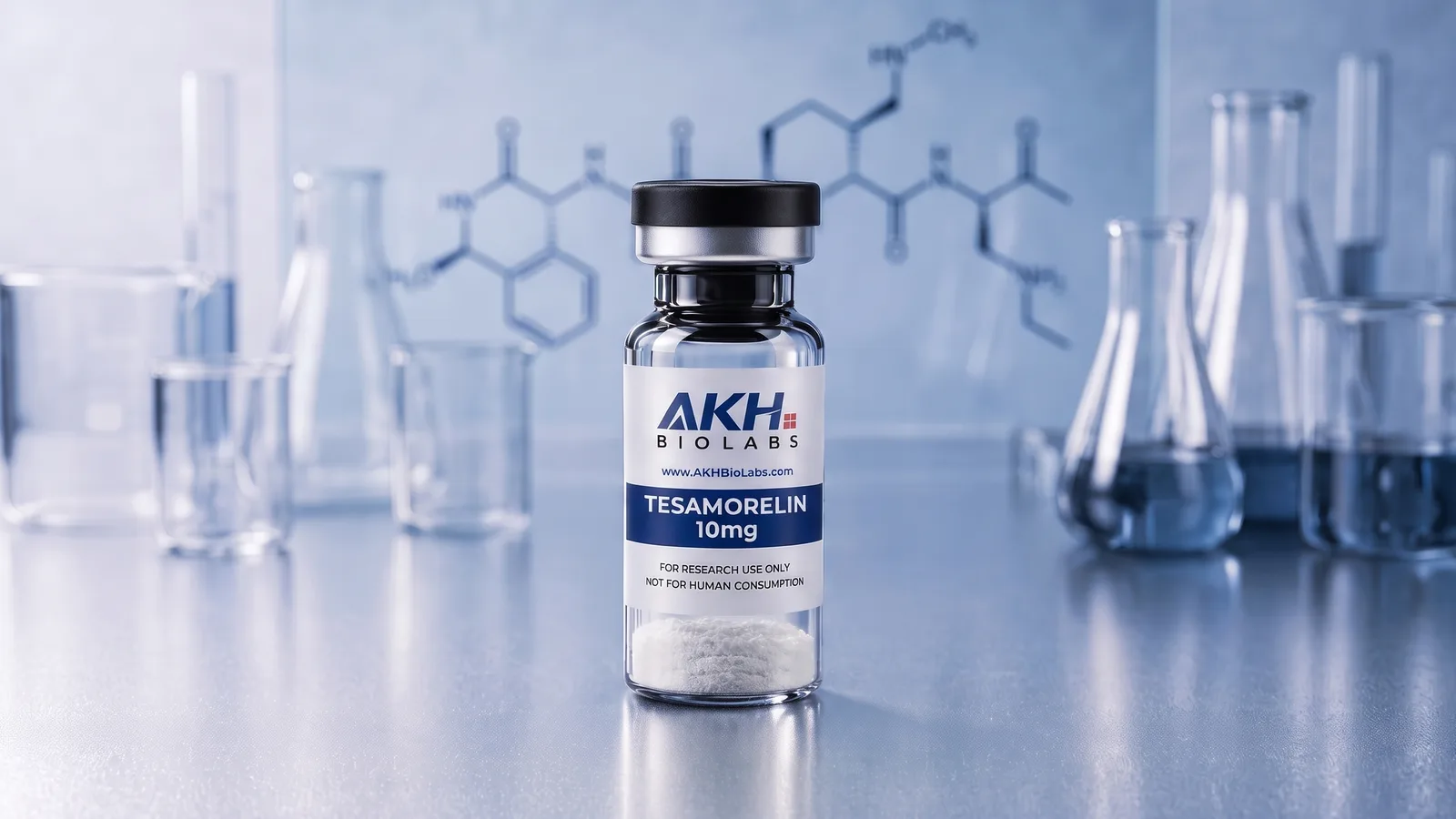
Tesamorelin vs AOD-9604: which to pick for a research project
A buyer's comparison of tesamorelin and AOD-9604 for laboratory research, covering molecular class, the size and type of each published record, and the batch documents the two product pages currently publish.
The short answer to the aod 9604 vs tesamorelin question is that the two are different classes of molecule with different records behind them: tesamorelin is a stabilised 44-amino-acid analogue of growth hormone-releasing hormone (GHRH), while AOD-9604 is a 16-amino-acid fragment of human growth hormone spanning residues 176 to 191. Neither is a substitute for the other in a study design, because the receptor context, the evidence tier and the batch documentation all differ.
Both are catalogued by AKH BioLabs as 10mg lyophilised powder for laboratory research. The Tesamorelin page publishes a certificate for batch 26094 from a named laboratory outside AKH, while the AOD-9604 page shows its purity field as pending. This article is written for laboratory researchers choosing between the two compounds and for buyers checking documents before an order; it compares identity, published evidence and batch records, and it makes no claim about human use of either material.
Key takeaways
- The receptor context differs: tesamorelin binds the GHRH receptor on pituitary somatotroph cells, and the AOD-9604 product page reports that the fragment is not reported to signal through the growth hormone receptor's proliferative pathways.
- Compare evidence tiers rather than compound names: the tesamorelin research record cites 34 published studies, 13 since 2023, while the AOD-9604 record cites 17, 4 since 2023.
- Read the batch document for the presentation being bought: tesamorelin has a published certificate for batch 26094, and the AOD-9604 purity field is still shown as pending.
aod 9604 vs tesamorelin: the comparison in one view
The two compounds are searched together because both sit in metabolic research catalogues and both ship as 10mg lyophilised powder, but the resemblance stops at the packaging. The rows below are drawn from the product pages, the research records and the COA archive, and each one is a field a buyer can re-read before ordering.
| Field | Tesamorelin | AOD-9604 |
|---|---|---|
| Molecular class | 44-amino-acid analogue of human GHRH(1-44), modified at the N-terminus | 16-amino-acid fragment of human growth hormone (residues 176 to 191) with an added N-terminal tyrosine |
| Receptor context | Binds the GHRH receptor on pituitary somatotroph cells | Not reported to signal through the growth hormone receptor's proliferative pathways, per the product page |
| Published record | 34 studies cited, 13 since 2023 | 17 studies cited, 4 since 2023 |
| Human efficacy data | Phase 3 programmes in HIV-associated lipodystrophy, with visceral adipose tissue as the primary endpoint | No peer-reviewed controlled efficacy trial published |
| Batch document | Certificate for batch 26094, tested 14 Aug 2026, 99.66% | Purity field shown as pending |
What each compound is
Tesamorelin, also written TH9507, is a synthetic analogue of human GHRH(1-44). The product page states that a trans-3-hexenoyl moiety added to the tyrosine at position 1 confers resistance to cleavage by dipeptidyl peptidase-IV, extending the molecule's stability relative to native GHRH while preserving its receptor pharmacology. The peptide binds the GHRH receptor on pituitary somatotroph cells, and the page records FDA approval in November 2010 under the Egrifta brand.
AOD-9604 is a synthetic peptide corresponding to the C-terminal region of human growth hormone, residues 176 to 191, with an additional tyrosine at the N-terminus for stability. The product page states that it was developed in the 1990s by Metabolic Pharmaceuticals, an Australian biotechnology company, and frames the fragment as a tool for studying fat metabolism separately from growth hormone signalling. The page also reports that the chronic rodent studies describe no adverse effect on insulin sensitivity or glucose tolerance.
A 2026 narrative review of therapeutic peptides in orthopaedics groups both compounds among growth hormone secretagogues, alongside ipamorelin, CJC-1295 and sermorelin, and states that preclinical studies are promising while clinical trials are currently lacking. The grouping is a classification in a review; it does not make the two molecules interchangeable.
How the published research differs
The tesamorelin record is built around controlled human work. It cites 34 published studies, 13 of them since 2023, with the newest dated 2026. The core is the phase 3 programme in people with HIV and excess abdominal fat, where visceral adipose tissue was the primary endpoint, and the compound was subsequently approved for HIV-associated lipodystrophy. Later investigator-initiated trials extended the work to hepatic fat in NAFLD and MASLD, to cognitive endpoints in mild cognitive impairment and in HIV, and to lean mass and physical function. The record's own limitations section states that evidence outside HIV-associated visceral adiposity and hepatic steatosis remains limited, that cognitive trials have been small and inconsistent, and that no histology-based endpoints in MASLD or long-term cardiovascular or oncological outcome data have been established.
The AOD-9604 record is smaller and more preclinical. It cites 17 published studies, 4 since 2023. Work published between 1993 and 2001 characterised the fragment's effects on lipolysis, lipogenesis and fat oxidation in rodent models, and the compound then entered human obesity trials whose pooled safety and tolerability data were published in 2013. Later literature is dominated by anti-doping analytical chemistry, a single rabbit study of collagenase-induced knee osteoarthritis, and narrative reviews. The record states that no peer-reviewed controlled efficacy trial in humans has been published as a standalone report, and that body-composition outcomes have not been independently replicated in an indexed journal.
A second 2026 review, this one in sports medicine, describes a parallel market of unapproved compounds operating largely outside regulatory oversight. It reports that many unapproved peptides show favourable tissue repair and metabolic outcomes in animal models while rigorous human safety data remain scarce. That sentence applies to the wider field rather than to one product, and it is the reason a buyer should read the evidence record for each compound rather than a category label.
Reading the batch documents before ordering
The COA archive describes each row as one Certificate covering one batch, tested once, by a named laboratory outside AKH, on a report ordered by the manufacturer. Tesamorelin's row gives batch 26094, a test date of 14 Aug 2026, the Brown Institute of Biomolecular Research as the issuing laboratory, and a purity of 99.66%. Those details appear in the archive as separate table columns for product, batch, purity, test date, and laboratory. The product page carries the same 99.66% figure, labelled HPLC verified.
For AOD-9604 the position is different. The product page lists the size as 10mg and shows the purity field as "Certificate pending" rather than a percentage. The archive table holds 45 published reports and none of them names AOD-9604. A buyer comparing the two therefore has a batch record to read for one compound and an open field for the other, and that asymmetry belongs in the decision rather than in a footnote.
Neither figure states how much peptide is in a vial.
Choosing between them for a study
The decision usually turns on four questions, and only the first of them is about the compound itself.
- 01
Fix the receptor question first
Tesamorelin binds the GHRH receptor on pituitary somatotroph cells. The AOD-9604 product page reports that the fragment is not reported to signal through the growth hormone receptor's proliferative pathways. A study built around GHRH-receptor signalling points one way; a study of lipolytic-pathway enzymology in adipose tissue points the other.
- 02
Match the evidence tier to the question
Tesamorelin offers a phase 3 programme plus later investigator-initiated trials. AOD-9604 offers rodent and tissue work plus a pooled safety analysis.
- 03
Read the document that exists now
A published certificate carrying a batch number, test date and named laboratory can be matched to the material on arrival. A pending certificate cannot, and the field should be recorded as unanswered rather than filled from a different product's report.
- 04
Confirm the presentation matches the plan
Both compounds are catalogued as 10mg lyophilised powder for laboratory research. The AOD-9604 page also publishes the formula C78H123N23O23S2, and its research record notes that the identity figures describe the free base rather than the salt in a vial.
Where to buy each compound and what to check
Both products are supplied for laboratory research only and are not for human or veterinary use. Tesamorelin is listed at 10mg with its certificate published on the product page, and AOD-9604 is listed at 10mg with its purity field shown as pending while its identity fields stay readable. AKH states worldwide delivery in a 9 to 14 day window for both listings.
The final check is the one a buyer controls: compare the batch number on the published report with the batch printed on the material when it arrives. Where a report exists, that comparison is possible and the measurement can be tied to the container. Where it does not, the honest position is that verification is incomplete, and a research plan is better for saying so.
Common questions.
- Is AOD-9604 a fragment of tesamorelin?
No. AOD-9604 is a 16-amino-acid fragment of human growth hormone, spanning residues 176 to 191 with an added N-terminal tyrosine, as the product page describes. Tesamorelin is a 44-amino-acid analogue of growth hormone-releasing hormone. The two derive from different parent hormones and act in different receptor contexts.
- Has AOD-9604 been tested in a randomised controlled trial in humans?
The AOD-9604 research record states that no peer-reviewed controlled efficacy trial in humans has been published as a standalone report. The human data it cites are a pooled safety and tolerability analysis of six randomised, double-blind, placebo-controlled trials, published in 2013, which examined tolerability and metabolic markers rather than body-composition efficacy.
- Do tesamorelin and AOD-9604 act through the same receptor?
No. Tesamorelin binds the GHRH receptor on pituitary somatotroph cells, according to the product page. The AOD-9604 page reports that the fragment is not reported to signal through the growth hormone receptor's proliferative pathways, and its research record separates fat-metabolism effects from growth hormone receptor and IGF-1 mediated effects.
Sources
- 01COA archive — every published Certificate · AKH BioLabs
- 02Tesamorelin Peptide Buy 10mg: COA · AKH BioLabs
- 03Tesamorelin research: published studies · AKH BioLabs
- 04AOD 9604 peptide for sale 10mg: COA · AKH BioLabs
- 05AOD-9604 research: published studies · AKH BioLabs
- 06Therapeutic Peptides in Orthopaedics: Applications, Challenges, and Future Directions.
- 07Safety and Efficacy of Approved and Unapproved Peptide Therapies for Musculoskeletal Injuries and Athletic Performance.