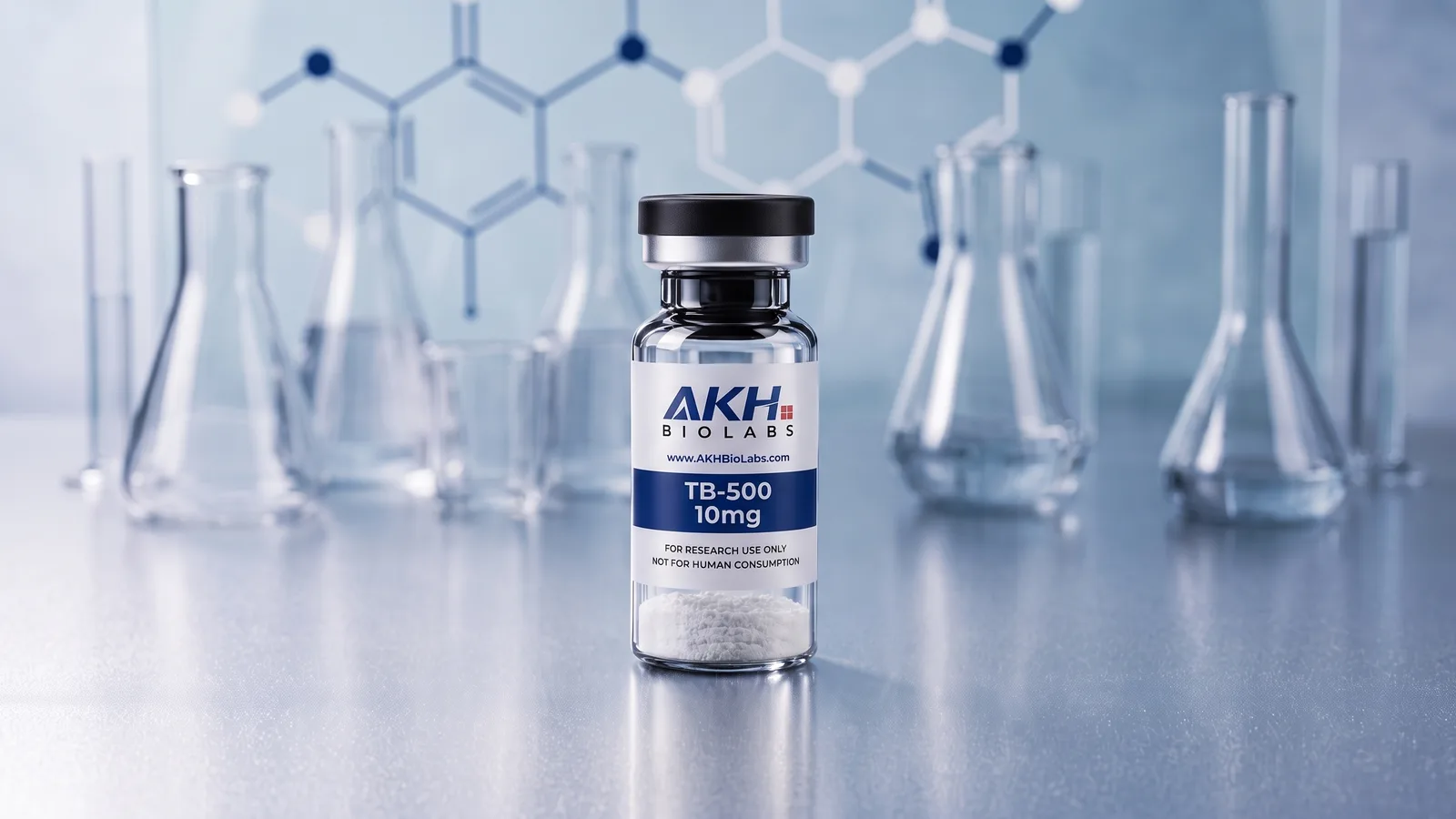
What does TB-500 do?
TB-500 is a seven-residue synthetic fragment of thymosin beta 4. In preclinical models the thymosin beta 4 literature describes cell migration, new blood vessel growth and tissue repair, but no human trial has tested TB-500 itself, and the fragment is prohibited in sport.
What does TB-500 do? In published preclinical research, the activity attributed to TB-500 is the activity of its parent protein, thymosin beta 4: it binds actin, encourages cells to migrate, and supports new blood vessel growth and tissue repair in animal and cell models. Two 2026 reviews in sports medicine journals summarise that work and reach the same conclusion: the animal results are favourable, and controlled human data are missing.
The name causes most of the confusion. Thymosin beta 4 is a 43-amino-acid protein made by the body. TB-500 is a short synthetic peptide, written Ac-LKKTETQ, that copies the protein's actin-binding region. Almost every published study used the full protein, not the fragment.
This note is for researchers and laboratory buyers who need a clear answer on what TB-500 is, what the record does and does not show, and where the full study list lives.
Key takeaways
- TB-500 is a seven-residue synthetic fragment, Ac-LKKTETQ, built on the actin-binding region of thymosin beta 4.
- The published biology of tissue repair, cell migration and blood vessel growth was almost all generated with full-length thymosin beta 4, not with the fragment.
- No human trial has tested TB-500. The human trials that exist used full-length thymosin beta 4, for dry eye, chronic venous ulcers, cardiac reperfusion and healthy-volunteer safety.
- Thymosin beta 4 and TB-500 are prohibited in sport, and there is no approved TB-500 product in any country.
- The only head-to-head experiment with BPC-157 is one small rat tendon study, which its authors called exploratory.
What TB-500 is
Thymosin beta 4 is a 43-amino-acid peptide found in most mammalian cells, where it is the main protein that holds monomeric actin, the building block cells use to move and change shape. A short stretch in the middle of the protein, the sequence LKKTETQ, carries its actin-binding activity.
TB-500 is a synthetic peptide built around that stretch, written Ac-LKKTETQ: seven amino acids with an acetyl group on the first one. It is marketed as an analogue of thymosin beta 4. The two names describe different molecules, which matters for every claim made about either of them.
| Thymosin beta 4 | TB-500 | |
|---|---|---|
| What it is | A 43-amino-acid protein the body makes | A seven-residue synthetic fragment, Ac-LKKTETQ |
| Share of the published biology | Almost all of it | Very little of its own |
| Human trials | Yes: dry eye, venous ulcers, cardiac reperfusion, healthy volunteers | None |
| Sport status | Prohibited | Prohibited |
What the research shows TB-500 and thymosin beta 4 do
The thymosin beta 4 literature describes four lines of activity in preclinical work: holding actin and promoting cell migration, endothelial migration and new blood vessel growth, activation of the heart's outer cell layer after cardiac injury, and reduced scarring and faster resolution of inflammation.
A 2026 narrative review in the American Journal of Sports Medicine states that thymosin beta 4 and its derivative TB-500 promoted angiogenesis and tissue repair in preclinical models, that human orthopaedic data are lacking, and that both remain banned in sport. A second 2026 review in Sports Medicine, covering twelve approved and unapproved peptides, reaches the same overall view: favourable tissue repair outcomes in animal models, and scarce rigorous human safety data.
One experiment has tested TB-500 directly against BPC-157. In a four-week rat Achilles tendon study with eight animals per group, TB-500 was the only group to reach statistical significance on maximum load to failure, and combining the two peptides added nothing. The authors labelled the work exploratory and preliminary.
What is TB 500 used for in research?
In the laboratory, TB-500 is studied in tissue-repair models: tendon, muscle and wound experiments in animals, and cell-migration assays in culture. It is also the subject of anti-doping work, because sports testing laboratories need methods to detect it, and several recent papers are detection methods rather than efficacy studies.
Commercially, TB-500 is promoted for soft-tissue recovery. That use has never been tested in a human trial. The randomised trials that exist were run with full-length thymosin beta 4, in healthy volunteers, severe dry eye, chronic venous ulcers and heart attack reperfusion, and none of them studied tendon, ligament or muscle injury.
Thymosin beta 4 vs TB-500: why the distinction matters
Thymosin beta 4 vs TB-500 is a comparison between a full protein and a small piece of it. A study that used thymosin beta 4 has not tested TB-500, and the reverse is also true. The TB-500 research record notes that the fragment has very little independent pharmacology, and that its equivalence to the full protein is assumed rather than demonstrated.
This is the most common error in material about TB-500: results from thymosin beta 4 trials are presented as if they were results for the fragment. The human trial record belongs to the full protein, and it covers indications other than the one TB-500 is marketed for.
The name also collides with thymosin alpha 1, a 28-amino-acid peptide studied for immune signalling. Despite the shared word, the alpha and beta thymosins are unrelated molecules.
What a TB-500 certificate of analysis shows
The certificate published with the AKH TB-500 listing covers batch 26147, tested on 26 July 2026 by the Brown Institute of Biomolecular Research. Its results line reads "TB-500: 10mg | Purity: 99.85%".
A certificate answers a batch question: what was measured in that vial lot, by which laboratory, on which date. The purity figure is a chromatographic peak-area ratio, not the share of the vial's mass that is peptide. It does not describe what the compound does, and it is not evidence for any of the research findings above.
Common questions.
- What does TB-500 do according to published research?
Published preclinical work attributes cell migration, new blood vessel growth and tissue repair to thymosin beta 4, the protein TB-500 is a fragment of. Two 2026 sports medicine reviews describe these animal results as favourable and state that controlled human data are lacking. No human trial has tested TB-500 itself.
- Is TB-500 the same as thymosin beta 4?
No. Thymosin beta 4 is a 43-amino-acid protein made by the body. TB-500 is a seven-residue synthetic fragment, Ac-LKKTETQ, based on the protein's actin-binding region. Almost all published biology, including every human trial, used the full protein.
- Has TB-500 been tested in human trials?
No. The randomised human trials in this area used full-length thymosin beta 4, in healthy volunteers, severe dry eye, chronic venous ulcers and heart attack reperfusion. None tested the TB-500 fragment, and none studied tendon, ligament or muscle injury.
- Is TB-500 allowed in sport?
No. Thymosin beta 4 and TB-500 are prohibited in sport, and a 2026 orthopaedic review confirms both remain banned. Several recent papers on the compound are anti-doping detection methods rather than efficacy studies.
Sources
- 01Injectable Peptide Therapy: A Primer for Orthopaedic and Sports Medicine Physicians. Am J Sports Med, 2026.
- 02Safety and Efficacy of Approved and Unapproved Peptide Therapies for Musculoskeletal Injuries and Athletic Performance. Sports Med, 2026.
- 03TB-500 research record and study list, AKH BioLabs
- 04TB-500 10mg product page and batch certificate, AKH BioLabs