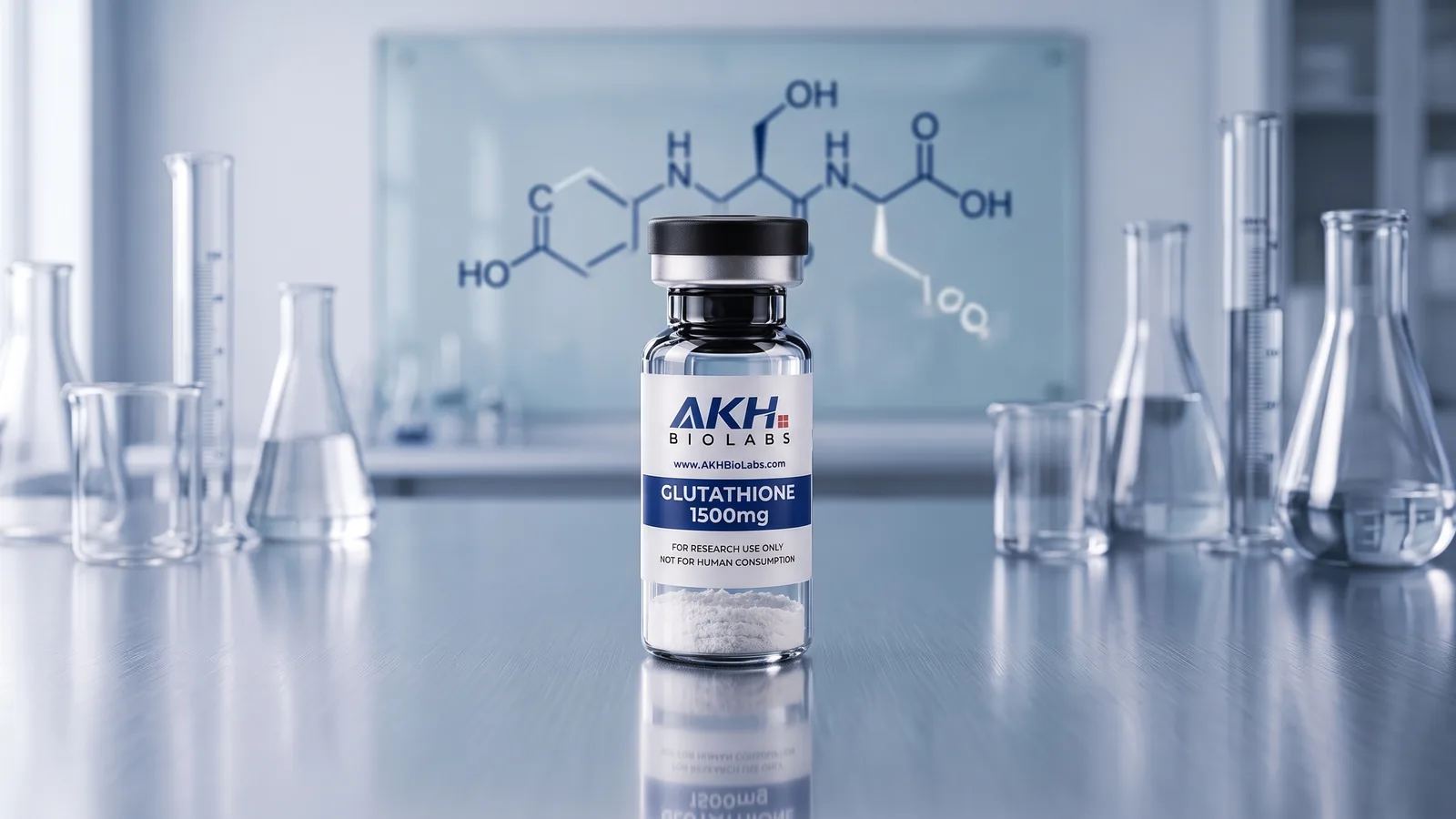
What is L-glutathione? Identity, the L- prefix and glutathione c
L-glutathione is the reduced form of the tripeptide glutathione, and the L- prefix is part of the residue names rather than a purity grade; glutathione c is an undefined label string to check against a batch record.
What is L-glutathione? It is the reduced form of glutathione, the tripeptide gamma-L-glutamyl-L-cysteinyl-glycine made from glutamate, cysteine and glycine.
The L- prefix belongs to the amino acid residues in that name, while the reduced form is a separate designation.
This article is written for laboratory researchers and buyers reading a product label or batch report who need the identity question separated from the formulation question. It also treats glutathione c as an ambiguous label string to check rather than a second compound name.
Key takeaways
- L-glutathione is the reduced tripeptide GSH, with formula C10H17N3O6S and molecular weight 307.33 g/mol.
- The L- prefix appears in the residue names gamma-L-glutamyl and L-cysteinyl; it is not a strength, purity grade or batch identifier.
- GSH is the reduced form with a free thiol; GSSG is the disulfide dimer, and the research literature reports the ratio as a redox marker.
- Glutathione c is not defined in the supplied records, so it must be resolved from the label and the batch report.
- The product record lists a 1500mg fill and 99.72% HPLC purity; chromatographic purity is not the same as net peptide content.
What is L-glutathione chemically?
Glutathione is a tripeptide: three amino acids linked in sequence. The research record gives the sequence as gamma-L-glutamyl-L-cysteinyl-glycine and describes an unusual gamma-linkage between glutamate and cysteine that makes the peptide resistant to ordinary peptidases. It also records that the compound is present in most mammalian cells at millimolar concentrations, is synthesised intracellularly in two ATP-dependent steps, and is a metabolite rather than a signalling peptide.
The same record gives the identifiers used to check a label: molecular formula C10H17N3O6S, molecular weight 307.33 g/mol, CAS number 70-18-8 and PubChem CID 124886. The product record names the supplied material L-Glutathione (Reduced) and gives a 1500mg fill with 99.72% purity by high-performance liquid chromatography (HPLC).
| Field | Value in the supplied records |
|---|---|
| Chemical name | gamma-L-glutamyl-L-cysteinyl-glycine |
| Molecular formula | C10H17N3O6S |
| Molecular weight | 307.33 g/mol |
| CAS number | 70-18-8 |
| PubChem CID | 124886 |
| Product name | L-Glutathione (Reduced) |
| Fill and purity | 1500mg fill; 99.72% by HPLC |
What the L- prefix does and does not say
The L- appears in the residue names gamma-L-glutamyl and L-cysteinyl. That is its role in the chemical name: it labels those two residues as they appear in the sequence. It is not a strength, a purity grade or a batch identifier, because the product record reports the fill as 1500mg and the purity as 99.72% by HPLC in separate fields.
The prefix also does not distinguish reduced from oxidised. The product record adds '(Reduced)' to the name, while the research record uses GSH for the reduced form and GSSG for the disulfide dimer. A label reading L-glutathione therefore identifies the peptide form; the redox state needs its own statement.
Nor does the L- prefix state the counterion, the ion paired with the peptide in the salt form. The research record separates the molecular weight from the salt form of the lyophilised powder, noting that lyophilised peptide is normally supplied as an acetate or trifluoroacetate salt and carries residual water.
GSH, GSSG and the cysteine thiol
The research record defines GSH as the reduced form with a free thiol and GSSG as the oxidised disulfide dimer formed when two GSH molecules donate electrons. Glutathione reductase converts GSSG back to GSH using NADPH, and the ratio between the two forms is used in the literature as a marker of cellular redox state.
The cysteine thiol is the reactive group. A 2001 paper in the supplied sources describes glutathione-dependent activation of matrix metalloproteinase precursors by peroxynitrite, with extensive S-glutathiolation of the proMMP protein and formation of glutathione disulfide S-oxide. That is a mechanistic finding about protein modification in an experimental system, not a statement about a batch's purity or a clinical result.
Glutathione c: how to read an ambiguous label
None of the supplied records uses glutathione c as a compound name, a salt name or a synonym. The research record uses glutathione, GSH and GSSG. The product record uses L-Glutathione (Reduced). That absence matters because a label string can look like a chemical name while carrying no defined meaning in the documents that would verify it.
The practical response is not to guess at a second compound or a grade. It is to check what the label and the batch report actually state.
- 01
Compound name
The label should name glutathione or L-glutathione rather than leave the identity to an undefined suffix.
- 02
Redox form
The label should state reduced (GSH) or oxidised disulfide (GSSG), because L-glutathione alone does not carry that distinction.
- 03
Batch link
The product page links a full certificate of analysis, and a separate research page explains how to read one.
- 04
Purity basis
The figure should state whether it is chromatographic purity, with net peptide content reported separately where relevant.
What a batch record can settle
The product record lists a 1500mg presentation with a purity of 99.72% by HPLC. The catalogue page also links a full certificate of analysis. The catalogue fields are size, purity and formula, and no net peptide content figure appears among them.
Chromatographic purity on a certificate of analysis does not resolve the difference made by salt form and residual water. Net peptide content, meaning the peptide mass rather than the total powder mass, is a separate measurement. The research record explains why the distinction matters: lyophilised peptide is normally supplied as an acetate or trifluoroacetate salt and carries residual water, so the mass of powder in a vial is not the same quantity as the molecular weight would suggest.
The second analytical paper in the sources describes a capillary electrophoresis method for acetic acid and trifluoroacetic acid in synthetic peptide samples. It notes that such samples may contain counterions such as acetate or trifluoroacetate as a result of their preparation, and that those acids can be present as impurities. That is a general point about synthetic peptide material, not a measurement of this glutathione batch; it supports the separation between a peptide name and the salt form of the supplied powder. The product page describes the material as for research use only and not for human consumption.
Common questions.
- What does the L- in L-glutathione mean?
The L- appears in the residue names gamma-L-glutamyl and L-cysteinyl, so it is part of the chemical name of the peptide. It is not a strength, purity grade or batch identifier. The product record reports the 1500mg fill and 99.72% HPLC purity separately, and it adds '(Reduced)' to distinguish the redox form.
- Is glutathione c the same as L-glutathione?
The supplied records do not define glutathione c as a compound name or a synonym. They use glutathione, GSH, GSSG and L-Glutathione (Reduced). A label using glutathione c should be checked against the compound name, redox form and batch report before the string is treated as an identity.
- Why are GSH and GSSG both called glutathione?
GSH is the reduced form with a free thiol. GSSG is the disulfide dimer formed when two GSH molecules donate electrons. The research record states that glutathione reductase converts GSSG back to GSH using NADPH and that the ratio between the two forms is used as a marker of cellular redox state.
- Does the L- prefix state the purity of a glutathione batch?
No. Purity is a separate measurement. The product record gives 99.72% by HPLC for its 1500mg presentation. The L- prefix is part of the chemical name, not the purity figure.
Sources
- 01Activation of matrix metalloproteinases by peroxynitrite-induced protein S-glutathiolation via disulfide S-oxide formation.
- 02Capillary electrophoretic determination of acetic acid and trifluoroacetic acid in synthetic peptide samples.
- 03Buy Glutathione 1500mg (Reduced): Batch COA · AKH BioLabs
- 04Glutathione research: published studies · AKH BioLabs