Best pinealon: how to choose for laboratory research
A buying guide to Pinealon for laboratory research: the identity fields a listing should resolve, what the stated 10mg fill does and does not describe, what a pending certificate status means, and which supply terms to read before ordering.
The best pinealon for laboratory research is the listing that resolves the compound's identity, states the fill it supplies, discloses its certificate status and gives supply terms that can all be checked before an order is placed. Judging that on the published record means reading Pinealon field by field rather than relying on a single printed number.
This guide is written for laboratory buyers comparing research-use-only listings of the EDR tripeptide. It covers what the compound name should resolve to, what the stated 10mg fill does and does not describe, what a pending certificate status means for the measurement question, what the published research record establishes and where it stops, and which supply terms to read before ordering. Nothing here concerns human use; the material discussed is supplied for laboratory research only.
Key takeaways
- Four fields decide a Pinealon listing: identity, stated fill, certificate status and supply terms.
- Pinealon is the tripeptide Glu-Asp-Arg (EDR), recorded under CAS 175175-23-2 and PubChem CID 10273502, with a free-base molecular weight of 418.40 g/mol.
- The 10mg figure is the stated fill, while the page shows the purity certificate as pending, so no purity percentage is currently printed for the presentation.
- The research record lists 21 published studies and states that no randomised, placebo-controlled trial of Pinealon or EDR alone exists in humans.
What Pinealon is, in checkable terms
Pinealon is the synthetic tripeptide Glu-Asp-Arg, abbreviated EDR, one of the short peptide bioregulators developed by the Khavinson group at the St Petersburg Institute of Bioregulation and Gerontology, according to the research record. The product page describes it the same way and supplies it as a 10mg presentation for laboratory research.
The mechanism proposed in that literature is epigenetic. The research record describes short peptides entering the nucleus and interacting with specific double-stranded DNA sequences, influencing transcription rather than acting at a cell-surface receptor. It also states that this mechanism rests on molecular docking and in vitro binding rather than on in vivo target engagement, which is the right register for reading the rest of the file.
Identity is the field a buyer can check even when nothing has been measured. The figures below come from the research record, which sources them to the PubChem entry for the compound and notes that they describe the free base.
| Field | Value on the published record | What it establishes |
|---|---|---|
| Sequence | Glu-Asp-Arg (EDR) | Which tripeptide the name covers |
| Molecular formula | C15H26N6O8 | Composition of the free base |
| Molecular weight | 418.40 g/mol | Mass of the free base, not of the vial contents |
| CAS number | 175175-23-2 | A registry identifier to match across listings |
| PubChem CID | 10273502 | The database record behind the figures |
The stated 10mg fill and the pending certificate
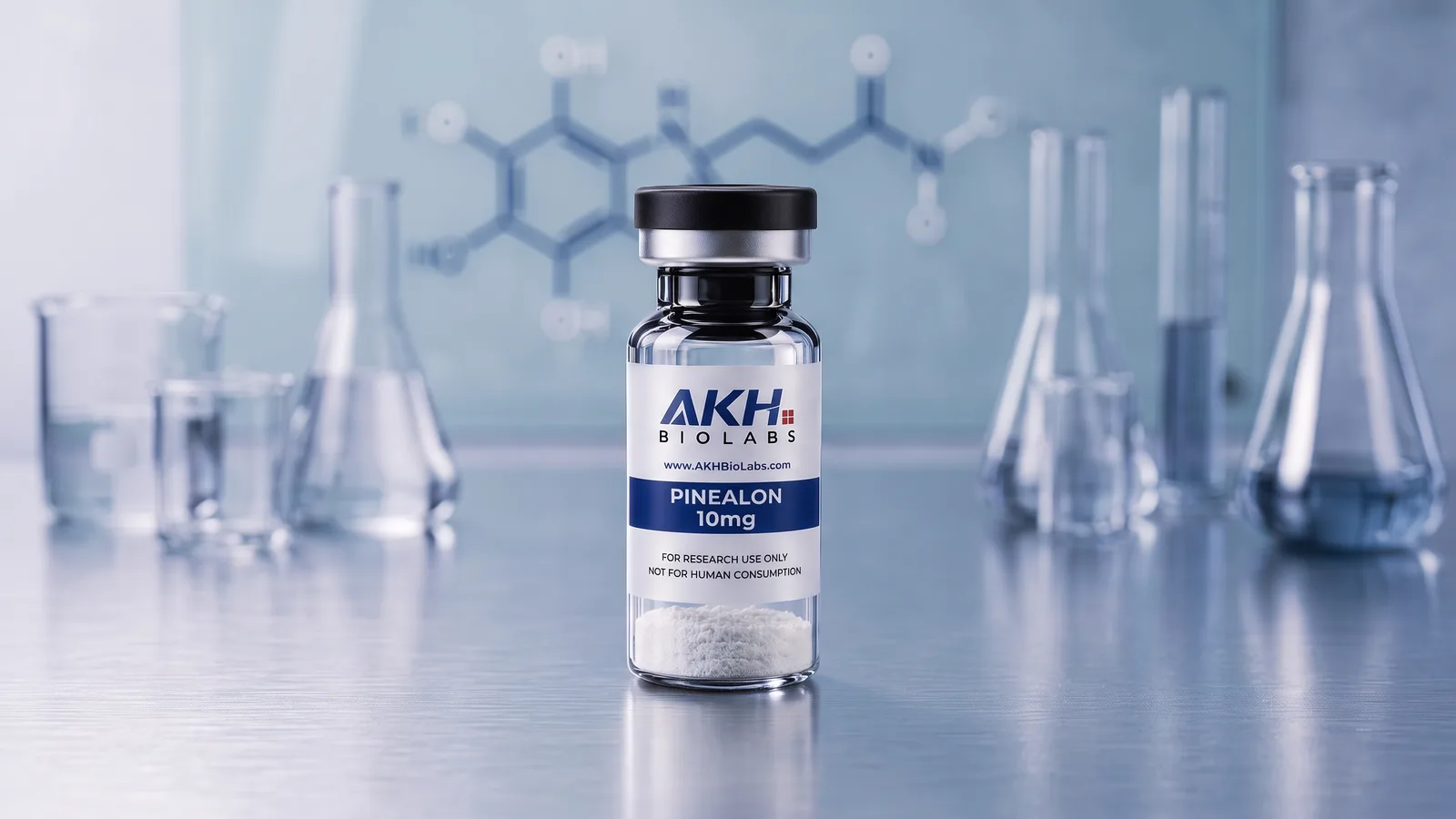
The Pinealon page states a 10mg size and shows the purity certificate as pending. Those are two different statements. The 10mg is the fill offered for the presentation, and the pending status means no purity percentage is printed beside it.
On the AKH Pinealon product page, the purity certificate is listed as pending. For this presentation the page records the certificate status as pending, so the measurement question stays open on the listing while the identity fields, the stated fill and the supply terms remain readable.
A stated fill and a purity result answer different questions. The fill describes the quantity offered; a purity result, when one is published, is a laboratory measurement for the batch it names. Neither converts into the other. The research record notes that lyophilised peptide is normally supplied as an acetate or trifluoroacetate salt and carries residual water, so the mass of powder in a vial is not the same quantity as the free-base figures suggest, and a chromatographic purity result does not resolve that difference either.
The practical consequence is that a buyer records the certificate field as unanswered rather than filling it from another product's report. A report written for a different product describes different material, whatever the compound name on the label says.
What the published research record establishes, and where it stops
The research record lists 21 published studies, 3 of them since 2023, with the newest dated 2024, and records that it was last reviewed in October 2026.
The limits are stated directly. There is no randomised, placebo-controlled trial of Pinealon or EDR alone in humans, and there are no pharmacokinetic data. The record adds that the proposed epigenetic mechanism rests on molecular docking and in vitro binding rather than in vivo target engagement, and has not been demonstrated to operate in intact human tissue.
The supplied abstract record shows the register of that work rather than a result to lean on. A 2008 paper compares four short regulatory peptides in a model of hypobaric hypoxia and reports Pinealon as the most pronounced among them; a 2015 report of 32 adults aged 41 to 83 examines Pinealon alongside a second short peptide rather than alone. Neither closes the gaps the record sets out.
The product page repeats the caution in its own words: a thin evidence base, small sample sizes, scarce independent replication outside the originating group, and human reports that are observational rather than randomised. None of that changes the identity fields, which are checkable now.
Supply terms, storage and intended use
The retrieved page text prints no holding temperature for the material, although a stability question appears in the product FAQ. That field stays open on the listing and should not be inferred from the delivery window or from the powder form.
Delivery is stated as worldwide in a 9 to 14 day window, and the 10mg presentation is shown as in stock. The page also carries a public review record of 4.7 on Trustpilot from 29 reviews. Those are commercial statements about reach, availability and past service; they say nothing about identity or purity.
The intended-use statement is the other field to read. The page states that the material is supplied for laboratory research and is not for human or veterinary use. A certificate, when one is published, records measurements for the batch it names and does not change that statement.
Where each check sits on the Pinealon page
Read in sequence, the checks produce a short record that can be compared with the material on arrival. The identity fields come from the research record, while the fill, the certificate status and the supply terms come from the product listing.
For the 10mg presentation described here the route ends at Pinealon, where the size, the certificate status, the stock line and the delivery window appear together. A buyer who prefers to settle the evidence question first can start at the research record and return to the product page once the identity fields and the stated limits are clear.
- 01
Identity
The page names the EDR tripeptide and the Khavinson peptide family, and the research record carries the sequence, formula, CAS number, PubChem CID and free-base molecular weight.
- 02
Stated fill
The listing states a 10mg presentation, which is a quantity for the presentation rather than a net peptide content figure.
- 03
Certificate status
The page shows the purity certificate as pending rather than printing a percentage, so the measurement stays open until a report is published.
- 04
Supply terms
Worldwide delivery in a 9 to 14 day window is stated, the presentation is shown as in stock, and a Trustpilot rating of 4.7 from 29 reviews is displayed.
- 05
Intended use
The listing states that the material is for laboratory research and not for human or veterinary use.
Common questions.
- Which chemical identifiers should appear on a Pinealon listing?
At minimum the sequence Glu-Asp-Arg (EDR), the molecular formula C15H26N6O8, the free-base molecular weight of 418.40 g/mol, CAS number 175175-23-2 and PubChem CID 10273502. The research record carries all five and notes that they come from the PubChem entry for the compound. Those identifiers let the same compound be matched across listings without relying on the trade name.
- What does the 418.40 g/mol figure on a Pinealon record describe?
It is the molecular weight of the free base, taken from the PubChem record for the compound. It is not the mass of powder in a vial. The research record notes that lyophilised peptide is normally supplied as an acetate or trifluoroacetate salt carrying residual water, so the two quantities differ, and net peptide content would be a separate measurement.
- Does Pinealon have a randomised controlled trial in humans?
The research record states that no randomised, placebo-controlled trial of Pinealon or EDR alone exists in humans, and that there are no pharmacokinetic data.
- What does the Pinealon product page state about delivery and intended use?
The page states worldwide delivery in a 9 to 14 day window and shows the 10mg presentation as in stock. It also states that the material is supplied for laboratory research and is not for human or veterinary use. Those are commercial and intended-use statements, and they sit beside the identity record rather than replacing it.