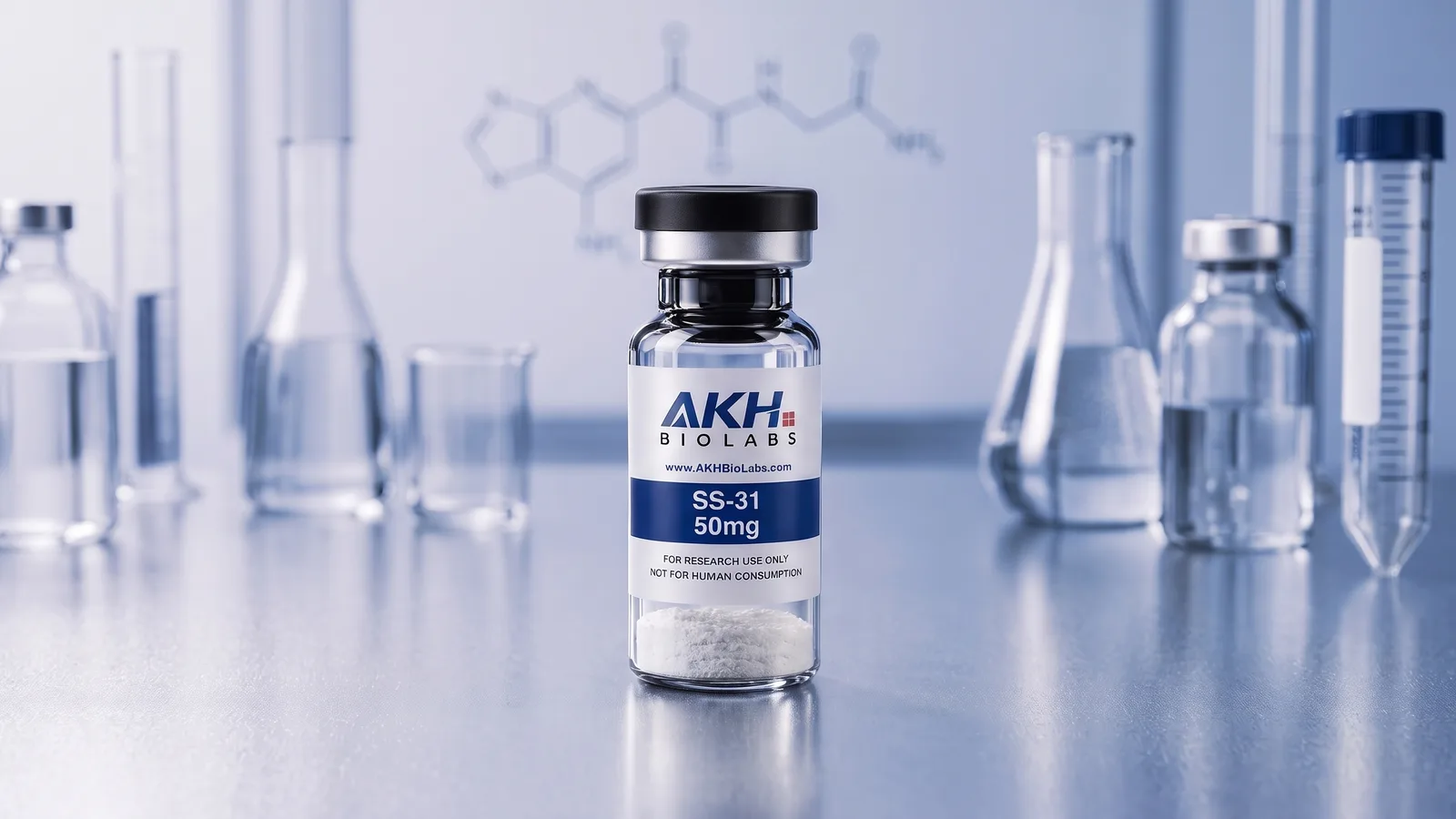
How to choose SS-31 for laboratory research
A buyer's guide to choosing SS-31 for laboratory research: the identity fields to match, the 50mg presentation and its 99.82% HPLC purity figure, the certificate from a named outside laboratory, and the storage question the listing leaves open.
A listing that prints its identity fields, its stated size, a certificate from a named outside laboratory and its delivery terms gives a reader fields that can be read and checked before payment. No single number settles the choice: a 50mg presentation and a 99.82% HPLC purity result describe different things, and only one of them is a quantity.
This article is written for laboratory buyers who compare SS-31 listings on documents rather than descriptions, and who need the material for research use only. The 50mg SS-31 presentation is used as the worked example throughout, because its page prints the formula, the stated size, the purity figure marked HPLC verified, a certificate from a named outside laboratory and a worldwide delivery window of 9 to 14 days in one place.
Nothing below ranks a brand, and the compound's regulatory position is described only as the published record gives it. Where the page is silent, that silence is stated as a gap rather than filled in.
Key takeaways
- SS-31 is the catalogue name for elamipretide, a synthetic four-amino-acid peptide with formula C32H49N9O5, CAS number 736992-21-5 and PubChem CID 11764719.
- The AKH BioLabs presentation is 50mg of lyophilised powder with a stated purity of 99.82%, marked HPLC verified on the page.
- The certificate from a named outside laboratory is published on the product page and reports an HPLC purity of 99.82%.
- Chromatographic purity is not a mass fraction: salt form and residual water sit between the stated fill and the mass of peptide.
- No holding temperature is printed in the page text used here, so storage is a field to confirm from the listing rather than assume.
What SS-31 is, and which identity fields a listing should print
SS-31 is the catalogue name for elamipretide. The research record lists Elamipretide, bendavia and Ocuvia as alternative writings, and the product page adds Bendavia and MTP-131, so several labels point at one molecule and a listing is matched on identifiers rather than on the name alone.
The product page describes a synthetic four-amino-acid peptide built on the Szeto-Schiller alternating aromatic-cationic motif, with formula C32H49N9O5 and a stated 50mg size. The research record gives CAS number 736992-21-5, PubChem CID 11764719 and a free-base molecular weight of 639.8 g/mol. Those figures describe the free base as recorded in PubChem, which is a chemical identity rather than a measurement of a batch.
The same page describes the peptide as concentrating in the inner mitochondrial membrane by binding cardiolipin, the anionic phospholipid of that membrane. It adds that the earlier antioxidant framing has given way in the current literature to the cardiolipin interaction as the primary mechanism, which is useful context for reading what the published record tests.
Size, form and what the 99.82% figure measures
The catalogue places SS-31 in a Performance category, described on the page as mitochondrial and cellular-energy research compounds, and supplies it as a lyophilised powder in a 50mg presentation. Beside the size the page prints 99.82%, marked HPLC verified, and states that the certificate from a named outside laboratory shows the same 99.82% HPLC purity. The abbreviation HPLC is printed on the page beside that purity figure.
A purity result is not a content assignment. The 2023 report on reference standards for synthetic peptide therapeutics describes HPLC and GC methods for assessing peptide content and impurities, and a two-step mass balance approach that assigns a quantitative value to a bulk peptide material before the vialed material is valued against it. That assignment is a separate exercise from the purity figure a batch report prints.
The research record makes the same point from the other direction. It notes that lyophilised peptide is normally supplied as an acetate or trifluoroacetate salt carrying residual water, and that chromatographic purity does not resolve the difference between powder mass and peptide mass. The 50mg figure therefore describes the presentation, while the 99.82% figure describes the chromatogram.
The certificate: what it is and what to read on it
AKH BioLabs publishes a certificate for the product on its product page, and describes it there as a Certificate (COA) from a named outside laboratory that shows 99.82% HPLC purity. The page is also where the document itself is displayed, so the listing and the report can be read together.
The certificate described on the page comes from a named outside laboratory and shows 99.82% HPLC purity, the same figure printed beside the 50mg size. The page gives no further certificate detail beyond that named laboratory and that purity figure.
What the page does not do is state a net peptide content. It gives a fill figure and a purity figure, and no mass of peptide beside them, so the two numbers are recorded as different fields. Reading the certificate as a measurement of identity and purity, rather than as a statement of how much peptide is present by weight, keeps the two apart.
Storage and delivery: what the page states and what it leaves open
The page states worldwide delivery in 9 to 14 days. That is a shipping term about reach and timing, not a statement about identity or purity, and it sits beside the certificate rather than in place of it.
A holding temperature is not printed in the page text used here, although the page's own question list raises a stability question about the solution form. A buyer is therefore left to confirm the storage condition from the listing before ordering, rather than inferring it from the powder form or borrowing a figure from a different compound's page.
The product page gives the lyophilised powder and the 50mg size without stating storage conditions. The 2023 reference-standard report likewise places handling and storage among the practices it sets out to benchmark, alongside preparation and analytical testing. Storage is a listing field to be read, not a detail to be assumed from the presentation.
What the published record covers, and what it does not
The research record counts 36 studies, 21 of them since 2023, split into human, animal and review entries, and records a last review in October 2026. That record is the place where the compound's literature is set out, and this article does not restate it.
Two limits are worth carrying into a buying decision because they bear on how a listing's claims should be read. The record states that elamipretide's only approved indication is Barth syndrome, granted under accelerated approval on a muscle-strength surrogate endpoint in a very small cohort, with confirmatory clinical benefit not yet demonstrated. It also states that the largest randomised trial in primary mitochondrial myopathy (MMPOWER-3, n=218) missed its primary endpoints.
The record then states what is absent: no controlled trials of elamipretide in healthy individuals for exercise capacity, athletic performance or body composition, and no evidence for use in healthy individuals or for athletic performance. A batch certificate says nothing about that either way, which is why the two documents are read separately.
Where each check sits on the AKH BioLabs SS-31 page
The 50mg SS-31 presentation prints the formula and the stated size, the 99.82% purity figure marked HPLC verified, the certificate from a named outside laboratory, a worldwide 9 to 14 day delivery window and a public review record of 4.7 on Trustpilot from 30 reviews. The identity fields, the purity figure and the certificate are all readable on the page before payment.
The three kinds of document stay apart. The product page carries identity and commercial terms, the certificate carries the measurement for the material, and the research record at /research/ss-31 carries the literature and its limits. Keeping them apart is what makes the checks work: none of the three substitutes for another, and the page states that the material is supplied for research purposes only.
- 01
Match the compound
Elamipretide, formula C32H49N9O5, CAS 736992-21-5 and PubChem CID 11764719, rather than the trade name on its own.
- 02
Record the two numbers separately
The 50mg presentation is a stated fill and the 99.82% is a chromatographic result, so neither is entered as the other.
- 03
Open the certificate
The page states a certificate from a named outside laboratory showing 99.82% HPLC purity, which can be read before the order is placed.
- 04
Get the storage answer from the listing
No holding temperature is printed in the page text used here, so the condition is confirmed rather than assumed.
Common questions.
- Which details on an SS-31 listing can be checked before ordering?
Four groups: the identity fields (Elamipretide, C32H49N9O5, CAS 736992-21-5, PubChem CID 11764719), the stated size and form, the certificate from a named outside laboratory reporting 99.82% HPLC purity, and the stated delivery scope. The AKH BioLabs page publishes the identity fields, the 50mg size, a certificate from a named outside laboratory reporting 99.82% HPLC purity, and worldwide delivery in 9 to 14 days.
- Is SS-31 the same compound as elamipretide and Bendavia?
The names point to one molecule. The research record lists Elamipretide, bendavia and Ocuvia as alternative writings, and the product page adds Bendavia and MTP-131, all against the same identity fields: formula C32H49N9O5, CAS 736992-21-5 and PubChem CID 11764719. Because the labels vary between sellers, a listing is matched on identifiers rather than on a single name.
- How does the salt form change what the 50mg figure means?
The 50mg is the stated size of the presentation. The research record notes that lyophilised peptide is normally supplied as an acetate or trifluoroacetate salt and carries residual water, so the powder in a vial contains counterion and water alongside the peptide. The figure describes the presentation rather than an assigned mass of peptide, and net peptide content would be a separate measurement that the page does not report.
- What is the regulatory status of elamipretide outside Barth syndrome?
The research record states that its only approved indication is Barth syndrome, granted under accelerated approval on a muscle-strength surrogate endpoint in a very small cohort, with confirmatory clinical benefit not yet demonstrated. Elsewhere it remains investigational: the largest randomised trial in primary mitochondrial myopathy missed its primary endpoints, the phase 2 heart failure and Leber hereditary optic neuropathy trials also missed theirs, and the catalogue listing is supplied for laboratory research only.