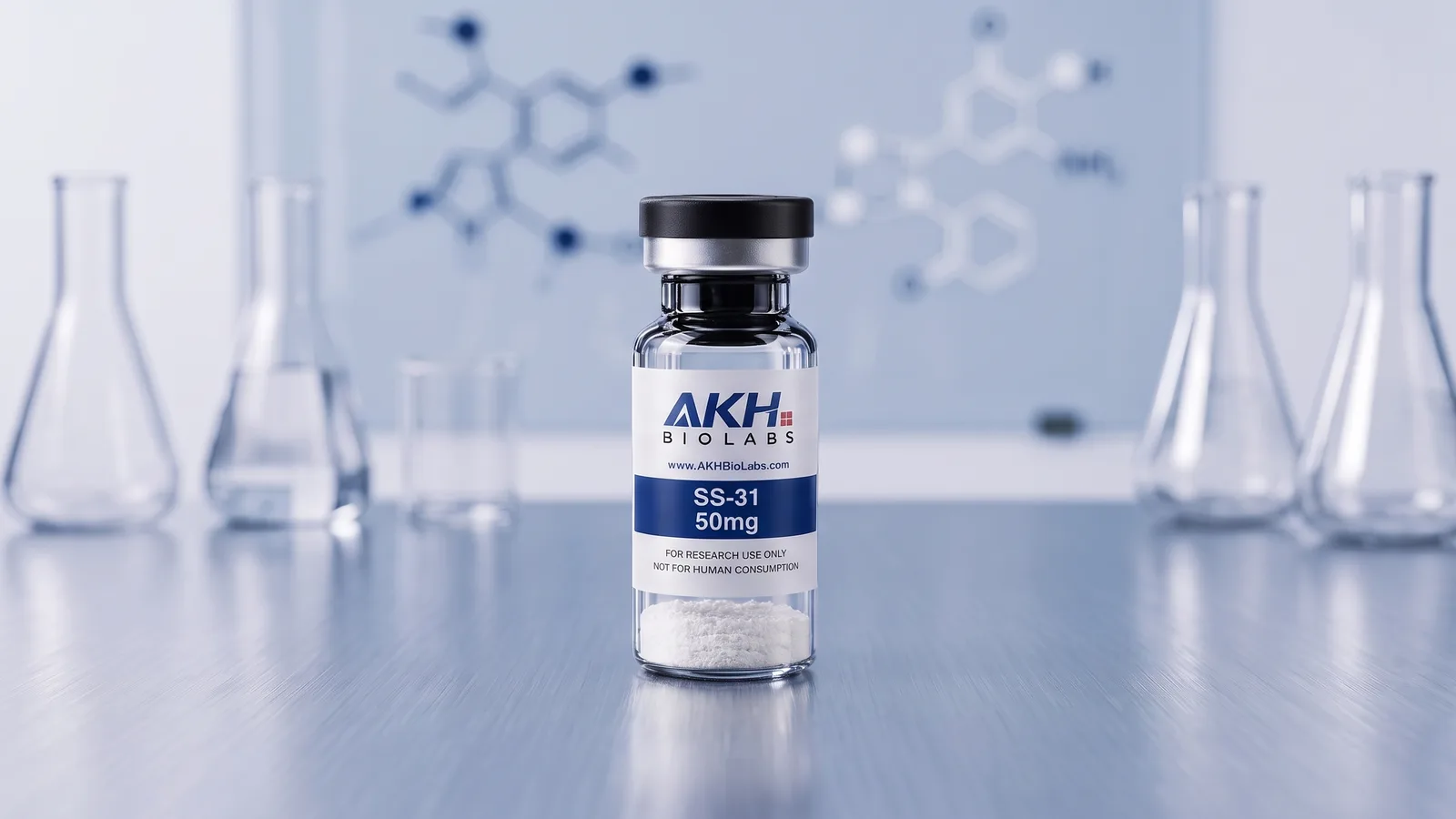
Buy SS-31: what to check before ordering
A buyer's checklist for SS-31 research material: the four public facts to verify on any seller, what the AKH BioLabs SS-31 page shows for each, and what a certificate of analysis does and does not establish.
To buy SS-31 for research, four public facts should be checked on any seller before an order is placed: a certificate published for that exact product, the identity and purity that certificate reports, the seller's stated shipping destination and timeline, and the public review record read with its volume. The AKH BioLabs SS-31 page shows each of those, and the SS-31 product page is where the current listing, size and price sit.
This article is written for laboratory buyers and research groups comparing suppliers of SS-31 (elamipretide), a mitochondria-targeted tetrapeptide studied for cardiolipin binding in the inner mitochondrial membrane. It covers what a certificate can and cannot establish, how to read the batch fields, why a purity figure is not a quantity figure, and what shipping and review evidence look like in practice. It is a buying guide, not a statement about the compound's research status, which lives on the SS-31 evidence record.
Key takeaways
- Four checkable facts decide most of the buying question: a published certificate for the exact product, the laboratory, batch and test date on it, the stated shipping destination and window, and the public review record with its volume.
- The batch number is the field that ties a certificate to a physical vial; a purity figure without a matching batch describes different material.
- A chromatographic purity figure is a peak-area ratio, not a mass fraction, so it does not state how much peptide is in the vial.
- The AKH BioLabs SS-31 listing carries one certificate for batch 26080, tested 31 Jul 2026 by the Brown Institute of Biomolecular Research, with the results string "SS-31: 50mg | Purity: 99.82%".
- AKH states worldwide shipping in a 9-14 day window; the product page shows the price rather than this article.
The four checks that answer where to buy SS-31 for research
A supplier listing can be long and still leave the buying question unanswered. Four fields do most of the work, and each is readable from a public page before an order is placed.
The first is a certificate of analysis published for the exact product being ordered, not for a related compound or a different presentation. The second is what that certificate reports: the compound identity, the batch number, the test date, the laboratory that produced the measurement, and the result. The third is the seller's stated shipping destination and delivery window. The fourth is the public review record, read with the number of reviews rather than as a star rating alone.
None of the four is sufficient on its own. Together they make a listing checkable, which is a different and more useful property: a buyer can verify each one, and can verify the batch again when the parcel arrives.
- 01
A certificate for the exact product
The document should name the compound being ordered. A certificate for a different presentation or a different compound does not describe the material in the parcel.
- 02
The fields on that certificate
Compound, batch number, test date, laboratory name and result. The batch number is the link between the document and the vial.
- 03
Shipping destination and window
A named destination list and a stated delivery window, rather than a vague promise. AKH states worldwide shipping in a 9-14 day window.
- 04
The public review record
Read the reviews alongside their count. A small number of reviews and a large number are different kinds of evidence, and neither substitutes for the certificate.
What the SS-31 certificate actually reports
The AKH BioLabs SS-31 listing carries one certificate of analysis. It is a test report from a named laboratory outside AKH, ordered by the manufacturer and shown on the product page exactly as the laboratory issued it. A printed copy ships in every parcel.
For this product the report covers batch 26080, tested 31 Jul 2026 by the Brown Institute of Biomolecular Research, with a purity of 99.82% and the results string "SS-31: 50mg | Purity: 99.82%". The task ID is #1812376. Those are the fields a buyer can compare against the batch printed on the vial after delivery.
The archive at /lab/coa lists every certificate AKH has published, one row per batch, with the product, batch, purity, test date and laboratory. It is the full published record rather than a selection, which is what makes a batch-by-batch comparison possible at all.
Batch 26080
The batch number on the SS-31 certificate. It is the field that ties the document to the physical vial.
31 Jul 2026
The test date recorded on the report. It dates the measurement, not the material's shelf life.
Brown Institute of Biomolecular Research
The laboratory named on the report. The name is the checkable part: an unnamed laboratory cannot be verified.
99.82%
The purity figure recorded for that batch, alongside the results string "SS-31: 50mg | Purity: 99.82%".
Why a purity figure is not a quantity figure
A purity figure from liquid chromatography is a peak-area ratio taken from the chromatogram. It states what share of the detected material is the target peak, not what share of the vial mass is the peptide. Salt form and residual water both sit between the two numbers, which is why net peptide content is measured separately.
This matters at the buying stage because a listing that quotes a purity figure and a fill mass is quoting two different measurements. The 50mg in the SS-31 results string is the stated fill; the 99.82% is the chromatographic result. Neither one converts into the other without a separate measurement.
The SS-31 research record notes the same distinction for this compound: lyophilised peptide is normally supplied as an acetate or trifluoroacetate salt and carries residual water, so the mass of powder in a vial is not the same quantity as the molecular weight would suggest, and chromatographic purity does not resolve that difference either.
Shipping, reviews and the parts a certificate cannot cover
A certificate documents a measurement for one batch. It does not document whether the seller ships to a given country, how long delivery takes, or what other buyers experienced. Those are separate questions with separate evidence.
AKH states worldwide shipping in a 9-14 day window. That is a shipping fact rather than a quality claim, and it should be read alongside the batch record for the product being ordered rather than instead of it.
The public review record is the fourth check. It is worth reading with its volume attached: a handful of reviews and several hundred are different kinds of evidence, and neither one verifies identity or purity. The certificate does that job, and only for the batch it names.
What the listing states about intended use
The SS-31 listing is a research-use-only product page. It states: "For research purposes only. Not for human consumption, diagnosis, treatment, or prevention of any condition." That is an intended-use statement for the material, and it is the frame in which the certificate, the shipping terms and the price all sit.
The compound's research position is a separate question from its supply. The SS-31 evidence record summarises 16 published studies, 11 of them published since 2023, and sets out what the evidence does not establish, including the absence of controlled trials in healthy individuals for exercise capacity or athletic performance. A buying guide is not the place to re-argue that record; the record itself is where it belongs.
A short pre-order routine
The checks above collapse into a short routine that can be run in a few minutes on any seller's site. It is the same routine whether the seller is AKH or another supplier, and it produces a yes or no rather than an impression.
The SS-31 product page is where the current listing sits, including the size, the certificate for the current batch and the price. The archive at /lab/coa is where the full published record can be read, and the SS-31 evidence record at /research/ss-31 is where the published studies are collected.
- 01
Find the certificate for the exact product
If no certificate is published for the product being ordered, the listing is not checkable at the batch level.
- 02
Read the batch number, test date and laboratory name
These three fields are what make the document specific. A report without them describes material that cannot be matched to a vial.
- 03
Check the shipping destination and window
Confirm the seller ships to the destination country and states a delivery window.
- 04
Read the review record with its volume
Reviews are one input among four, and their count is part of how they should be read.
- 05
Compare the batch on arrival
The batch number printed on the vial should match the batch number on the published report. That comparison is the point of publishing the record.
Common questions.
- Where can SS-31 peptide be bought online in the USA for research?
From a seller that publishes a certificate for the exact product, names the laboratory, batch and test date on it, and states shipping to the destination country. The AKH BioLabs SS-31 page shows a certificate for batch 26080, tested 31 Jul 2026 by the Brown Institute of Biomolecular Research, and states worldwide shipping in a 9-14 day window. The listing is supplied for research use only.
- What does the SS-31 peptide price depend on?
The product page shows the price rather than this article, and the listing states the size alongside it. What a buyer can check independently is the certificate for the batch being supplied, the laboratory named on it, and the shipping terms. Those are the fields that distinguish one listing from another; the price is a separate commercial fact shown on the product page.
- Does the SS-31 certificate state how much peptide is in the vial?
No. The report for batch 26080 carries the results string "SS-31: 50mg | Purity: 99.82%". The 50mg is the stated fill and the 99.82% is a chromatographic purity result, which is a peak-area ratio rather than a mass fraction. Lyophilised peptide is normally supplied as a salt with residual water, so net peptide content is measured separately.
- Why does the batch number matter more than the purity figure on an SS-31 report?
The batch number is the field that ties the document to the physical vial. A report with a high purity figure but a batch that does not match the material being supplied describes a different batch. The purity figure states what was measured; the batch number states which material the measurement applies to.
- Is SS-31 an approved medicine for human use?
The AKH BioLabs research record states that elamipretide's only approved indication is Barth syndrome, granted under accelerated approval on a muscle-strength surrogate endpoint in a very small cohort, and that confirmatory clinical benefit has not yet been demonstrated. The SS-31 listing itself is supplied for research purposes only and states that it is not for human consumption, diagnosis, treatment, or prevention of any condition.