BPC157 UK: what to check before ordering
A buyer's checklist for BPC157 UK searches: the four public facts that separate a checkable BPC 157 supplier from an unverifiable one, and where AKH BioLabs publishes each of them.
For anyone searching bpc157 uk, the answer to where to buy BPC-157 for research is a seller that publishes a Certificate from a named outside laboratory for that exact product, states the identity and purity that certificate reports, ships to the destination country, and carries a public review record that can be read with its volume. Those four facts are checkable from public pages before any order is placed, and each can be re-checked against the batch on the vial after delivery.
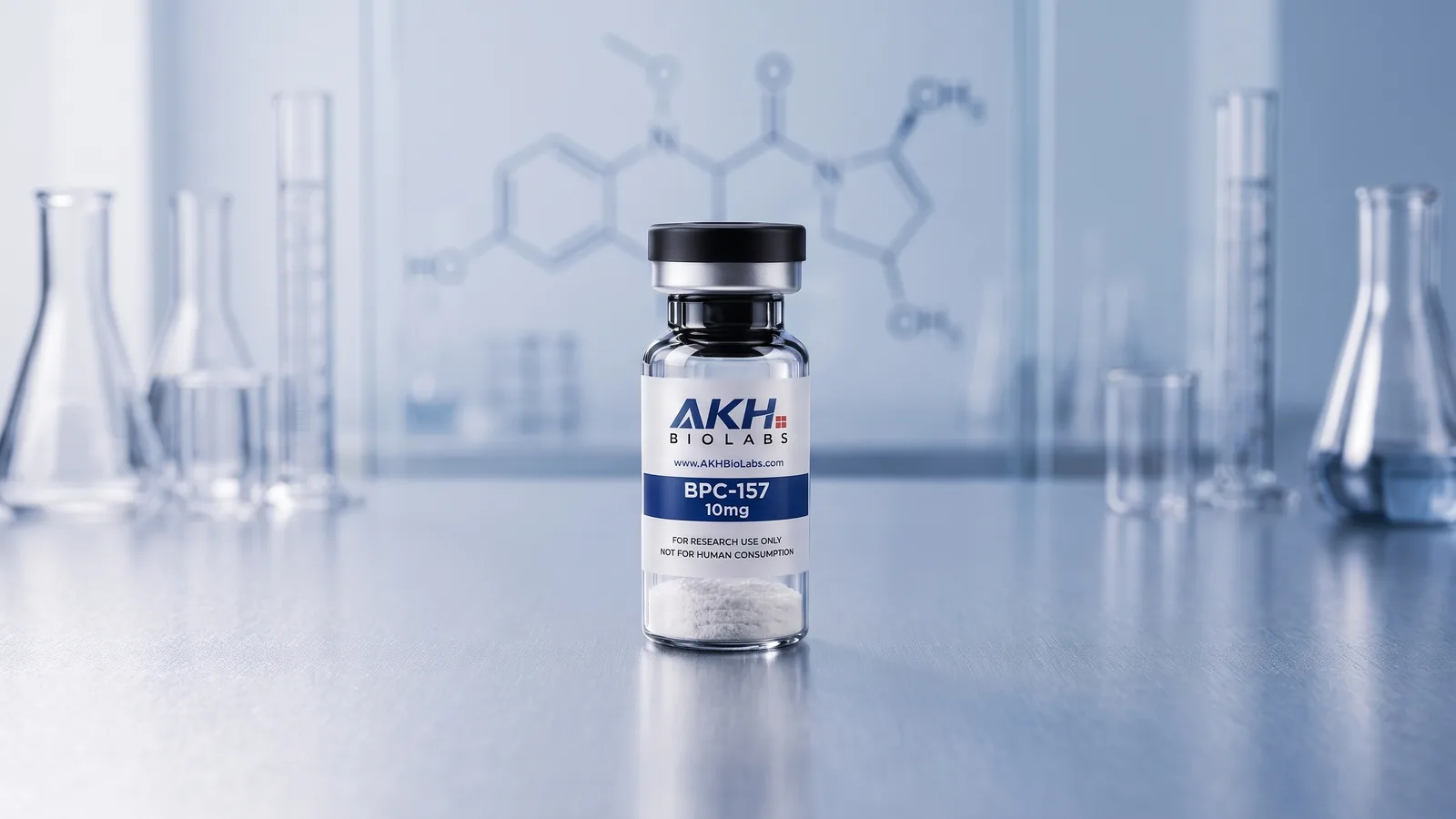
The AKH BioLabs BPC-157 10mg vial page shows each of those four facts in one place: the certificate for batch 26149, the laboratory that produced it, the shipping window, and the review record. This article sets out what each fact means, why the batch number matters more than the purity figure, and where the published evidence for the compound itself lives.
The scope is deliberately narrow. This is a buying article for research-use-only material, not a compound explainer and not a guide to human use. The audience is a laboratory buyer comparing BPC 157 supplier listings, and the material below is limited to what a public page can be checked against.
Key takeaways
- A Certificate from a named outside laboratory is the document that makes a purity claim checkable; a purity figure with no laboratory name attached is not.
- The batch number is the field that ties a report to a physical vial. A report whose batch does not match the material being supplied describes a different batch.
- A chromatographic purity figure is a peak-area ratio from the chromatogram, not a statement of how much peptide is in the vial by weight.
- Shipping destination and timeline are stated facts, not assumptions. AKH BioLabs ships worldwide in 9 to 14 days.
- The published evidence for BPC-157 is overwhelmingly preclinical, and the research record states that plainly rather than implying otherwise.
The four facts worth checking on any BPC 157 supplier listing
A listing can carry a purity figure, a photograph of a vial and a paragraph of marketing copy without any of it being checkable. The four facts below are different, because each one can be read from a public page and compared against the material that arrives.
The first is a published Certificate for the exact product. The second is the identity of the laboratory that produced the measurement, together with the batch number and test date on the report. The third is the seller's stated shipping destination and timeline. The fourth is the public review record, read with its volume rather than as a star rating alone.
None of the four requires contacting the seller, and none depends on trusting a claim that cannot be looked up again later. That is the point of the list: it converts a set of assertions into a set of documents.
- 01
A Certificate published for the exact product
Not a generic sample report, and not a certificate for a different compound from the same seller. The document should be reachable from the product page itself.
- 02
The laboratory name, batch number and test date
These three fields together identify which material was measured and when. A report without a batch number cannot be matched to a vial.
- 03
The stated shipping destination and timeline
A seller that ships worldwide should say so, and should give a window rather than a vague promise. AKH BioLabs states worldwide delivery in 9 to 14 days.
- 04
The public review record, read with its volume
A review record is more informative when the number of reviews is visible alongside the rating. A small number of reviews and a large number are different kinds of evidence.
What a Certificate from a named outside laboratory actually shows
A Certificate of Analysis is a test report for one batch of one material. On the AKH BioLabs BPC-157 page, the published report covers batch 26149, tested 28 Jul 2026 by the Brown Institute of Biomolecular Research, with a purity figure of 99.66% and the results string "BPC-157: 10mg | Purity: 99.66%". Each of those fields is a fact about that batch rather than about the product line as a whole.
The laboratory name is the part that makes the report checkable. A certificate issued by the seller's own operation is a different kind of document from one issued by a laboratory outside the seller, because the second has no commercial stake in the result. The AKH BioLabs archive at /lab/coa lists every published certificate by product, batch, purity, test date and laboratory, so a report can be located independently of the product page that links to it.
The archive page states its own scope in one line: each row is one certificate of analysis, one batch, tested once, by a named third-party laboratory. That sentence is worth reading carefully, because it describes what the table is and, by implication, what it is not. It is a record of published reports, not a claim about testing frequency or about any manufacturing standard.
Why the batch number matters more than the purity figure
A purity figure is the number buyers notice first, and it is the least useful field on its own. A chromatographic purity result is a peak-area ratio taken from the chromatogram: it states what share of the detected material sits in the target peak, not what share of the vial mass is the peptide. Salt form and residual water both sit between those two quantities, which is why net peptide content is measured separately.
The batch number is the field that does the linking work. It ties the document to the physical vial, so a report whose batch does not match the material being supplied describes a different batch, whatever its purity figure says. The test date does similar work in the other direction: it states when the measurement was made, which is a fact a buyer can compare against the date on the vial.
For batch 26149, the four identifying fields are the product name, the batch number, the laboratory and the test date. A buyer checking a listing can look for those four fields on the report and confirm they match the vial. The purity figure is the fifth field, and it is the one that means least without the other four.
Shipping, reviews and the limits of what a listing can establish
Shipping is a stated fact rather than an inference. AKH BioLabs states worldwide delivery in 9 to 14 days, which is a window a buyer can plan around and compare against other sellers' stated windows. A listing that does not state a destination or a timeline leaves the buyer to find out after ordering, which is a different experience from reading it beforehand.
The public review record is the fourth check, and it needs to be read with its volume. A rating without a review count is hard to interpret, because a small number of reviews and a large number are different kinds of evidence. The useful reading is the combination: how many reviews, over what period, and whether the pattern is consistent.
It is worth being explicit about what none of these four facts establishes. A certificate documents measurements for one batch. It does not establish that a seller tests every batch, that a material is sterile, or that any manufacturing standard has been met. Those are separate claims, and a listing that makes them without a document behind them is making a claim rather than showing a record.
What the published BPC-157 evidence covers, and where it lives
A buying article is not the place to re-argue the compound literature, and the evidence record for BPC-157 sits at /research/bpc-157 rather than here. What that record states is worth summarising in one line, because it bears on how a listing should be read: the evidence base is overwhelmingly preclinical, human data are limited to a small number of uncontrolled pilot studies and one retrospective case series, and no completed randomised controlled trial exists.
The 2026 review cited below describes BPC-157 among the wound-healing peptides studied for angiogenesis, extracellular matrix remodelling and fibroblast activation, and states that although preclinical studies are promising, there is a current lack of clinical trials. That is a statement about the state of the research, not a claim about any product.
The practical consequence for a buyer is that the certificate and the literature answer different questions. The certificate states what was measured in a batch. The literature states what has been studied in models. Neither one substitutes for the other, and a listing that blurs them is harder to check than one that keeps them apart.
Where to buy BPC-157 for research, and what to check on arrival
The AKH BioLabs BPC-157 10mg vial page carries the certificate for batch 26149, the laboratory name, the test date, the shipping window and the review record in one place, which is what makes the four checks above possible without leaving the page. The same page links to the full report and to the archive at /lab/coa, where every published certificate is listed by product, batch, purity, test date and laboratory.
On arrival, the check that matters most is the batch number. The vial carries a batch, and the report carries a batch; if the two match, the document describes the material in hand. If they do not, the report describes a different batch, and the seller should be able to supply the report for the batch that was actually shipped.
The second check is the form of the material. BPC-157 is supplied as a lyophilised powder, which means freeze-dried: a solution is frozen and its ice is removed under vacuum, leaving a dry solid. The powder is a formulated solid with some residual water rather than pure peptide, which is the same distinction that separates a purity figure from a quantity figure.
The third check is the intended-use statement. The product page states that the material is for research purposes only and is not for human consumption, diagnosis, treatment or prevention of any condition. That is an intended-use statement for the material, and it is the frame within which everything on the page should be read.
Common questions.
- What should be checked before ordering BPC 157 for sale in the UK?
Four public facts: a Certificate published for the exact product, the laboratory name, batch number and test date on that certificate, the seller's stated shipping destination and timeline, and the public review record read with its volume. Each is readable from a public page before ordering, and each can be checked again after delivery against the batch on the vial.
- Does a BPC 157 supplier certificate state how much peptide is in the vial?
No. A chromatographic purity figure is a peak-area ratio from the chromatogram, not a mass fraction. Lyophilised material is normally supplied as a salt and carries residual water, so the powder mass differs from the peptide mass. Net peptide content is a separate measurement, and the certificate reports the purity result rather than the fill quantity.
- Why does the batch number matter more than the purity figure on a BPC-157 report?
The batch number is the field that ties the document to the physical vial. A report with a high purity figure but a batch that does not match the material being supplied describes a different batch. The purity figure states what was measured; the batch number states which material the measurement applies to.
- Is BPC-157 an approved medicine for human use?
No. The AKH BioLabs research record states that the evidence base is overwhelmingly preclinical, that human data are limited to a small number of uncontrolled pilot studies and one retrospective case series, and that no completed randomised controlled trial and no approved formulation exist. The material is supplied for research purposes only.
- Where is the published evidence for BPC-157 recorded?
On the BPC-157 research record, which lists the published studies ordered by strength of study design and sets out what the evidence does not establish. That record covers the tendon, ligament, muscle and gastrointestinal work, the angiogenesis and VEGFR2 findings, the small human reports and the limitations of the current literature.