AHK cu vs GHK cu: which to pick for a research project
AHK cu vs GHK cu comes down to sequence, literature size and evidence tier: GHK-Cu carries a large extracellular-matrix and skin-remodelling record, while AHK-Cu rests on a single 2007 ex vivo hair-follicle study. The sections below cover what each compound is, how the published work differs, and how a researcher picks between them.
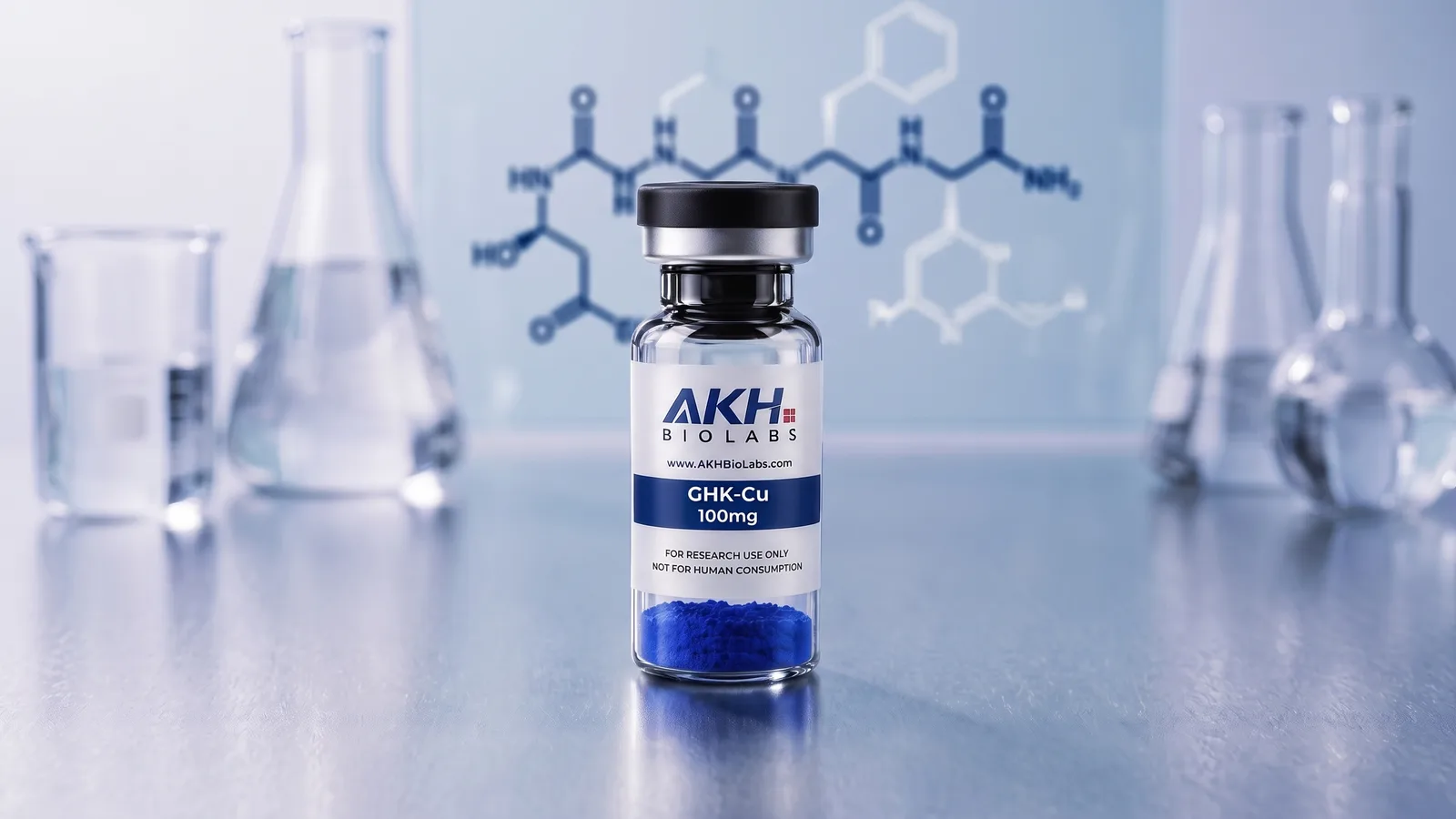
AHK cu vs GHK cu is a choice between two copper-binding tripeptides that differ by one residue and by a very large gap in published evidence. GHK-Cu is the copper(II) complex of glycyl-L-histidyl-L-lysine, and AHK-Cu is the copper(II) complex of L-alanyl-L-histidyl-L-lysine, in which alanine replaces glycine. Both are supplied as lyophilised powder for laboratory research, and both are listed in the AKH BioLabs catalogue as GHK-cu and AHK-cu.
This article is written for laboratory researchers deciding which of the two to study, and for buyers who need to know what a listing and a batch certificate actually document. It compares the compounds as research materials: chemical identity, the shape of the published literature, the evidence tier each sits in, and the practical checks that apply to either purchase. It does not cover human use, and neither compound is an approved medicine.
Key takeaways
- GHK-Cu and AHK-Cu are distinct tripeptides: GHK-Cu is glycyl-L-histidyl-L-lysine bound to copper(II), AHK-Cu is L-alanyl-L-histidyl-L-lysine bound to copper(II).
- The GHK-Cu evidence record cites 15 published studies, including two randomised human trials that found no significant benefit on objective endpoints.
- The AHK-Cu evidence record cites 10 studies, and its principal dermatological source is a single 2007 ex vivo and cell-culture study of human hair follicles.
- No controlled comparison of AHK-Cu against GHK-Cu has been published in any model.
- Each AKH BioLabs product carries one Certificate from a named outside laboratory, published on its product page, and ships worldwide in 9 to 14 days.
What each compound is, chemically
Both compounds are copper tripeptides: a three-amino-acid chain that binds a copper(II) ion through the histidine imidazole group. The difference is the first residue. GHK-Cu uses glycine, giving the sequence glycyl-L-histidyl-L-lysine and the molecular formula C14H24CuN6O4. AHK-Cu uses alanine, giving L-alanyl-L-histidyl-L-lysine and the formula C15H24ClCuN6O4-.
The AKH BioLabs research records list the identifiers for each. GHK-Cu carries PubChem CID 378611 and a molecular weight of 403.92 g/mol. AHK-Cu carries CAS number 682809-81-0, PubChem CID 168431292 and a molecular weight of 451.39 g/mol. Both records note that these figures describe the free base, and that lyophilised peptide is normally supplied as an acetate or trifluoroacetate salt carrying residual water, so the mass of powder in a vial is not the same quantity the molecular weight implies.
| Field | GHK-Cu | AHK-Cu |
|---|---|---|
| Sequence | glycyl-L-histidyl-L-lysine | L-alanyl-L-histidyl-L-lysine |
| Molecular formula | C14H24CuN6O4 | C15H24ClCuN6O4- |
| Molecular weight | 403.92 g/mol | 451.39 g/mol |
| PubChem CID | 378611 | 168431292 |
| CAS number | not listed in the supplied record | 682809-81-0 |
| Evidence tier on the research record | Early clinical | Preclinical only |
How the published research differs
The two evidence records are not the same size, and they are not about the same thing. The GHK-Cu record cites 15 published studies, 10 of them since 2023, with the newest dated 2026. The AHK-Cu record cites 10 studies, 6 since 2023, and states that no recent study addresses AHK-Cu directly.
The recurring themes also diverge. GHK-Cu work clusters around collagen synthesis, copper transport and chelation, extracellular matrix remodelling, glycosaminoglycan and elastin synthesis, wound healing and re-epithelialisation, antioxidant and anti-inflammatory gene modulation, and topical skin permeation. AHK-Cu work clusters around dermal papilla cell proliferation, hair follicle elongation ex vivo, copper tripeptide analogue chemistry, VEGF induction, sebum modulation and topical delivery of hydrophilic tripeptides.
The single dedicated AHK-Cu dermatological study is a 2007 paper by Pyo and colleagues in Archives of Pharmacal Research. It reports that AHK-Cu at 10^-12 to 10^-9 M stimulated elongation of human hair follicles ex vivo and proliferation of dermal papilla cells, and that 10^-9 M AHK-Cu reduced the proportion of apoptotic dermal papilla cells on annexin V and propidium iodide flow cytometry. The AHK-Cu research record states that nothing comparable has been published since.
Evidence tier: what each record does and does not establish
GHK-Cu sits in a higher tier, but the tier is still thin on controlled human data. The GHK-Cu research record states that a 2026 PRISMA systematic review searching from database inception located only 20 studies of GHK-Cu as a standalone aesthetic intervention, of which 18 were preclinical and 2 were randomised controlled trials. Both of the largest randomised trials were negative: a 1992 evaluator-blinded trial in 86 evaluable subjects with venous stasis ulcers found a 0.4 percent tripeptide-copper cream no different from inert vehicle, while silver sulfadiazine outperformed both, and a 2006 trial in 13 completers after CO2 laser resurfacing found no significant difference in erythema resolution, wrinkle improvement or overall skin appearance.
AHK-Cu sits lower still. The AHK-Cu research record states that there are no published human clinical trials of AHK-Cu for hair growth or skin appearance, and no controlled comparison of AHK-Cu against GHK-Cu in any model. Most claims made for the compound are extrapolated from the wider copper-tripeptide literature rather than from AHK-specific data.
A 2026 review by Fan and colleagues in Biomedicines surveyed short peptides investigated for hair loss and positioned them against approved agents such as minoxidil, finasteride and dutasteride and against transplantation and stem cell approaches. That review covers the peptide class rather than AHK-Cu specifically, which is the pattern across most of the AHK-Cu record.
How a researcher picks between the two
The choice follows from the research question rather than from a ranking. GHK-Cu is the better-documented material for extracellular matrix, collagen and fibroblast work, and it is the compound with controlled human trials attached, even though those trials were negative on objective endpoints. AHK-Cu is the more specific choice for hair-follicle and dermal-papilla-cell models, where its one dedicated study sits, and it is the thinner evidence base of the two.
A researcher weighing the pair should also account for what neither record supplies. No study has compared the two compounds head to head, so any statement that one outperforms the other is an extrapolation. The AHK-Cu record states this directly: claims about AHK-Cu efficacy in cosmetic use are extrapolations from copper-tripeptide class data.
- 01
Match the compound to the model
GHK-Cu for extracellular matrix, collagen, fibroblast and wound-model work; AHK-Cu for hair-follicle and dermal-papilla-cell work.
- 02
Check the evidence tier before designing
GHK-Cu has two randomised human trials, both negative on objective endpoints. AHK-Cu has no human trials at all.
- 03
Treat class-level findings as class-level
Copper-tripeptide findings from one compound do not transfer automatically to the other, and the AHK-Cu record says so explicitly.
- 04
Read the batch certificate for the material supplied
The certificate names the compound, the batch, the test date and the laboratory, and it documents one batch rather than a product line.
What the batch certificates document for each compound
Each AKH BioLabs product carries one Certificate from a named outside laboratory, published on its product page. The GHK-cu certificate covers batch 26155, tested 03 Aug 2026 by the Brown Institute of Biomolecular Research, with a purity of 99.64 percent and the results string "GHK-CU: 100mg | Purity: 99.64%". The AHK-cu certificate covers batch 26202, tested 02 Aug 2026 by the same laboratory, with a purity of 99.60 percent and the results string "AHK-CU: 100mg | Purity: 99.60%".
A purity figure of this kind is a chromatographic peak-area ratio, not a statement of how much of the vial mass is peptide. Both research records note that salt form and residual water sit between the two, and that chromatographic purity does not resolve the difference. Net peptide content is a separate measurement. The full published record of certificates sits in the COA archive.
Where to buy each compound and what to check
Both compounds are supplied as 100mg lyophilised powder for laboratory research, and both are listed at the same catalogue size. The GHK-cu product page and the AHK-cu product page each publish the Certificate for the current batch, and each states that the material is not for human or veterinary use. AKH BioLabs ships worldwide in 9 to 14 days.
Before ordering either compound, the checkable facts are the same four: whether a Certificate is published for the exact product, which laboratory is named on it along with the batch number and test date, the stated shipping destination and timeline, and the public review record read with its volume. Each is readable from a public page before ordering, and each can be checked again after delivery against the batch printed on the vial. The batch number is the field that ties the document to the physical container, so a report whose batch does not match describes different material regardless of the figures it carries.
Common questions.
- What is the difference between AHK cu and GHK cu?
They are two distinct copper-binding tripeptides. GHK-Cu is the copper(II) complex of glycyl-L-histidyl-L-lysine, formula C14H24CuN6O4. AHK-Cu is the copper(II) complex of L-alanyl-L-histidyl-L-lysine, formula C15H24ClCuN6O4-, in which alanine replaces glycine. The GHK-Cu record cites 15 published studies; the AHK-Cu record cites 10, with one dedicated dermatological study.
- Which copper peptide has more published research, GHK-Cu or AHK-Cu?
GHK-Cu, by a wide margin. Its research record cites 15 published studies, 10 since 2023, covering collagen synthesis, matrix remodelling, glycosaminoglycan and elastin synthesis, wound healing and gene modulation. The AHK-Cu record cites 10 studies and states that its principal dermatological source remains a single 2007 ex vivo and cell-culture study of human hair follicles.
- Has AHK-Cu ever been compared with GHK-Cu in a controlled study?
No. The AHK-Cu research record states that no controlled comparison of AHK-Cu against GHK-Cu has been published in any model. The two compounds are studied in separate literatures with different endpoints, so any statement that one outperforms the other rests on extrapolation from copper-tripeptide class data rather than on a direct experiment.
- Do GHK-Cu and AHK-Cu have human clinical trial data?
GHK-Cu has some, and it is mixed. A 2026 systematic review located only two randomised controlled trials of GHK-Cu as a standalone aesthetic intervention, and both of the largest randomised trials were negative on objective endpoints. AHK-Cu has none: the research record states there are no published human clinical trials of AHK-Cu for hair growth or skin appearance.
- Does a purity figure on a copper peptide certificate state how much peptide is in the vial?
No. A chromatographic purity figure is a peak-area ratio from the chromatogram, not a mass fraction. Lyophilised peptide is normally supplied as a salt and carries residual water, so the powder mass differs from the peptide mass. Net peptide content is a separate measurement, and the certificate reports the purity result rather than the fill quantity.
Sources
- 01COA archive — every batch we have published · AKH BioLabs
- 02The effect of tripeptide-copper complex on human hair growth in vitro.
- 03Therapeutic Peptides in Orthopaedics: Applications, Challenges, and Future Directions.
- 04Buy GHK-Cu 100mg: Batch COA · AKH BioLabs
- 05GHK-Cu research: published studies · AKH BioLabs
- 06Buy AHK-Cu Peptide 100mg Powder: 99.60% COA · AKH BioLabs
- 07AHK-Cu research: published studies · AKH BioLabs