HGH 191aa vs HGH: what the 191aa label actually claims
The 191aa notation is a sequence-length claim about the full growth hormone chain, not a second compound, and it sits apart from the 176-191 fragment and from growth hormone secretagogues.
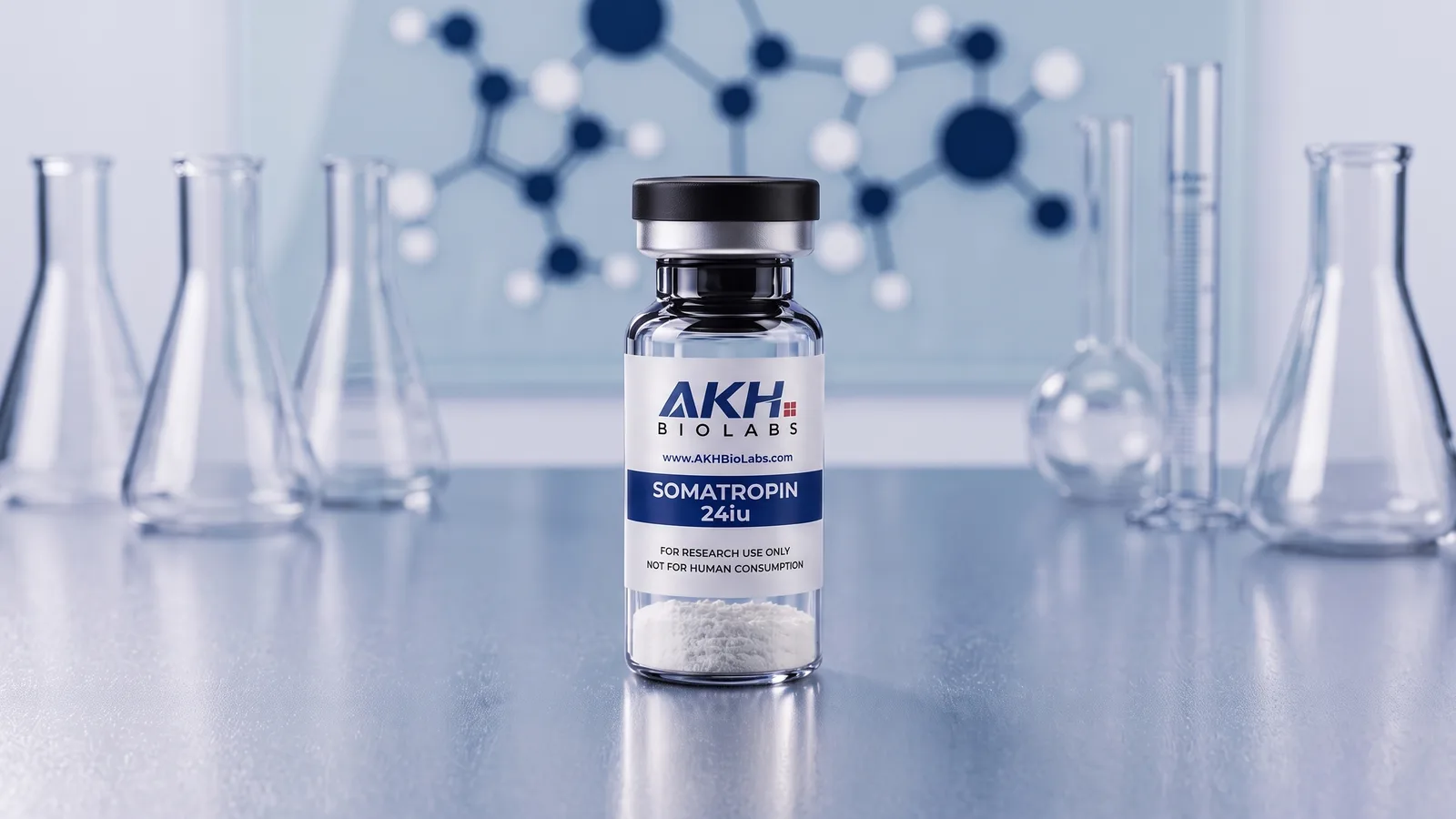
In the hgh 191aa vs hgh question, the two strings point at one material rather than two. The 191aa part is a length notation: it reads as a claim that the vial holds the full growth hormone chain whose residue numbering ends at 191, while hgh is the family name for that same hormone, so the suffix adds a specification rather than a second molecule.
The distinctions that do matter sit on either side of the notation. One side is the 176-191 fragment, catalogued as AOD-9604, which is a 16-amino-acid section of the same parent protein. The other side is the secretagogue and releasing-hormone analogue class, which includes growth hormone secretagogues such as ipamorelin and growth hormone-releasing hormone analogues such as CJC-1295 and sermorelin.
Key takeaways
- 191aa is a chain-length claim about the full hormone, not the name of a separate analogue or product family.
- AOD-9604 is the 16-residue fragment spanning positions 176 to 191 with an added N-terminal tyrosine, so it is a different molecule from the full chain.
- Ipamorelin, CJC-1295 and sermorelin belong to the secretagogue and releasing-hormone analogue groups, and a published review treats those as separate classes from synthetic fragments.
What the 191aa label is claiming
Numbered peptide names are read against a parent sequence, and the growth hormone fragment gives the clearest anchor in the supplied record. The AOD-9604 product page describes the compound as a 16-amino-acid fragment of human growth hormone spanning residues 176 to 191, with an added tyrosine at the N-terminus for stability. The research record writes the same region as Tyr-hGH 177-191 and notes that the literature commonly refers to it as hGH fragment 176-191.
Two points follow from that numbering. Because the fragment is described as the C-terminal region ending at residue 191, the parent chain is counted to that position, which is what a 191aa suffix is asserting. And a name such as 176-191 fixes both ends of a short window, whereas a length notation fixes only the total. On that reading, hgh 191aa and hgh describe one material at two levels: a sequence-length claim and a family name.
The reading has a limit worth stating. No supplied document defines 191aa as a formal term, and the published certificate table prints no residue count for any product.
| Label | What it names | Where the supplied record uses it |
|---|---|---|
| HGH 191aa | A length claim about the full-length hormone chain | Market notation; absent from the certificate table |
| HGH fragment 176-191 | The 16-residue C-terminal fragment with an added N-terminal tyrosine | AOD-9604 product and research pages |
| Ipamorelin, CJC-1295, sermorelin | Secretagogues and releasing-hormone analogues, separate compounds | Named as distinct classes in the published review |
Is 191aa hgh a separate compound?
No. Nothing in the supplied record gives 191aa hgh its own sequence, receptor or catalogue entry that differs from the full-length hormone. A listing that writes hgh 191aa is therefore naming the same product with an extra length qualifier attached.
The qualifier still does work. Because shortened growth hormone sequences are also sold, a length claim separates the whole chain from the 176-191 window in a way that the bare word hgh does not. What the qualifier cannot do is show that a particular vial contains the full chain; that question belongs to the batch record and the laboratory that issued it.
How the 176-191 fragment differs from the full chain
AOD-9604 is a distinct molecule rather than a version of the full chain: 16 residues against a parent sequence counted to 191, plus an N-terminal tyrosine the parent does not carry. The number in a fragment name marks a window, and the number in a length notation marks a total, which is why the two strings cannot be swapped for one another on a label.
The compound-level evidence is not rehearsed here. It sits on the AOD-9604 research record, which lists the published studies and states what they do not establish, and the naming question is covered in the separate fragment explainer.
Why secretagogues are not the same material
A published critical review groups the market into growth hormone secretagogues such as ipamorelin, growth hormone-releasing hormone analogues such as CJC-1295 and sermorelin, and synthetic fragments such as Frag 176-191 and KPV. Three groups, three sets of molecules, and none of them is the full-length chain that a 191aa suffix claims to describe.
The same review adds two cautions that bear on any label comparison. It states that most published studies examine clinical applications rather than the combined protocols reported in bodybuilding, and that the largely unregulated supply chain means products are often mislabelled or contaminated. It also notes that analytical detection is complicated by the structural similarity of these peptides to endogenous hormones and by short half-lives. A name on a listing, in other words, is a claim about contents, not a measurement of them.
Reading the label on a batch certificate
The certificate table is the part of the record that can be checked line by line. It states that each row is one certificate of analysis: one batch, tested once, by a named third-party laboratory, with product pages showing the current batch and the table holding the full published record. Two Somatropin rows appear in the supplied version: batch 26076 at 99.57 percent, test date 27 Jul 2026, and batch 26072 at 99.93 percent, test date 23 Jul 2026, both attributed to the Brown Institute of Biomolecular Research.
Two features of those rows bear on the 191aa question. The product column reads Somatropin with no length qualifier, so the notation belongs to the catalogue and search layer rather than to a field the laboratory prints. And the columns carry a product, a batch, a purity figure, a test date and a laboratory, which means the row identifies a batch and records a purity measurement for it without stating a sequence length. Confirming a chain-length claim for a specific vial therefore requires the underlying report rather than the table row.
One point on provenance: every published certificate is a report from a named laboratory outside AKH, ordered by the manufacturer and shown as the laboratory issued it. The supplier is not the analyst, which is why the laboratory name and the test date travel with the figure.
Common questions.
- What does 191aa mean in hgh 191aa?
It reads as a sequence-length claim: the material is the full-length growth hormone chain whose residue numbering ends at 191, rather than a shortened fragment. No supplied document defines the notation formally, so it works as a label specification. Checking whether a batch meets it needs the underlying laboratory report, not the catalogue string.
- Does a batch certificate of analysis state a residue count?
The supplied certificate table does not. Each row gives a product, a batch, a purity figure, a test date and a laboratory, so it documents a measurement for an identified batch rather than a sequence. Residue numbering appears in the compound literature instead, in the naming of the 176-191 fragment.
- Why is hgh 191aa listed separately from hgh fragment 176-191?
Because the two names describe different lengths of the same parent protein. The 176-191 name fixes a 16-residue window at the C-terminal end, with an added tyrosine, and AOD-9604 is that fragment. The 191aa notation claims the whole chain.
Sources
- 01A new era of doping? Use of peptide and peptide-analog drugs in recreational and professional sport and bodybuilding: a critical review.
- 02COA archive — every batch we have published · AKH BioLabs
- 03AOD-9604 — Anti-Obesity Drug 9604 (hGH Fragment 176-191) · AKH BioLabs
- 04AOD-9604 research — published studies and evidence · AKH BioLabs