pt 141 uk: what to check before ordering
What to check before ordering PT-141 for laboratory research: the published certificate, the batch record behind it, identity and purity reporting, shipping, and where AKH shows each.
Anyone searching pt 141 uk is asking a buying question rather than a pharmacology one: which seller can be checked before an order is placed? The checks are public and few, a Certificate for that exact product from a named laboratory outside the seller, the identity and purity that report states, a shipping destination that covers the buyer's country, and a public review record read with its volume, and AKH BioLabs shows the first three on the PT-141 product page.
This guide is for laboratory buyers and research groups comparing UK-facing listings, and it covers what to verify before an order is placed. It does not cover what the compound does or what the published studies found; that evidence record sits on the PT-141 research page, and the buying task is narrower.
Key takeaways
- A buying decision for a research peptide can rest on four public facts: a certificate for the exact product, the batch and laboratory named on it, a stated shipping destination with a window, and a public review record read with its volume.
- The certificate for PT-141 is a test report from a named laboratory outside AKH, ordered by the manufacturer, and it documents measurements for one batch.
- A purity figure is a chromatographic result for that batch, not a statement of how much of the vial mass is peptide.
- The compound's formula, molecular weight and CAS number are published on the research record and can be compared with a listing before ordering.
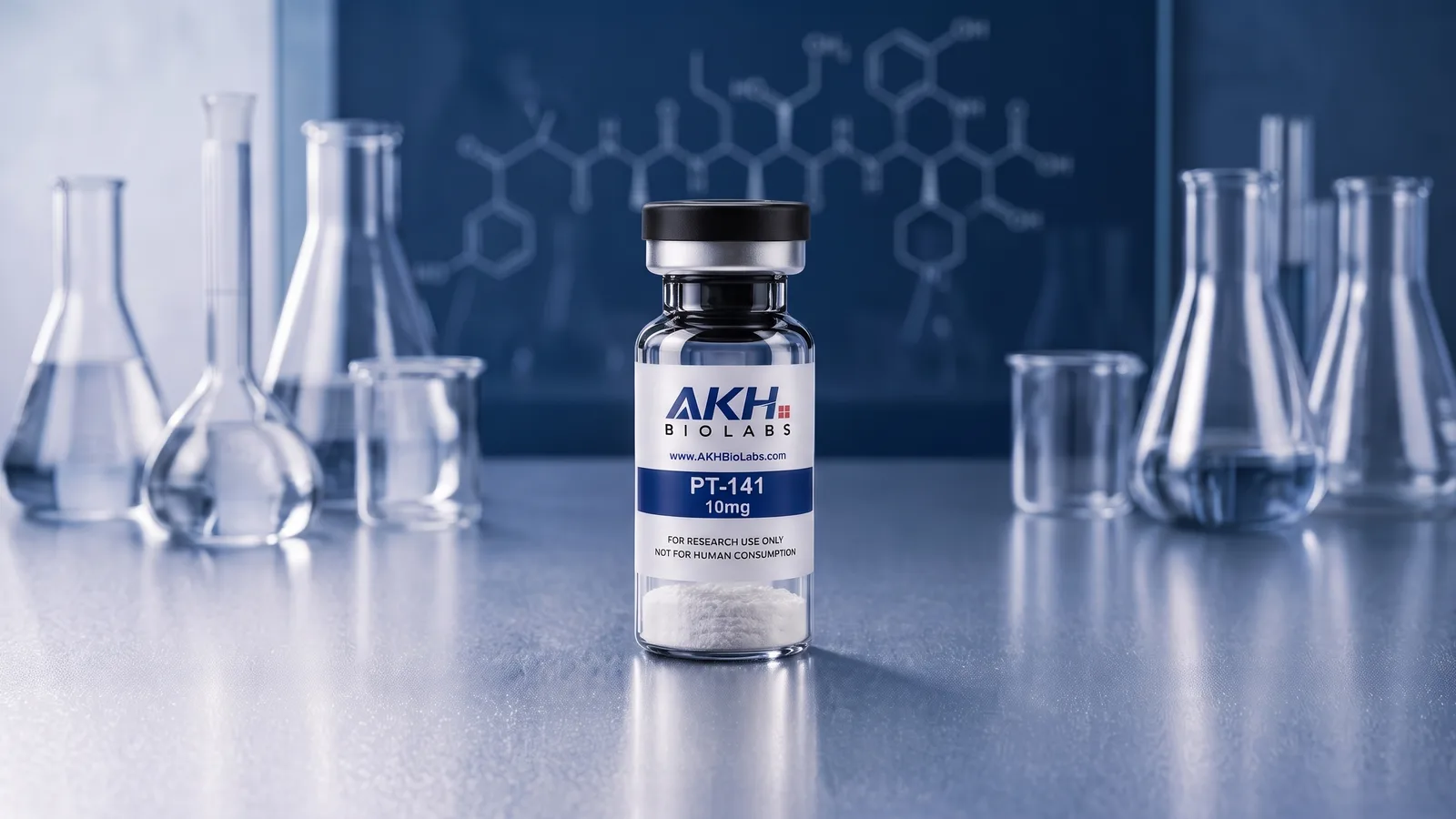
- The listing supplies lyophilised powder for laboratory research and states not for human or veterinary use.
The checks behind a pt 141 peptide buy
A search for pt 141 peptide for sale returns listings that use nearly identical wording and publish very different amounts of evidence. The checks below can each be completed from a public page, in order, before any payment is made.
Each check answers a different question. A certificate answers whether a measurement exists for that product; the laboratory, batch and test date answer whether the measurement can be traced; identity and purity answer what was measured; shipping answers whether the material can reach the buyer; and a review record answers what other buyers recorded, weighted by how many there were.
- 01
A certificate for the exact product
Not a report for a sibling compound, a different presentation or a compound family. The document should name the material being sold and carry a batch number that can be matched to the container.
- 02
A named laboratory, a batch number and a test date
Those three fields make a report traceable. An undated report, or one with no laboratory named, cannot be checked against anything.
- 03
The identity and purity the report states
The result should name the compound measured. The PT-141 research record supplies the identifiers to compare against: molecular formula C50H68N14O10, molecular weight 1025.2 g/mol, CAS 189691-06-3 and PubChem CID 9941379.
- 04
A shipping destination and a stated window
A destination list and a delivery window are shipping facts rather than quality claims. AKH states worldwide shipping in a 9-14 day window.
- 05
A public review record, read with its volume
The count matters as much as the sentiment. A handful of reviews and several hundred describe different evidence, and a record without a visible count cannot be weighted.
The published PT-141 certificate: batch 26115
The AKH BioLabs PT-141 page carries one certificate for the product. It names the batch as 26115, the test date as 11 Aug 2026 and the laboratory as the Brown Institute of Biomolecular Research, and it reports purity of 99.62% for that batch. The report identifier shown on the page is task ID #1812411.
The same entry appears in the COA archive, which lists published certificates by product, batch, purity, test date and laboratory and counts 44 published reports. Each row is one certificate for one batch, tested once, so the archive is a record of documents rather than a claim about how often material is tested.
What the report does not do is state how much of the vial mass is peptide. The research record notes that lyophilised peptide is normally supplied as an acetate or trifluoroacetate salt and carries residual water, so the mass of powder in a vial is not the same quantity as the molecular weight suggests, and that chromatographic purity does not resolve the difference. The glossary entries on net peptide content and on purity versus quantity address that gap.
The report is also not an approval. It is a test report from a named laboratory outside AKH, ordered by the manufacturer and published on the product page as the laboratory issued it.
What a purity number depends on
A purity figure is produced by a chromatographic method, and method choices change how a peptide mixture separates. A 2022 paper in the supplied evidence pack compared monolithic, packed and core-shell stationary phases for a mixture of synthetic peptides using the van Deemter model, and reports minimum plate heights of 0.03 and 0.1 mm for the monolithic column, with efficiency that was not significantly affected by increasing flow.
Using the gradient retention factor (k*), the authors designed, optimised and transferred a separation from a packed column to a monolithic one, cutting analysis time from 70 to 10 minutes while holding critical pair resolution at 1.4.
The useful conclusion for a buyer is not that one column type is superior. It is that a purity number belongs to a method, an instrument and a batch, which is why the laboratory name, the test date and the batch number carry as much weight as the percentage.
What the listing should state about form and quantity
The listing carries facts a certificate cannot. The AKH page describes PT-141 as bremelanotide supplied as 10mg lyophilised powder for laboratory research, gives the formula as C50H68N14O10, and displays a price on the page, which this article does not compare.
Two listing habits are worth flagging. A purity figure with no batch number or laboratory cannot be tied to a container. A description that equates the fill mass with peptide mass ignores the counterion and residual water, which is why the glossary keeps purity and quantity as separate questions.
The research-use-only statement is part of the specification rather than a footnote. The PT-141 page states not for human or veterinary use, and that wording describes the intended use of the material.
Matching the delivered vial to the published record
The batch number is the only field that ties a document to a physical vial. On arrival, the number printed on the container can be compared with the certificate and with the archive row for the same product.
Four fields should survive that comparison: the batch, the laboratory, the test date and the compound named in the result. Where the number on the vial does not appear in the published record, the report describes different material regardless of the figure printed on it.
Storage and handling are separate questions with their own records, and the stability guide and the storage stability glossary entry cover them rather than this checklist.
Where the checks are visible on the PT-141 page
The PT-141 product page is where the checks above resolve for this compound. It shows the certificate for batch 26115, the laboratory name and test date, the formula and the purity for that batch, and the research-use-only statement.
Shipping appears as worldwide delivery with a 9-14 day window, and the price is shown on the page rather than argued here.
The rest of the record sits one link away: the COA archive holds every published certificate in one table, and the PT-141 research page carries the 15 published studies and the limitations of that evidence. The material is supplied for laboratory research only.
Common questions.
- Where can PT-141 be bought for laboratory research in the UK?
From a seller that publishes a certificate for the exact product, names the laboratory, batch and test date on it, and states shipping to the buyer's country. The AKH BioLabs product page shows a certificate for batch 26115, tested 11 Aug 2026 by the Brown Institute of Biomolecular Research, and states worldwide shipping in a 9-14 day window.
- Does a PT-141 certificate state how much peptide is in the vial?
No. The certificate reports a purity of 99.62% for batch 26115, which is a chromatographic result for that batch rather than a mass fraction. The research record notes that lyophilised peptide is normally supplied as a salt with residual water, so the powder mass differs from the peptide mass, and net peptide content is measured separately.
- Why does the batch number matter more than the purity figure on a PT-141 report?
The batch number connects the document to the container. A high purity figure attached to a batch that does not match the material supplied describes different material. Reading the number on the vial against the published record is what makes the measurement applicable to the material in hand, and the archive makes that comparison possible.
- Is research PT-141 the same as the approved medicine bremelanotide?
The molecule is the same, bremelanotide, but the products are not equivalent. The research record notes FDA approval of bremelanotide in 2019 as Vyleesi, while the AKH listing supplies 10mg lyophilised powder for laboratory research and states not for human or veterinary use. A research reagent listing is not a medicine.
- What shipping information should be checked before ordering a research peptide to the UK?
A seller should name the destinations it ships to and give a delivery window rather than a vague promise. AKH states worldwide shipping in a 9-14 day window. The window is a shipping fact rather than a quality claim, and it should be read alongside the batch record for the product being ordered.