AKH Signature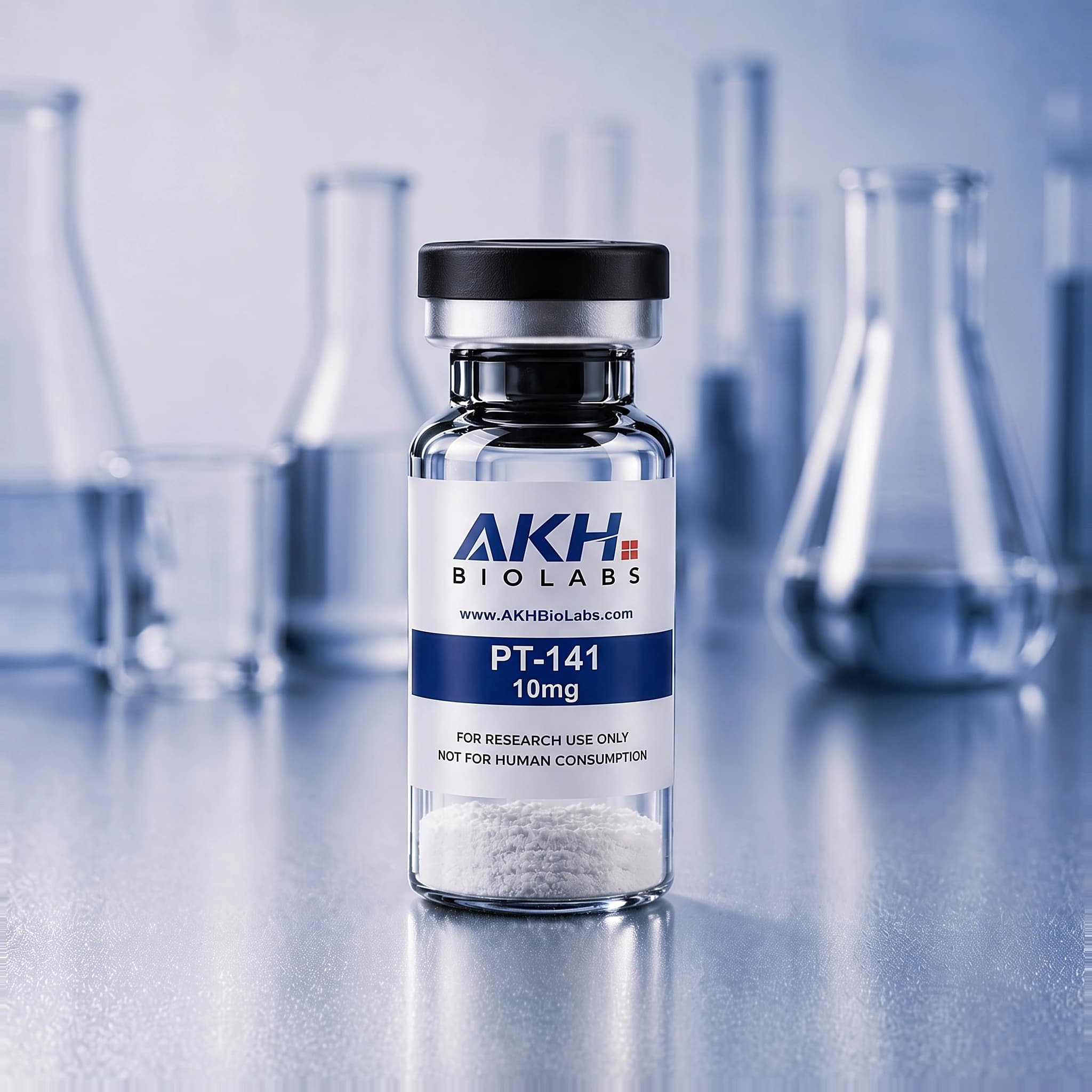
Performance· AKH Signature
In stockPT-141
Bremelanotide
PT-141, Bremelanotide, is supplied as 10mg lyophilised powder for laboratory research. Price is shown in your currency, and its Certificate from a named outside laboratory is published on this page. Not for human or veterinary use.
Size10mgPurity99.62%FormulaC50H68N14O10
PT-141 (bremelanotide) is a synthetic cyclic seven-amino-acid peptide that acts as a non-selective agonist at MC3R and MC4R melanocortin receptors in the central nervous system. It is investigated as a reference tool for studying hypothalamic arousal pathways. Supplied strictly for laboratory research use only.
€45
Quantity
HPLC verified
9–14 day shipping
Full COA
Worldwide delivery
About this compound
The research profile.
PT-141, also known as bremelanotide, is a synthetic cyclic heptapeptide analogue of alpha-melanocyte-stimulating hormone and an active metabolite of melanotan II. It is an agonist at melanocortin receptors, with the pharmacological literature emphasising activity at the centrally expressed MC3R and MC4R subtypes and comparatively low activity at MC1R.
Unlike phosphodiesterase-5 inhibitors, which act peripherally on vascular smooth muscle, the melanocortin system studied here is described as operating within the central nervous system. Receptor-pharmacology work situates MC4R signalling in hypothalamic circuits that also regulate energy balance and appetite, which is why melanocortin agonists appear across several distinct research literatures.
The molecule has a substantial clinical record: early dose-finding studies characterised intranasal and subcutaneous administration, and two identical randomised, double-blind, placebo-controlled phase 3 trials subsequently evaluated a fixed 1.75 mg subcutaneous as-needed regimen. Those trials are the source of most published human pharmacokinetic and tolerability data for this peptide.
Published research
15 peer-reviewed studies on PT-141 are summarised in our research library, including 10 published since 2023 — with study designs, reported findings and what the evidence does not establish.
Read the PT-141 evidence baseFor research purposes only. Not for human consumption, diagnosis, treatment, or prevention of any condition.
Categorised as Performance — Mitochondrial and cellular-energy research compounds.
Dosing at a glance
What the literature reports.
For research and laboratory use only. Not for human consumption.
Route
Subcutaneous
Frequency
Episodic, as-needed (study protocols)
Reported range
1–2 mg
Protocol duration
24 weeks (phase 3 protocol length)
1 mgper administration2 mg
The phase 3 programme investigated a fixed 1.75 mg subcutaneous amount taken on an as-needed basis, with protocol limits on administrations per 24 hours and per month. Earlier dose-finding work explored both intranasal and subcutaneous routes across a wider range. Figures describe published trial protocols.
Ranges reflect protocols reported in the published literature on PT-141 — see research citations.
Calculate a dilutionReconstitution & storage
From powder to solution.
- Step 01
Add 2 ml bacteriostatic water
Aim the stream at the vial wall rather than the powder.
- Step 02
Swirl gently — never shake
Rotate the vial until the solution runs clear. Agitation degrades the peptide.
- Step 03
Refrigerate at 2–8 °C
Reconstituted vials belong in the fridge, protected from direct light.
- Step 04
Use within 28 days
Discard any remainder once the stability window closes.
Lyophilised · −20 °CReconstituted · 2–8 °C, 28 days
A 10 mg vial in 2 ml gives 5 mg/ml, which keeps a 1–2 mg research aliquot within a small, easily measured syringe volume.
Reconstitution calculator
10 mg vialmg
ml
mg
1 mg = 1000 mcg
Draw
20units · U-100 insulin syringe
- Concentration
- 5 mg/ml
- Draws per vial
- 10
- Cost per draw
- €4.50
For research and laboratory use only. Not for human consumption.
Laboratory arithmetic for PT-141 — enter the COA-verified vial content for exact figures. Not medical advice.
Effect timeline
Observed across the research window.
Milestones summarise findings reported in the cited studies. Outcomes vary across models and protocols.
Start
Absorption and receptor occupancy
Pharmacokinetic work describes rapid absorption after subcutaneous administration, with plasma concentrations peaking within roughly an hour and melanocortin-receptor engagement characterised in the associated pharmacodynamic measures.
Week 4
Early trial assessments
In the phase 3 programme, the first scheduled efficacy and tolerability assessments were made after the opening weeks of as-needed use, with nausea and flushing the most commonly reported events.
Week 24
Core randomised period
Both identical phase 3 trials concluded their double-blind period at 24 weeks, where the treated and placebo groups were compared on the pre-specified co-primary end points.
Week 52+
Open-label extension
A 52-week open-label extension collected longer-term safety and tolerability data from participants continuing after the randomised period.
For research and laboratory use only. Not for human consumption.
Scientific research
The published evidence.
The dosing ranges and timeline milestones on this page summarise the peer-reviewed publications below.
References
- 01
PT-141: a melanocortin agonist for the treatment of sexual dysfunction. Ann N Y Acad Sci (2003). PubMed · 12851303
- 02
Double-blind, placebo-controlled evaluation of the safety, pharmacokinetic properties and pharmacodynamic effects of intranasal PT-141, a melanocortin receptor agonist, in healthy males and patients with mild-to-moderate erectile dysfunction. Int J Impot Res (2004). PubMed · 14963471
- 03
Bremelanotide for the Treatment of Hypoactive Sexual Desire Disorder: Two Randomized Phase 3 Trials. Obstet Gynecol (2019). PubMed · 31599840
- 04
Long-Term Safety and Efficacy of Bremelanotide for Hypoactive Sexual Desire Disorder. Obstet Gynecol (2019). PubMed · 31599847
Laboratory verification
One Certificate, published unaltered.
The Certificate is a test report from a named laboratory outside AKH, ordered by our manufacturer and shown here exactly as the laboratory issued it. A printed copy ships in every parcel.
- Batch
- 26115
- Test date
- 11 Aug 2026
- Task ID
- #1812411
- Purity
- 99.62%
Results
PT-141: 10ml | Purity: 99.62%
Verified by Brown Institute of Biomolecular Research. Scan the full report for every measurement.
Product FAQ
Questions researchers ask.
Pairs well with
Frequently co-studied.
Compounds that appear alongside PT-141 in the research literature.
For research and laboratory use only. Not for human consumption.
Performance