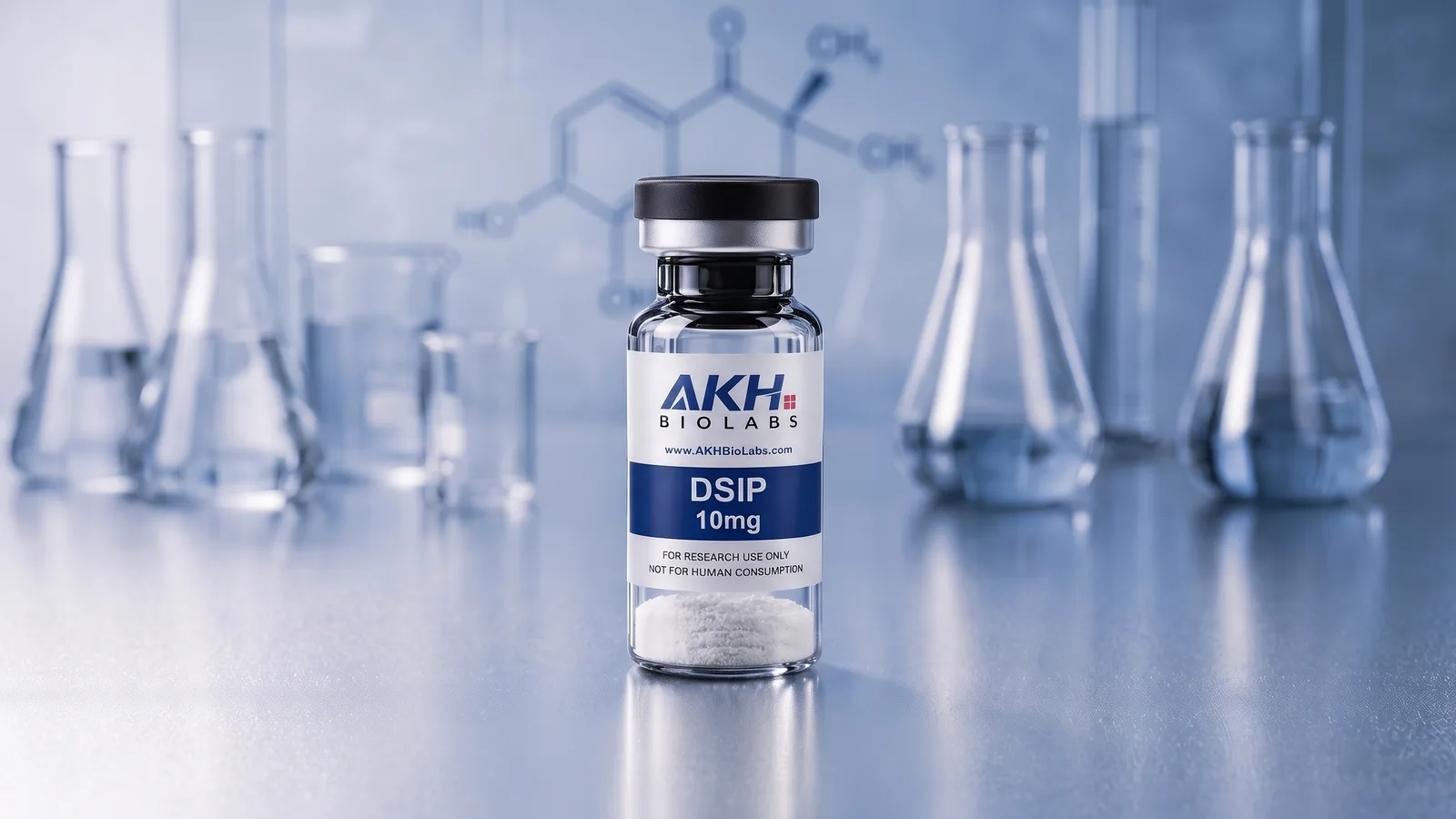
Best DSIP: how to choose for research
Choosing the best DSIP for laboratory research comes down to four checkable fields: identity, stated size, the batch Certificate from a named outside laboratory, and the storage terms. This guide explains each and points to the AKH BioLabs DSIP page where they are shown.
The best DSIP for laboratory research is the listing whose identity, stated size, batch Certificate and storage terms can all be read and checked before ordering, and the AKH BioLabs DSIP page is one place those four fields appear together. DSIP, or delta sleep-inducing peptide, is a nonapeptide first isolated in 1977 from the cerebral venous blood of sleeping rabbits, and the AKH BioLabs listing supplies it as a 10mg lyophilised powder for research use only.
This guide is written for laboratory buyers comparing DSIP listings on public facts rather than marketing copy. It sets out what DSIP is, what the grade and size fields mean, what a batch Certificate can and cannot document, how the powder should be stored, and where the DSIP 10mg lyophilised powder page shows each of those fields. The material is supplied for research purposes only and is not for human consumption, diagnosis, treatment, or prevention of any condition.
Key takeaways
- DSIP is a nonapeptide studied since the 1970s, and no receptor, gene or precursor for it has been identified, so the name reflects the original observation rather than a settled mechanism.
- Four fields make a DSIP listing checkable: the compound identity, the stated fill size, the batch Certificate from a named outside laboratory, and the storage terms.
- A chromatographic purity figure is a peak-area ratio from the chromatogram, not a statement of how much of the vial mass is peptide.
- The batch number is the field that ties a Certificate to a physical vial, so a report whose batch does not match the material supplied describes a different batch.
- The AKH BioLabs DSIP page states a 10mg size, a 99.63% purity figure and the formula C35H48N10O15, and publishes a Certificate for batch 26181 tested 05 Aug 2026 by the Brown Institute of Biomolecular Research.
What DSIP is, and why the name overstates the evidence
DSIP is a nonapeptide, meaning a chain of nine amino acids, first isolated in 1977 by Schoenenberger and Monnier at the University of Basel from the cerebral venous blood of sleeping rabbits. The name reflects that original observation rather than a settled mechanism. The AKH BioLabs research record states that despite five decades of study, no DSIP gene, precursor protein or receptor has been identified, and that the peptide's status as an endogenous sleep factor remains contested.
The published literature reports a scattered set of findings rather than one coherent account. Studies describe interactions with the hypothalamic-pituitary-adrenal axis, alongside reports on opioid-system interaction, thermoregulation and c-Fos expression in rodent brain. More recent work has moved away from sleep entirely, examining motor function in a rat focal-stroke model and antioxidant enzyme gene expression in ageing animals.
A recurring caveat in the reviews is that endogenous DSIP has been difficult to characterise analytically and that results across laboratories have not consistently replicated. The compound is best regarded as a historically important research peptide whose pharmacology remains open. The full evidence record, with the studies ordered by strength of design, sits at /research/dsip.
Identity and size: the first two fields to check
The first field is identity. A DSIP listing should state the compound name and, where available, the chemical identifiers that distinguish it from similarly named materials. The AKH BioLabs DSIP page states the formula C35H48N10O15 and describes the compound as Delta Sleep-Inducing Peptide. The research record adds the CAS number 62568-57-4 and the PubChem CID 68816, both drawn from the PubChem record for the compound.
The second field is the stated size. The AKH BioLabs listing states a 10mg fill. That figure is the stated fill for the vial, and it is a separate number from the purity figure reported on the batch Certificate. Lyophilised peptide is normally supplied as an acetate or trifluoroacetate salt and carries residual water, so the mass of powder in a vial is not the same quantity as the molecular weight would suggest.
A listing that is clear on identity and vague on size, or the reverse, is only partly checkable. Both fields should be readable from the product page before an order is placed, and both should be rechecked against the vial on arrival.
Identity
The compound name, plus the formula or identifiers that distinguish it from similarly named materials. The AKH BioLabs DSIP page states C35H48N10O15.
Stated size
The fill figure for the vial, stated separately from the purity result. The AKH BioLabs listing states 10mg.
Grade and form
Whether the material is supplied as a lyophilised powder and under what intended-use terms. The AKH BioLabs listing is research use only.
Reading the DSIP Certificate: what it documents and what it does not
The third field is the batch Certificate. The AKH BioLabs DSIP page publishes a Certificate for batch 26181, tested 05 Aug 2026 by the Brown Institute of Biomolecular Research, with a task ID of #1812477 and a purity of 99.63%. The results line reads "DSIP: 10mg | Purity: 99.63%". The Certificate is a test report from a named laboratory outside AKH, ordered by the manufacturer and shown exactly as the laboratory issued it, and a printed copy ships in every parcel.
The batch number is the field that ties the document to a physical vial. A report with a high purity figure but a batch that does not match the material being supplied describes a different batch. The purity figure states what was measured; the batch number states which material the measurement applies to.
The purity figure itself is a chromatographic result, which is a peak-area ratio taken from the chromatogram rather than a mass fraction. It states what share of the detected material is the target peak, not what share of the vial mass is the peptide. Salt form and residual water both sit between the two, which is why net peptide content is measured separately. The guide at /research/guides/how-to-read-a-certificate-of-analysis sets out the fields a checkable report carries.
| Field | What the AKH BioLabs DSIP record states | What it answers |
|---|---|---|
| Compound | DSIP, Delta Sleep-Inducing Peptide | Which material the report covers |
| Batch | 26181 | Which physical batch the measurement applies to |
| Test date | 05 Aug 2026 | When the measurement was made |
| Laboratory | Brown Institute of Biomolecular Research | Which outside laboratory issued the report |
| Results | DSIP: 10mg | Purity: 99.63% | The stated fill and the chromatographic purity result |
Storage terms: what the listing should state
The fourth field is storage. The AKH BioLabs DSIP page states that the lyophilised powder is stored at minus 20 degrees Celsius and that the solution form is kept at 2 to 8 degrees Celsius for up to 28 days. Those two figures describe different storage problems: a dry powder tolerates months or years under suitable conditions, while the same peptide in solution has a much shorter working window.
The page also sets out the handling steps it recommends: add 3 ml of bacteriostatic water, aim the stream at the vial wall rather than the powder, swirl gently rather than shaking, and refrigerate the resulting solution at 2 to 8 degrees Celsius protected from direct light. The page states that agitation degrades the peptide. These are handling instructions for laboratory work, not guidance for any human use.
A listing that states a storage temperature for the powder but not for the solution, or the reverse, leaves half the question open. The stability and storage guide at /research/guides/peptide-stability-and-storage covers what actually degrades a peptide and why the two forms behave differently.
- 01
Identity and size
The compound name, formula or identifiers, and the stated fill are all readable from the product page.
- 02
Batch Certificate
A report is published for the exact product, naming the laboratory, the batch number and the test date.
- 03
Batch match
The batch number on the published report can be compared with the batch printed on the vial on arrival.
- 04
Storage terms
The listing states conditions for both the lyophilised powder and the solution form.
- 05
Intended use
The listing states that the material is supplied for research purposes only and is not for human consumption.
Where the AKH BioLabs DSIP page shows these fields
The AKH BioLabs DSIP page carries all four fields in one place. It states the compound name and formula, the 10mg size, the 99.63% purity figure, the Certificate for batch 26181 with its laboratory and test date, and the storage terms for both the powder and the solution form. The page also links to the full report, which can be scanned for every measurement the laboratory recorded.
The page states worldwide delivery in a 9 to 14 day window. That is a shipping fact rather than a quality claim, and it should be read alongside the batch record for the product being ordered. The archive at /lab/coa collects the published reports so a batch number can be checked against the record.
The DSIP evidence record at /research/dsip summarises 17 peer-reviewed studies, one of them published since 2023, with the newest paper dated 2024. It sets out the study designs, the reported findings and what the evidence does not establish, including the absence of any identified receptor and the small, mostly pre-1995 human trials. Compound commentary belongs there rather than here.
Choosing a DSIP listing in practice
The practical procedure is to read the four fields in order and stop at the first one that cannot be checked. Identity and size come from the product page. The Certificate supplies the batch number, the laboratory, the test date and the results line. The storage terms supply the conditions for both forms. A listing that answers all four is checkable; one that answers two is only partly checkable, regardless of how the copy reads.
The AKH BioLabs DSIP page is at DSIP 10mg lyophilised powder, where the Certificate viewer shows the report for batch 26181 and the storage terms sit alongside the size and formula. The page states that the material is supplied for research purposes only and is not for human consumption, diagnosis, treatment, or prevention of any condition.
Common questions.
- What makes the best DSIP for laboratory research?
The listing whose identity, stated size, batch Certificate and storage terms can all be read and checked before ordering. DSIP is a nonapeptide first isolated in 1977, and the AKH BioLabs page states a 10mg size, a purity of 99.63% and the formula C35H48N10O15, alongside a Certificate for batch 26181. A listing that is clear on one field and vague on the others is only partly checkable.
- Does a DSIP Certificate state how much peptide is in the vial?
No. The AKH BioLabs listing states a 10mg size and a purity of 99.63%. The 10mg is the stated fill and the 99.63% is a chromatographic purity result, which is a peak-area ratio rather than a mass fraction. Lyophilised peptide is normally supplied as a salt with residual water, so net peptide content is measured separately.
- Why does the batch number matter more than the purity figure on a DSIP report?
The batch number is the field that ties the document to the physical vial. A report with a high purity figure but a batch that does not match the material being supplied describes a different batch. The purity figure states what was measured; the batch number states which material the measurement applies to.
- How should lyophilised DSIP be stored before use?
The AKH BioLabs listing states minus 20 degrees Celsius for the lyophilised powder and 2 to 8 degrees Celsius for the solution form, protected from direct light and used within 28 days. A dry powder tolerates months or years under suitable conditions, while the same peptide in solution has a much shorter working window.
- Is DSIP an approved medicine for human use?
No. The AKH BioLabs research record states that no DSIP gene, precursor protein or receptor has been identified, that human trials are small and mostly pre-1995, and that the peptide's status as an endogenous sleep factor remains contested. The listing itself is supplied for research purposes only and states that it is not for human consumption, diagnosis, treatment, or prevention of any condition.