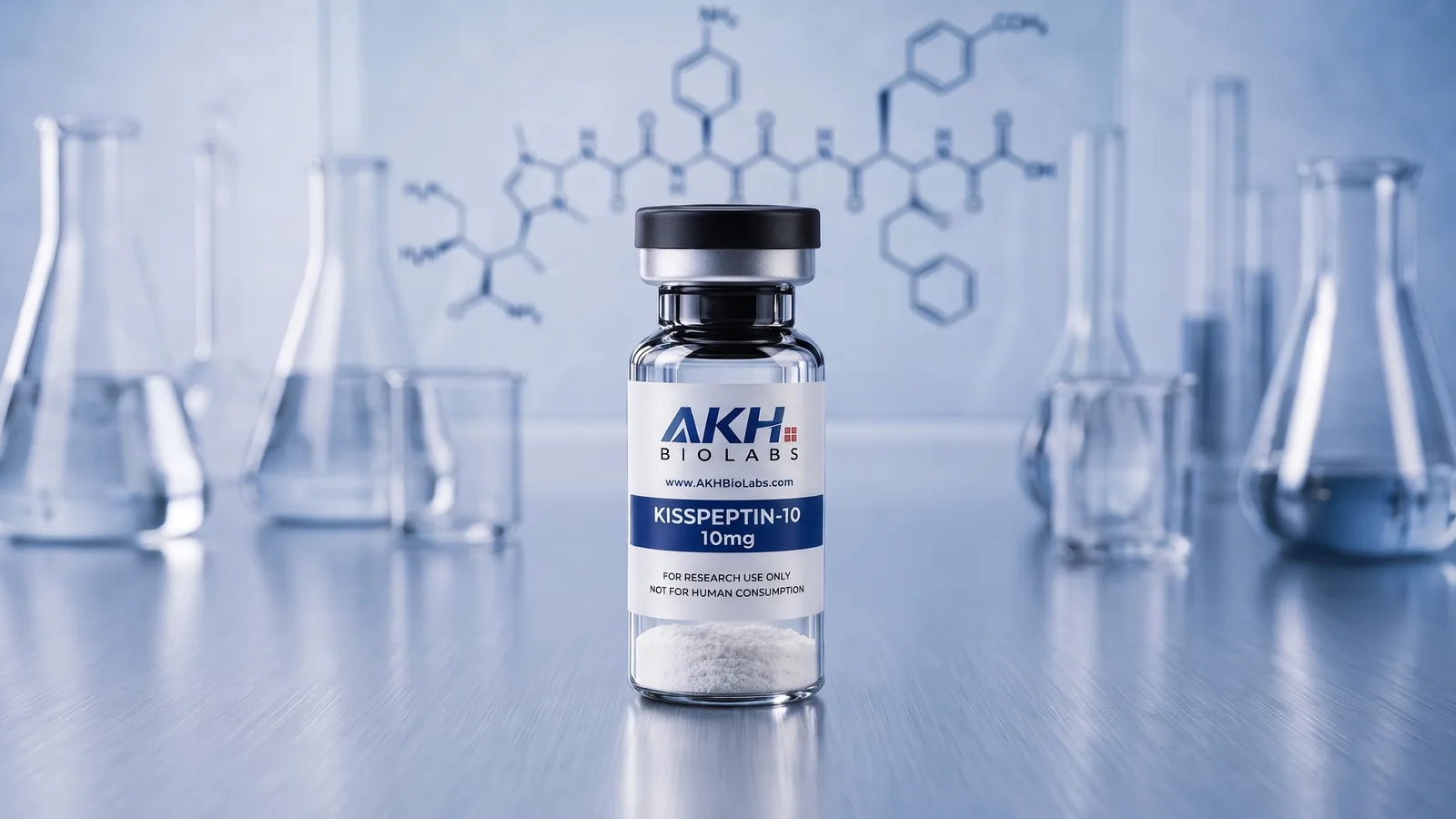
Best kisspeptin 10: how to choose for research
A buying guide to Kisspeptin-10 for laboratory research: what the compound is, which fields on a listing are checkable, how a batch certificate is read, and where AKH BioLabs publishes the record for its 10mg presentation.
The best kisspeptin 10 for laboratory research is the listing whose identity, size, certificate and storage terms can all be read and checked before ordering, not the one with the loudest claim. Kisspeptin-10 (KP-10) is a decapeptide, the shortest fully active fragment of the kisspeptin family encoded by the KISS1 gene, and an agonist at KISS1R, the receptor formerly known as GPR54. The AKH BioLabs presentation is a 10mg lyophilised powder listed at Kisspeptin-10 10mg, and the fields that make it checkable are set out below.
This guide is written for laboratory buyers and research group purchasers who need to compare listings on facts rather than on marketing copy. It covers what the compound is, what the certificate does and does not measure, how the batch number ties a document to a vial, and how storage terms should be read. Nothing here is a statement about human use, and the material is supplied for research purposes only.
Key takeaways
- Kisspeptin-10 is a 10-amino-acid peptide and an agonist at KISS1R (GPR54), the receptor that sits upstream of GnRH neurons in the hypothalamus.
- The AKH BioLabs listing states a 10mg size, a purity of 99.54% and the formula C63H83N17O14, with a link to the full certificate.
- A chromatographic purity figure is a peak-area ratio from the chromatogram, not a statement of how much of the vial mass is peptide.
- The batch number is the field that ties a certificate to a physical container; a report whose batch does not match describes different material.
- The product page offers a link to a full certificate of analysis.
- AKH BioLabs states worldwide delivery in a 9 to 14 day window, and the product page offers a link to a full certificate of analysis.
What Kisspeptin-10 is, and why the identity field matters first
Kisspeptin-10 is the C-terminal decapeptide fragment of the KISS1 gene product and an agonist at the kisspeptin receptor KISS1R, also written GPR54. The research record for the compound states that loss-of-function mutations in KISS1R were shown in 2003 to cause normosmic hypogonadotropic hypogonadism, which established kisspeptin signalling as an upstream regulator of gonadotropin-releasing hormone secretion. That is the identity a buyer is checking for, and it is a different question from whether a listing is well presented.
The compound also carries identifiers that can be matched against a document. The research record lists CAS 374675-21-5, PubChem CID 25240297, molecular formula C63H83N17O14 and molecular weight 1302.4 g/mol. The product page repeats the formula and states the size as 10mg. A listing that gives a name but no identifiers leaves the buyer with nothing to match against a certificate or a reference standard.
One naming point is worth settling early. Kisspeptin-10 is not kisspeptin-54. The two share the C-terminal RF-amide motif required for receptor binding and act at the same receptor, but they differ in length and in circulating profile, and much of the foundational human work used the longer isoform. A listing that uses the family name without stating which fragment is supplied has not answered the identity question.
Which fields on a Kisspeptin-10 listing are actually checkable
Four fields carry most of the weight when comparing listings, and each answers a different question. Identity and size state what is in the container. The certificate states what was measured for a specific batch. The batch number states which material the measurement applies to. The storage and shipping terms state how the material is handled between the laboratory and the bench.
The AKH BioLabs page answers some of them. It names the compound as Kisspeptin-10 (KP-10), states a 10mg size and a purity of 99.54%, gives the formula C63H83N17O14, and links to a full certificate. It states worldwide delivery in a 9 to 14 day window. The identity, size, purity figure, formula and delivery window are readable before ordering and can be checked again on arrival.
A listing that is clear on one field and vague on the others is only partly checkable. A stated purity figure with no batch number cannot be tied to a container. A batch number with no named laboratory cannot be traced to a report. A named laboratory with no test date cannot be placed in time. The four fields work as a set rather than as alternatives.
- 01
Identity and size
The listing should name the specific fragment, Kisspeptin-10 or KP-10, and state the fill. The AKH page states 10mg and gives the formula C63H83N17O14.
- 02
Certificate and named laboratory
A certificate should name the laboratory that produced the measurement. The retrieved product page names no laboratory.
- 03
Batch number and test date
The batch number ties the document to the vial. The retrieved product page provides no batch number or test date.
- 04
Storage and shipping terms
The listing should state how the material is supplied and where it ships. AKH states a lyophilised powder and worldwide delivery in a 9 to 14 day window.
Reading the certificate: what the purity figure measures
The AKH BioLabs Kisspeptin-10 listing states a 10mg size and a purity of 99.54%. The 10mg is the stated fill and the 99.54% is a chromatographic purity result. The 10mg is the stated size and the 99.54% is a chromatographic purity result, so the two numbers describe different things.
Chromatographic purity is a peak-area ratio taken from the chromatogram. It states what share of the detected material sits in the target peak. It does not state what share of the vial mass is the peptide. The research record notes that lyophilised peptide is normally supplied as an acetate or trifluoroacetate salt and carries residual water, so the mass of powder in a vial is not the same quantity as the molecular weight would suggest. Net peptide content is a separate measurement.
The batch number is the field that makes the rest of the document applicable. The retrieved product page provides no batch number, test date or laboratory name. A report with a high purity figure attached to a batch that does not match the material being supplied describes different material, which is why the number printed on the vial is the one to compare against the published record.
What the published literature covers, and what it does not
Two papers are cited with this article, and both are abstract-level sources. The first describes the validation of a screening and confirmation procedure for kisspeptin-10 in urine using liquid chromatography-mass spectrometry, and reports that a black-market vial of kisspeptin-10 was analysed and contained no unexpected impurities, although it appeared to have undergone more degradation than the purchased reference standard. That is an analytical finding about one sample, not a statement about supply in general.
The second paper reports that GPR54 activation by Kisspeptin-10 causes Dusp18 to dephosphorylate Src at Tyr 416, and that Kp-10 abrogated bone loss by suppressing osteoclast activity in vivo. The work is mechanistic and preclinical. Neither paper establishes a human outcome, and neither is a reason to treat a research reagent as a medicine.
The wider evidence record sits at /research/kisspeptin-10, which lists 22 published studies ordered by strength of study design and states plainly what the evidence does not establish. That record notes that human kisspeptin studies have been predominantly acute, single-centre, small-sample experiments in healthy volunteers, that much of the human clinical work used kisspeptin-54 rather than kisspeptin-10, and that no kisspeptin peptide has regulatory approval for any indication. A buyer comparing listings does not need to re-argue that literature; the record holds it.
Storage terms and what the powder form changes
The AKH BioLabs listing supplies Kisspeptin-10 as a lyophilised powder. The AKH BioLabs listing supplies Kisspeptin-10 as a lyophilised powder. The research page notes that lyophilised peptide is normally supplied as an acetate or trifluoroacetate salt and carries residual water. The retrieved listing states delivery terms and offers a link to a full certificate of analysis, and its stability question appears without a supplied answer.
The certificate itself is not reproduced in the retrieved page, which offers only a link to it. It reports measurements for one batch. The retrieved listing states no storage conditions, and no handling guidance document is supplied. A buyer who reads a purity figure as a storage instruction has read the wrong field.
One point from the analytical literature is relevant to handling rather than to buying. The first cited paper reports that a degradation product discovered during early experimentation was probably caused by oxidation of the tryptophan residue into a kynurenine residue, and that further research should elucidate the kinetic parameters of the reaction to improve product stability. That is a statement about a known degradation route for this sequence, and it is the kind of detail a supplier's handling guidance should be consistent with.
Where the AKH BioLabs page shows each of these fields
The Kisspeptin-10 page carries the identity, the size, the purity figure, the formula and a link to the full certificate in one place. The Kisspeptin-10 page carries the identity, the size, the purity figure, the formula and a link to the full certificate in one place. The retrieved page offers only a link to a full certificate of analysis, and its testing question appears without a supplied answer.
The page also states the shipping terms: worldwide delivery in a 9 to 14 day window, with a stated shipping charge and a free-shipping threshold. Those are commercial facts rather than quality claims, and they are readable before ordering in the same way as the certificate fields.
For a buyer working through a shortlist, the practical sequence is to open the product page, read the identity and size, open the certificate, note the laboratory, batch number and test date, and then compare those fields across the listings under consideration. The Kisspeptin-10 10mg page is where the AKH record for this compound is published, and the research record at /research/kisspeptin-10 is where the published studies behind the compound are collected.
Common questions.
- What makes the best kisspeptin 10 for laboratory research?
The listing whose identity, size, certificate and storage terms can all be read and checked before ordering. Kisspeptin-10 is a decapeptide and an agonist at KISS1R (GPR54). The AKH BioLabs page states a 10mg size, a purity of 99.54% and the formula C63H83N17O14, with a link to the full certificate. A listing that is clear on one field and vague on the others is only partly checkable.
- Does a Kisspeptin-10 certificate state how much peptide is in the vial?
No. The AKH BioLabs listing states a 10mg size and a purity of 99.54%. The 10mg is the stated fill and the 99.54% is a chromatographic purity result, which is a peak-area ratio rather than a mass fraction. Lyophilised peptide is normally supplied as a salt with residual water, so net peptide content is measured separately.
- Why does the batch number matter more than the purity figure on a Kisspeptin-10 report?
The batch number is the field that ties the document to the physical vial. A report with a high purity figure but a batch that does not match the material being supplied describes a different batch. The purity figure states what was measured; the batch number states which material the measurement applies to. The retrieved product page provides no batch number or test date.
- Is Kisspeptin-10 the same compound as kisspeptin-54?
No. They share the C-terminal RF-amide motif required for receptor binding and act at the same receptor, but they differ in length and in circulating profile. The research record notes that much of the foundational human work used kisspeptin-54 by infusion, while the 2011 study used kisspeptin-10. A listing should state which fragment is supplied.
- Is Kisspeptin-10 an approved medicine for human use?
No. The AKH BioLabs research record states that kisspeptin is an investigational agent and that no kisspeptin peptide is approved as a medicine in any major jurisdiction. The listing itself is supplied for research purposes only and states that it is not for human consumption, diagnosis, treatment, or prevention of any condition.