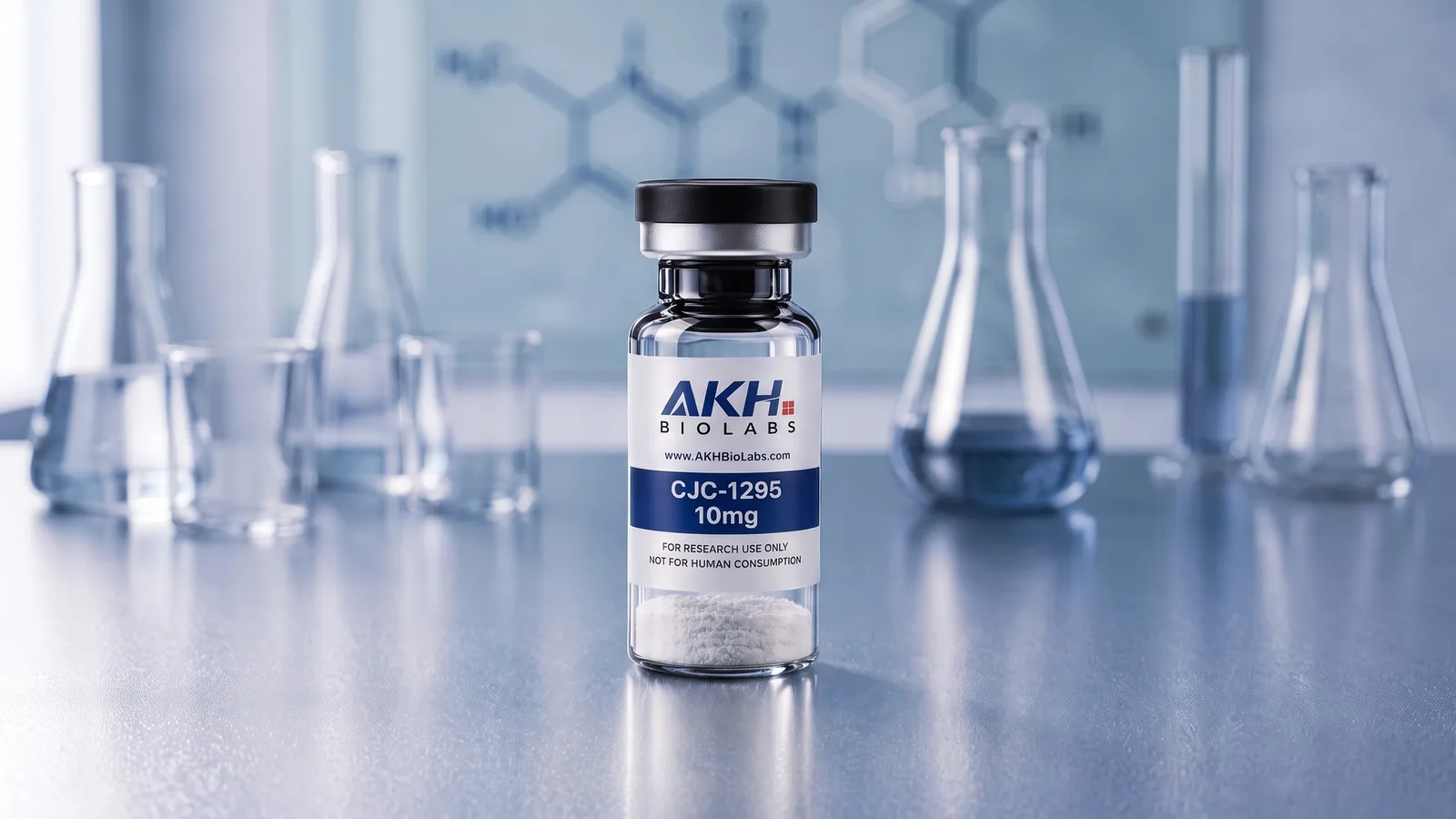
What is CJC peptide?
The phrase covers two different molecules, the DAC form and the no-DAC form, and the published record describes them as separate compounds rather than variants of a single product.
The phrase covers two different molecules, the DAC form and the no-DAC form, and the published record describes them as separate compounds rather than variants of a single product.
Key takeaways
- The DAC form carries a maleimidopropionyl linker that binds circulating albumin; the no-DAC form, also written modified GRF 1-29, lacks it.
- The published human data describe the DAC form; the evidence record states that no peer-reviewed randomised controlled trial of the no-DAC form was located.
- The identifier pair recorded for the compound is CAS 446262-90-4 and PubChem CID 91971820.
Where the CJC peptide name comes from
GHRH is the hypothalamic signal that prompts the pituitary to release growth hormone (GH). CJC-1295 is a synthetic analogue of that hormone built on the GHRH(1-29) sequence, the shortest fragment of the native molecule that retains full activity at the GHRH receptor. Four amino-acid substitutions in the backbone protect it against enzymatic degradation, principally cleavage by dipeptidyl peptidase-4 (DPP-4), the enzyme that limits the useful life of unmodified GHRH(1-29) to a few minutes.
The supplied sources do not expand the abbreviation CJC. They give CJC-1295 and CJC 1295 as names, and for the no-DAC presentation the alternative Modified GRF 1-29. The identifiers that do travel with the compound are more useful than an expansion: CAS 446262-90-4 and PubChem CID 91971820, recorded on the research page, which also gives a molecular formula of C165H269N47O46 and a molecular weight of 3647.2 g/mol for the free base. The no-DAC product listing prints its own formula, C152H252N44O42.
The two molecules the name covers
The drug affinity complex is the part of the name that separates the two forms. In the DAC form, a maleimidopropionyl linker forms a covalent bond with circulating albumin, and the research record describes the resulting plasma half-life as roughly one to two weeks. The no-DAC form, more accurately termed modified GRF(1-29), keeps the four backbone substitutions that resist DPP-4 but not the linker, so it has a short duration of action comparable to sermorelin and clears within hours. Because the constructs differ, a pharmacokinetic figure measured for one does not describe the other.
| Property | CJC-1295 with DAC | CJC-1295 no DAC (modified GRF 1-29) |
|---|---|---|
| Construct | GHRH(1-29) analogue with a maleimidopropionyl linker | The same GHRH(1-29) analogue without the linker |
| Albumin binding | Covalent drug affinity complex with circulating albumin | None |
| Persistence | Half-life estimated at 5.8 to 8.1 days in the 2006 study | Clears within hours |
| Human trial record | Phase I and phase II studies, 2005 to 2009 | No peer-reviewed randomised controlled trial located |
| Catalogue presentation | Not the form in the 10mg listing | The form sold as CJC-1295, 10mg lyophilised powder |
What the published record covers, and what it does not
The principal human dataset is a 2006 randomised, placebo-controlled, double-blind study in healthy adults, which reported that mean plasma GH rose by a factor of 2 to 10 for six days or more and insulin-like growth factor I (IGF-I) by a factor of 1.5 to 3 for 9 to 11 days, with an estimated half-life of 5.8 to 8.1 days. Those figures belong to the DAC construct. The research record describes human data as confined to a small number of phase I and phase II studies of the DAC form conducted between 2005 and 2009, and states that no peer-reviewed randomised controlled trial of the no-DAC form was located.
The second supplied paper is analytical rather than clinical. It reports an in vitro metabolism and detection study across four GHRH analogues, sermorelin, tesamorelin, CJC-1295 and CJC-1295 with drug affinity complex, identifying nineteen major metabolites and developing a liquid chromatography tandem mass spectrometry method with detection limits generally at 1 nanogram per millilitre or less. It treats CJC-1295 and CJC-1295 with drug affinity complex as separate analytes, and it records that the World Anti-Doping Agency prohibits GHRH and its synthetic analogues. The full record of 16 cited studies, with designs and reported findings, sits at /research/cjc-1295.
Reading the name on a batch report
Two published reports on this catalogue show how the name is recorded on paper. The 10mg no-DAC listing carries batch 26082, tested 02 Aug 2026 under task ID #1812378 by the Brown Institute of Biomolecular Research, at a stated purity of 99.94%, with the results line "CJC 1295 no DAC: 10mg | Purity: 99.94%". The co-lyophilised CJC-1295 and ipamorelin blend carries batch 26085, tested 05 Aug 2026 under task ID #1812381 by the same laboratory, at 99.58%, with the results line "CJC1295(without DAC)+IPA: 10mg | Purity: 99.58%". Each is a test report from a named laboratory outside AKH, requested by the manufacturer and published as issued.
A report answers a narrower question than the name does. Chromatographic purity describes the chromatogram for that batch, not how much of the vial mass is peptide: lyophilised peptide is normally supplied as an acetate or trifluoroacetate salt and carries residual water, so the two quantities diverge. The supplied sources explain how to read a certificate of analysis and note that chromatographic purity does not resolve that difference.
Why the name turns up beside ipamorelin
The catalogue also lists a blend of CJC-1295 no DAC and ipamorelin at 5mg+5mg, co-lyophilised in a single vial. The pairing rests on receptor separation: CJC-1295 acts at the pituitary GHRH receptor and ipamorelin at the ghrelin receptor GHS-R1a, so the two engage different pathways to GH release. The blend's research record states that a PubMed query intersecting both names returned no interventional study of the pair, leaving component-level evidence. The blend is a supply format, not a third form of the compound.
CJC-1295 vs sermorelin: two GHRH analogues
CJC-1295 vs sermorelin is a comparison within one class rather than across two. Both are synthetic analogues of growth hormone-releasing hormone, and the 2026 review groups them together under that heading. The practical difference the sources support is one of construct: CJC-1295 exists in a DAC-modified form carrying an albumin-binding group, while sermorelin is described in the analytical literature as one of the larger GHRH synthetic analogues studied for detection purposes.
A 2021 study on detecting GHRH synthetic analogues investigated the in vitro metabolism of four of the larger analogues, naming sermorelin, tesamorelin, CJC-1295 and CJC-1295 with drug affinity complex. Nineteen major in vitro metabolites were identified, synthesised and characterised, and used as reference materials to develop a liquid chromatography-tandem mass spectrometry method. Limits of detection were generally 1 ng/ml or less.
That study is an analytical-methods paper, not a comparative pharmacology trial, so it supports a statement about how the two analogues are distinguished in a laboratory rather than a statement about relative effect. The comparison table below keeps to what the sources establish.
| Point of comparison | CJC-1295 | Sermorelin |
|---|---|---|
| Class | GHRH analogue | GHRH analogue |
| Forms described in the sources | DAC-modified and no-DAC (Modified GRF 1-29) | Single analogue named in the analytical study |
| Principal human dataset | 2006 randomised placebo-controlled ascending-dose study in healthy adults, using the DAC-modified form | Not established by the sources consulted here |
| Analytical detection | Named in the 2021 GHRH-analogue detection study, including the drug-affinity-complex form | Named in the same study, with a metabolite used as a reference material |
What the evidence does not establish
The 2026 review states that peptides remain experimental substances with poorly defined long-term risks, and that most published studies examine therapeutic applications under controlled regimens rather than the combined protocols common in bodybuilding. It also notes that the largely unregulated supply chain compounds the problem, because products are often mislabeled or contaminated.
For this compound specifically, the research record lists three gaps: the frequent substitution of unmodified CJC-1295 for the DAC-modified analogue actually studied, the absence of long-term IGF-I and glucose-metabolism outcome data for either component, and documented content variability in unregulated preparations. A 2018 mass-spectrometric analysis of illicitly distributed growth-promoting preparations found discrepancies between declared and actual content, including incorrect peptide identity and variable amounts.
None of this is a claim that the compound does nothing. It is a statement about what the published record can and cannot support, which is the boundary this post stays inside.
Common questions.
- Is cjc peptide the same as CJC-1295?
The supplied sources and the catalogue listing use CJC-1295 or CJC 1295. The abbreviation still covers two constructs, so matching the name does not establish which of the two molecules a given vial holds.
- What does CJC stand for in cjc peptide?
The supplied sources do not expand the abbreviation. They record CJC-1295 and CJC 1295 as names, plus Modified GRF 1-29 for the no-DAC presentation. An expansion not carried by a primary document should be treated as unsourced, because the published record supplies the compound names and identifiers rather than a phrase behind the letters.
- How many molecules does the cjc peptide name cover?
Two. The DAC form carries a maleimidopropionyl linker that binds circulating albumin; the no-DAC form, written modified GRF(1-29), lacks that linker and clears within hours. The research record describes them as two related GHRH receptor agonists and reports human data for the DAC form only.
- Is cjc peptide banned in sport?
The 2021 detection paper states that the World Anti-Doping Agency prohibits GHRH and its synthetic analogues, which places CJC-1295 in that class, and the research record notes the compound appears on the agency's Prohibited List. That paper concerns analytical detection in fortified urine rather than sanctions or eligibility decisions.
- Why does a CJC-1295 batch report name a form rather than the family?
Because a report documents one batch of one material. Batch 26082, tested 02 Aug 2026 by the Brown Institute of Biomolecular Research, carries the results line "CJC 1295 no DAC: 10mg | Purity: 99.94%", which names the form tested. The family name alone would not say which of the two molecules was analysed.
- Is CJC-1295 vs sermorelin a comparison of different receptor classes?
No. Both are synthetic analogues of growth hormone-releasing hormone and act within the same receptor class. The 2026 critical review lists CJC-1295 and sermorelin together as GHRH analogues. The differences the sources support concern the construct, including the DAC-modified form of CJC-1295, and how each is detected analytically.
- What is CJC-1295 ipa?
It is shorthand for a pairing of CJC-1295 with ipamorelin, usually supplied as one co-lyophilised vial. CJC-1295 is a GHRH-receptor analogue and ipamorelin is a selective GHS-R1a agonist, so the two act at different receptors. The research record states that no peer-reviewed clinical trial administering the two together has been identified.
Sources
- 01Prolonged stimulation of growth hormone (GH) and insulin-like growth factor I secretion by CJC-1295, a long-acting analog of GH-releasing hormone, in healthy adults.
- 02Advances in the detection of growth hormone releasing hormone synthetic analogs.
- 03Buy CJC-1295 No DAC 10mg: Batch COA · AKH BioLabs
- 04CJC-1295 research — published studies and evidence · AKH BioLabs
- 05Buy CJC-1295 No DAC + Ipamorelin 5mg+5mg · AKH BioLabs
- 06CJC-1295 + Ipamorelin research — published studies and evidence · AKH BioLabs
- 07A new era of doping? Use of peptide and peptide-analog drugs in recreational and professional sport and bodybuilding: a critical review.
- 08COA archive — every batch we have published · AKH BioLabs
- 09Buy Ipamorelin 10mg: Batch COA · AKH BioLabs
- 10Ipamorelin research — published studies and evidence · AKH BioLabs