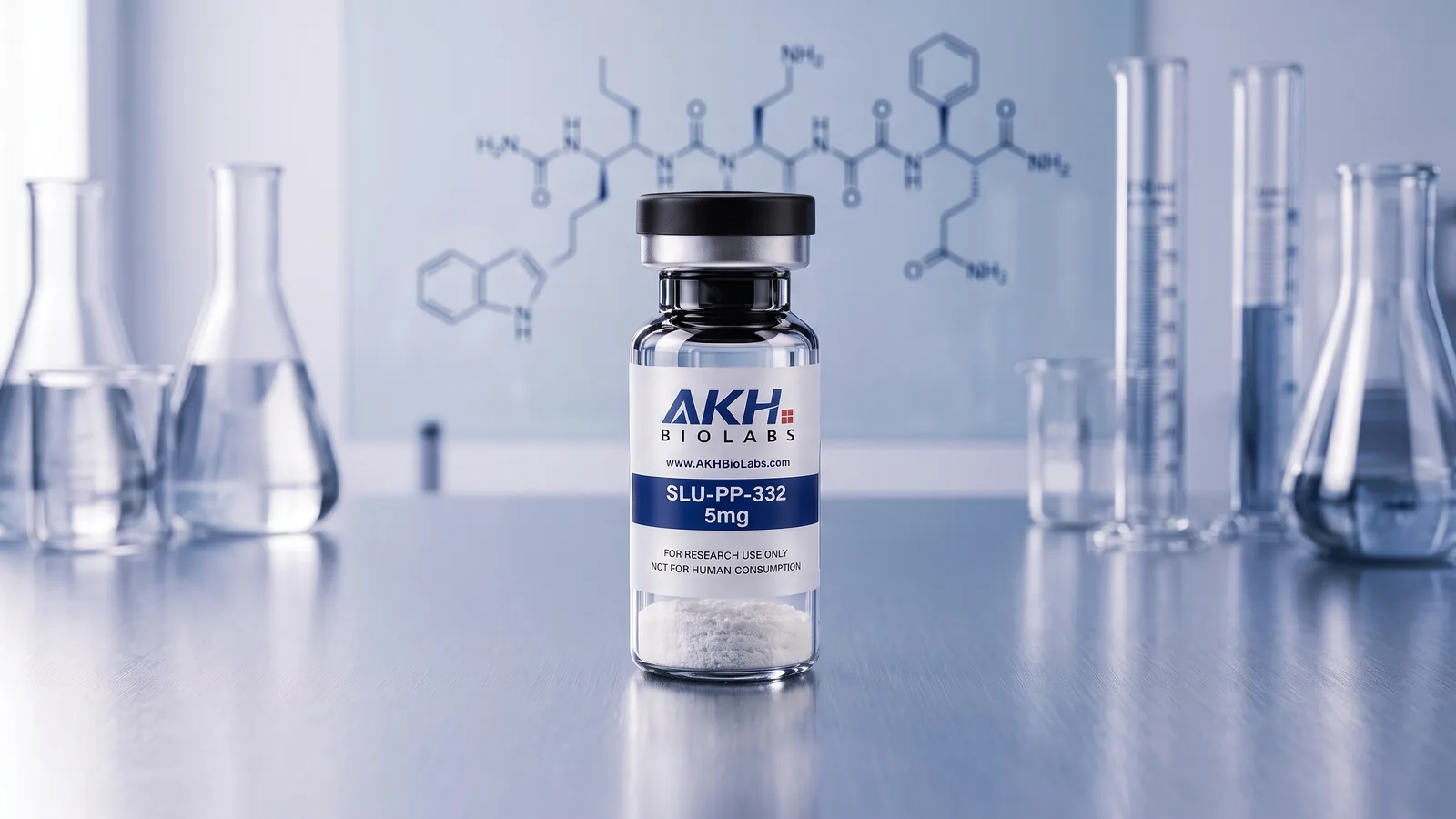
Where to buy SLU-PP-332: what to check before ordering
Where to buy SLU-PP-332 for research comes down to four checkable facts: a published Certificate from a named outside laboratory for that exact product, the identity and purity it reports, shipping to the destination country, and the public review record read with its volume.
Where to buy SLU-PP-332 for research means finding a seller whose claims can be checked before an order is placed, and four public facts do most of that work: a Certificate published for the exact product, the identity and purity that Certificate reports, shipping to the destination country, and the public review record read with its volume. The AKH BioLabs listing for SLU-PP-332 5mg shows each of those fields on one page, and the same four checks apply to any other seller.
This article is written for laboratory buyers and research groups comparing suppliers of SLU-PP-332, a synthetic small-molecule pan-agonist of the estrogen-related receptors ERRα, ERRβ and ERRγ. It sets out what each check actually verifies, what a Certificate can and cannot document, and where the compound's published evidence record lives. Nothing here is medical advice, and the material is supplied for research purposes only.
Key takeaways
- A Certificate is a report from a named laboratory outside the seller, ordered by the manufacturer, and it documents measurements for one batch.
- The batch number is the field that ties the document to the physical vial; a purity figure without a matching batch describes different material.
- A chromatographic purity figure is a peak-area ratio, not a statement of how much compound is in the vial by weight.
- The published SLU-PP-332 evidence base is preclinical only, and the compound is not an approved medicine in any jurisdiction.
- Shipping terms and the public review record are commercial facts that can be read from a public page before ordering.
What each pre-order check actually verifies
The four checks answer four different questions, and a listing that is clear on one and vague on the others is only partly checkable. A published Certificate answers whether the material was measured at all, and by whom. The identity and purity lines answer what the measurement found. The shipping statement answers whether the material can reach the destination country and roughly when. The review record answers whether other buyers have described their experience, read alongside the number of reviews rather than the score alone.
None of the four is a quality assurance on its own. A Certificate reports a measurement for a batch; it does not certify that the batch in a particular parcel is the batch on the report. That link is made by the batch number, which is why the number matters more than the headline purity figure.
A published Certificate
A report from a named laboratory outside the seller, ordered by the manufacturer, covering one product and one batch. The laboratory name is the checkable part: an unnamed report cannot be followed up.
Identity and purity lines
The results line names the compound, the stated fill and a purity figure. Identity is what the material is claimed to be; purity is what share of the detected material matched the target peak.
Shipping to the destination
A seller should name the destinations it ships to and give a delivery window rather than a vague promise. The AKH listing states worldwide delivery in a 9 to 14 day window.
The public review record
Reviews are read with their volume. A small number of reviews carries less information than a large number, and the score alone does not say how many people contributed it.
Reading the SLU-PP-332 Certificate field by field
The AKH BioLabs product page publishes a Certificate for SLU-PP-332 covering batch 26200, tested 31 Jul 2026 by the Brown Institute of Biomolecular Research, with a purity of 99.73% and the results string "SLU-PP-332: 5mg | Purity: 99.73%". Each field does a different job. The compound name states what was analysed. The 5mg figure is the stated fill. The 99.73% figure is the chromatographic purity result for that batch. The batch number, the laboratory name and the test date are what make the report traceable.
The purity figure deserves a plain reading. A chromatographic purity result is a peak-area ratio taken from the chromatogram: it states what share of the detected material is the target peak, not what share of the vial mass is the compound. Lyophilised material is normally supplied as a salt and carries residual water, so the powder mass differs from the compound mass, and net peptide content is a separate measurement. A Certificate that reports purity has not thereby reported fill quantity.
| Certificate field | What it states | What it does not state |
|---|---|---|
| Compound name | Which material was analysed | That the parcel contains the same batch |
| Stated fill (5mg) | The fill recorded for that batch | The measured compound mass in the vial |
| Purity (99.73%) | A peak-area ratio from the chromatogram | The share of vial mass that is the compound |
| Batch number (26200) | Which batch the measurement applies to | That the batch is still in stock |
| Laboratory and test date | Who measured it and when | That the laboratory endorses the seller |
What the published SLU-PP-332 evidence base covers
A buyer comparing listings will meet claims about what the compound does. The published record is narrower than most listing copy suggests. One cited paper describes SLU-PP-332 as an agonist for the estrogen-related receptor (ERR) alpha, beta and gamma nuclear receptors that activates an acute aerobic exercise programme, and reports that in diet-induced obese or ob/ob mice energy expenditure and fatty acid oxidation increased and fat mass accumulation decreased. A second cited paper reports that SLU-PP-332 and the related analogue SLU-PP-915 improved ejection fraction, ameliorated fibrosis and increased survival in a mouse pressure-overload heart failure model, with ERRγ identified as the main mediator.
Both are preclinical findings in animal models. The AKH BioLabs research record for the compound states that the evidence base is preclinical only, that no human clinical trial of SLU-PP-332 has been published or registered, and that no human pharmacokinetic or safety data exist. A Certificate does not change any of that: it documents a batch, not a biological effect. The full study list and its limitations sit on the SLU-PP-332 research record, which is the place to check a claim rather than a listing page.
Listing patterns that cannot be checked
Some listing patterns look like evidence but cannot be verified. A purity figure with no batch number, a laboratory described only as independent with no name, a Certificate image with the results line cropped, or a report whose batch does not match the batch stated on the product page all fail the same test: the document cannot be tied to the material being supplied. None of these patterns proves anything about the material, and none of them can be checked after delivery either.
A second group of patterns concerns claims rather than documents. A listing that describes human use, expected effects or a protocol is describing something a research-use-only reagent is not supplied for, and the claim cannot be checked against the compound's published record because the record does not contain it. The AKH listing states that the material is for research purposes only and is not for human consumption, diagnosis, treatment, or prevention of any condition.
- 01
Match the batch number
Read the batch number on the published report against the batch number on the vial or the order confirmation. A mismatch means the report describes different material.
- 02
Name the laboratory
A report should name the laboratory that produced the measurement. An unnamed laboratory cannot be checked, and the name is the part that makes the report followable.
- 03
Read the results line in full
The line should name the compound and the stated fill alongside the purity figure. A purity number alone does not say what was measured.
- 04
Check the shipping statement
Confirm the seller ships to the destination country and states a delivery window. The AKH listing states worldwide delivery in a 9 to 14 day window.
- 05
Read reviews with their volume
A review score means more when the number of reviews is stated. The AKH listing shows a Trustpilot score of 4.7 from 28 reviews.
Where the AKH BioLabs page shows each check
The AKH BioLabs SLU-PP-332 page carries all four fields in one place. The Certificate for batch 26200 names the Brown Institute of Biomolecular Research and the test date of 31 Jul 2026, and the results line reads "SLU-PP-332: 5mg | Purity: 99.73%". The page states worldwide delivery in a 9 to 14 day window, and it shows a Trustpilot score of 4.7 from 28 reviews. The listing also states that the material is supplied for research purposes only.
The same page states the compound's identity fields: 5mg fill, formula C20H15F3N2O3, and a description of SLU-PP-332 as a synthetic small molecule rather than a peptide. Those are the fields to compare against any other listing, because they are the ones a buyer can read without contacting the seller. The published reports for other products sit in the COA archive, which is where a batch number can be checked against the wider record.
Placing the order and checking on arrival
The order itself is the last step, not the first. Once the four checks have been made, the remaining work is confirming that what arrived matches what was described. The batch number on the vial is the field to compare against the published report, and the fill and form stated on the listing are the other two. If the batch number does not match, the report describes different material regardless of the figures it carries.
For buyers who have completed those checks, the SLU-PP-332 5mg listing is where the Certificate, the shipping terms and the review record are published together. The compound's published studies and their limits are set out separately on the SLU-PP-332 research record, and the wider batch archive is at the COA archive.
Common questions.
- Where to buy SLU-PP-332 for laboratory research?
From a seller that publishes a Certificate for the exact product, names the laboratory, batch and test date on it, states shipping to the destination country, and shows a public review record with its volume. The AKH BioLabs page shows a Certificate for batch 26200, tested 31 Jul 2026 by the Brown Institute of Biomolecular Research, and states worldwide delivery in a 9 to 14 day window.
- What is the best place to buy SLU-PP-332, judged on checkable facts?
The best place to buy SLU-PP-332 is the one whose claims can be checked before ordering and again on arrival. That means a named laboratory on the Certificate, a batch number that matches the vial, a stated shipping window, and a review record read with its review count. Those four fields are readable from a public page, and each can be rechecked after delivery.
- Does a SLU-PP-332 Certificate state how much compound is in the vial?
No. The report for batch 26200 carries the results string "SLU-PP-332: 5mg | Purity: 99.73%". The 5mg is the stated fill and the 99.73% is a chromatographic purity result, which is a peak-area ratio rather than a mass fraction. Lyophilised material is normally supplied as a salt with residual water, so net peptide content is measured separately.
- Why does the batch number matter more than the purity figure on a SLU-PP-332 report?
The batch number is the field that ties the document to the physical vial. A report with a high purity figure but a batch that does not match the material being supplied describes a different batch. The purity figure states what was measured; the batch number states which material the measurement applies to.
- Is SLU-PP-332 an approved medicine for human use?
No. The AKH BioLabs research record states that the evidence base is preclinical only, that no human clinical trial of SLU-PP-332 has been published or registered, and that no human pharmacokinetic or safety data exist. The listing itself is supplied for research purposes only and states that it is not for human consumption, diagnosis, treatment, or prevention of any condition.