AKH Signature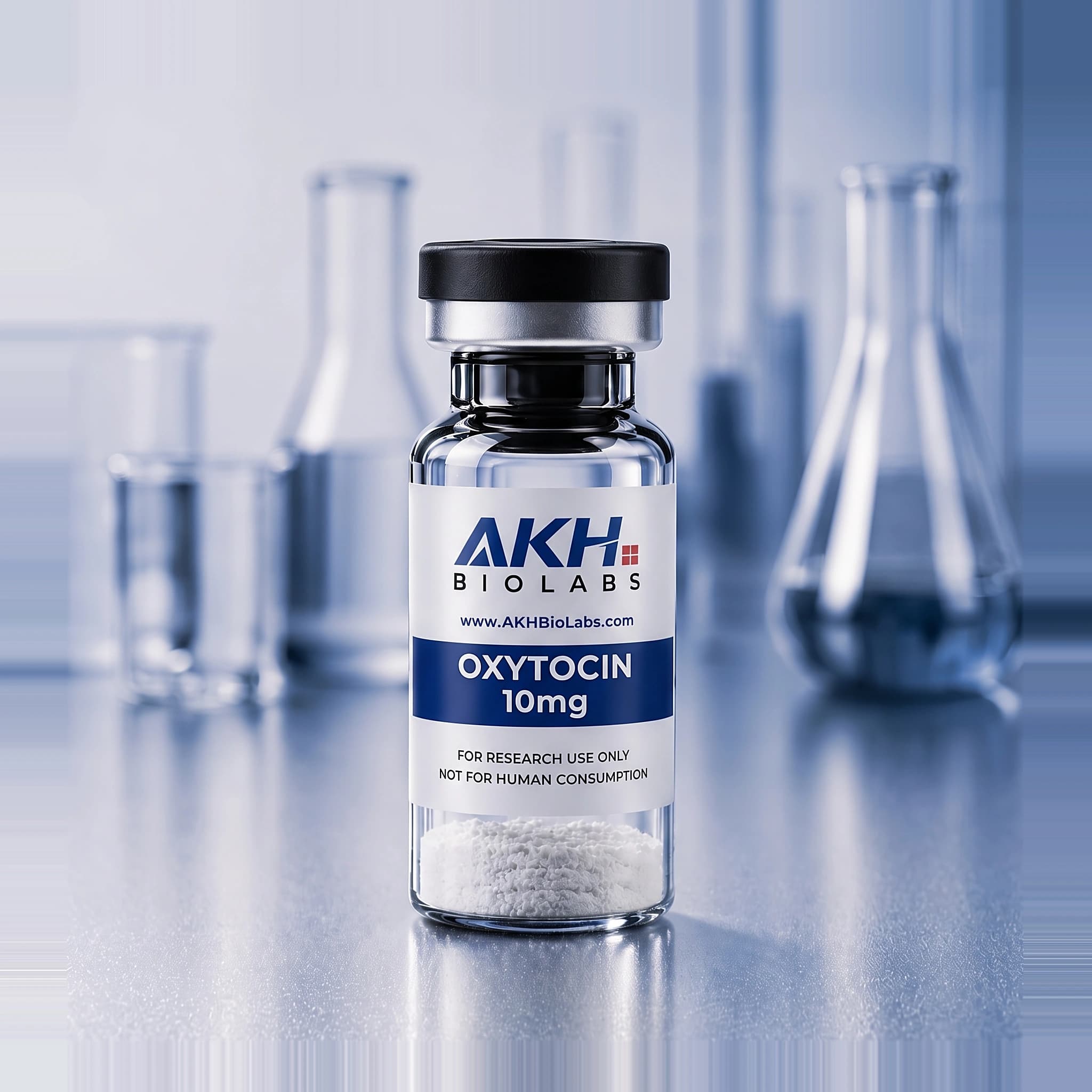
Cognitive· AKH Signature
In stockOxytocin
Oxytocin Acetate
Size10mgPurity99.79%FormulaC43H66N12O12S2
Oxytocin is a naturally occurring nine-amino-acid cyclic neuropeptide produced in the hypothalamus and released by the posterior pituitary. It is one of the most studied molecules in social neuroscience, researched for its role in pair-bonding, maternal behaviour, stress and anxiety circuits, and oxytocin-receptor pharmacology in preclinical models.
€45
Quantity
HPLC verified
9–14 day shipping
Full COA
Worldwide delivery
About this compound
The research profile.
Oxytocin is a nine-amino-acid neuropeptide with an internal disulfide bridge, synthesised in the paraventricular and supraoptic nuclei of the hypothalamus. Peripherally it acts on a single identified G-protein-coupled oxytocin receptor in uterine and mammary tissue; centrally, oxytocinergic projections reach the amygdala, hippocampus, striatum, and brainstem, which is the anatomical basis for its use in social-neuroscience research.
The experimental literature is dominated by intranasal administration in healthy volunteers. Landmark studies report changes in trust behaviour in economic games and in performance on emotion-recognition tasks, alongside functional imaging work describing altered amygdala reactivity to emotional faces. The interpretation of these findings is actively contested: a substantial methodological literature questions how much intranasally applied peptide reaches the central nervous system, how reliably the behavioural effects replicate, and whether peripheral or expectancy pathways contribute.
Reviews of the field converge on a set of practical caveats — small sample sizes, publication bias, sex and context dependence of effects, and inconsistent dosing and device protocols. Contemporary guidance for study design emphasises pre-registration and larger samples rather than treating the earlier results as settled.
Published research
21 peer-reviewed studies on Oxytocin are summarised in our research library, including 16 published since 2023 — with study designs, reported findings and what the evidence does not establish.
Read the Oxytocin evidence baseFor research purposes only. Not for human consumption, diagnosis, treatment, or prevention of any condition.
Categorised as Cognitive — Neuropeptides for neuroscience research.
Dosing at a glance
What the literature reports.
For research and laboratory use only. Not for human consumption.
Route
Intranasal
Frequency
Single administration per test session
Reported range
40–80 mcg
Protocol duration
Single session
40 mcgper session (equivalent to ~20–40 IU)80 mcg
Intranasal · 1–2x daily (repeated-dosing designs) · 40–96 mcg per day, divided across administrations · 1–8 weeks
Trial literature is written in international units, not mass: the canonical single-session amount is 24 IU intranasally. This vial is mass-labelled, so the calculator works in micrograms. Synthetic oxytocin has a potency of approximately 500 IU per mg, which puts 24 IU at roughly 48 mcg.
Ranges reflect protocols reported in the published literature on Oxytocin — see research citations.
Calculate a dilutionReconstitution & storage
From powder to solution.
- Step 01
Add 3 ml bacteriostatic water
Aim the stream at the vial wall rather than the powder.
- Step 02
Swirl gently — never shake
Rotate the vial until the solution runs clear. Agitation degrades the peptide.
- Step 03
Refrigerate at 2–8 °C
Reconstituted vials belong in the fridge, protected from direct light.
- Step 04
Use within 28 days
Discard any remainder once the stability window closes.
Lyophilised · −20 °CReconstituted · 2–8 °C, 28 days
A 10 mg vial in 3 ml of bacteriostatic water gives a 3.33 mg/ml solution. The amounts described in the literature are small, so a draw is only a few units on a U-100 syringe; a 0.3 ml insulin syringe reads them more precisely.
Reconstitution calculator
10 mg vialmg
ml
mcg
50 mcg = 0.05 mg
Draw
1.5units · U-100 insulin syringe
Draws under 5 units are difficult to measure accurately. More bacteriostatic water gives a longer, easier draw.
- Concentration
- 3.33 mg/ml
- Draws per vial
- 200
- Cost per draw
- €0.23
For research and laboratory use only. Not for human consumption.
Laboratory arithmetic for Oxytocin — enter the COA-verified vial content for exact figures. Not medical advice.
Effect timeline
Observed across the research window.
Milestones summarise findings reported in the cited studies. Outcomes vary across models and protocols.
Start
Post-administration window
Human study protocols conventionally begin behavioural testing 30–45 minutes after intranasal administration, a convention reviewed in detail in the methodological literature.
Session 1
Single-session behavioural measures
The landmark studies measured trust behaviour in economic games and emotion-recognition performance within a single test session after one administration.
Session 1 (imaging)
Functional imaging comparisons
Imaging work in the same single-session format reports differences in amygdala responsiveness to emotional face stimuli relative to placebo.
Weeks 1–8
Repeated-administration designs
Longer clinical protocols run daily administration over weeks; reviews of this body of work catalogue reported tolerability observations and the wide methodological variation between studies.
For research and laboratory use only. Not for human consumption.
Scientific research
The published evidence.
The dosing ranges and timeline milestones on this page summarise the peer-reviewed publications below.
References
- 01
Oxytocin increases trust in humans. Nature (2005). PubMed · 15931222
- 02
Oxytocin improves 'mind-reading' in humans. Biol Psychiatry (2007). PubMed · 17137561
- 03
Oxytocin attenuates amygdala responses to emotional faces regardless of valence. Biol Psychiatry (2007). PubMed · 17617382
- 04
A review of safety, side-effects and subjective reactions to intranasal oxytocin in human research. Psychoneuroendocrinology (2011). PubMed · 21429671
- 05
Advances in the field of intranasal oxytocin research: lessons learned and future directions for clinical research. Mol Psychiatry (2021). PubMed · 32807845
Laboratory verification
One Certificate, published unaltered.
The Certificate is a test report from a named laboratory outside AKH, ordered by our manufacturer and shown here exactly as the laboratory issued it. A printed copy ships in every parcel.
- Batch
- 26185
- Test date
- 09 Aug 2026
- Task ID
- #1812481
- Purity
- 99.79%
Results
Oxytocin Acetate: 10mg | Purity: 99.79%
Verified by Brown Institute of Biomolecular Research. Scan the full report for every measurement.
Product FAQ
Questions researchers ask.
Pairs well with
Frequently co-studied.
Compounds that appear alongside Oxytocin in the research literature.
For research and laboratory use only. Not for human consumption.
Cognitive