AKH Signature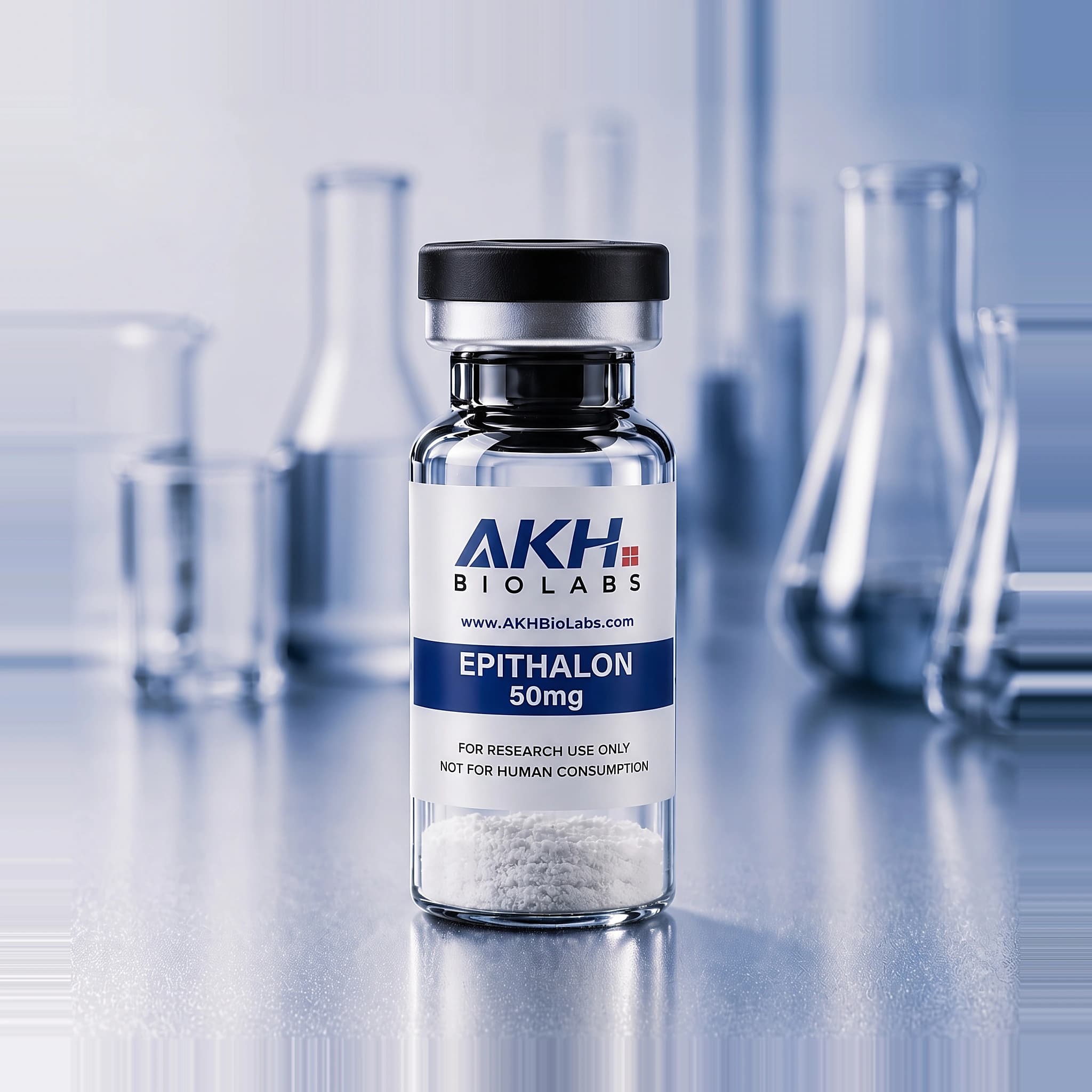
Longevity· AKH Signature
In stockEpithalon
Epithalamin Tetrapeptide
Size50mgPurity99.77%FormulaC14H22N4O9
Epithalon (also written Epitalon, sequence Ala-Glu-Asp-Gly) is a synthetic tetrapeptide modelled on the pineal extract epithalamin, originally developed at the St Petersburg Institute of Bioregulation and Gerontology. It is investigated for its reported upregulation of telomerase — the enzyme that maintains the protective caps at the ends of chromosomes — and is widely studied in cellular ageing models.
€85
Quantity
HPLC verified
9–14 day shipping
Full COA
Worldwide delivery
About this compound
The research profile.
Epithalon is a synthetic tetrapeptide with the sequence Ala-Glu-Asp-Gly (AEDG). It was designed by Khavinson and colleagues at the St Petersburg Institute of Bioregulation and Gerontology as a defined, single-sequence analogue of Epithalamin — a polypeptide extract of the pineal gland that had been the subject of Soviet and Russian gerontology research since the 1970s. Reducing the extract to one short sequence made it possible to study a reproducible molecule rather than a mixture.
The most-cited in-vitro finding is that adding the peptide to telomerase-negative human fetal fibroblast cultures induced expression of the telomerase catalytic subunit, measurable enzymatic activity, and telomere elongation. Microarray work in mouse brain describes altered expression across a large cDNA library following treatment with the tetrapeptide, which the authors interpret as a gene-regulatory rather than receptor-agonist mode of action; short peptides of this class are proposed to interact directly with DNA and chromatin.
In-vivo work is largely rodent carcinogenesis and lifespan research, alongside human studies of the parent Epithalamin preparation examining circadian melatonin output in elderly subjects. The evidence base is small, concentrated in a handful of research groups, and much of it is published in Russian-language or Russian-affiliated journals — a limitation worth weighing when designing any study around this compound.
Published research
15 peer-reviewed studies on Epithalon are summarised in our research library, including 8 published since 2023 — with study designs, reported findings and what the evidence does not establish.
Read the Epithalon evidence baseFor research purposes only. Not for human consumption, diagnosis, treatment, or prevention of any condition.
Categorised as Longevity — Compounds for cellular-ageing and immune research.
Dosing at a glance
What the literature reports.
For research and laboratory use only. Not for human consumption.
Route
Subcutaneous
Frequency
Once daily, within a defined course
Reported range
5–10 mg
Protocol duration
10–20 day courses, repeated once or twice yearly in the published protocols
5 mgper administration10 mg
The published rodent work is dosed far lower — roughly 1 mcg per animal, about 30–40 mcg per kg, given on five consecutive days each month. The 5–10 mg per-administration figures shown here reflect the intermittent course regimens described in the human pineal-peptide literature, and are reported for reference rather than recommended.
Ranges reflect protocols reported in the published literature on Epithalon — see research citations.
Calculate a dilutionReconstitution & storage
From powder to solution.
- Step 01
Add 2 ml bacteriostatic water
Aim the stream at the vial wall rather than the powder.
- Step 02
Swirl gently — never shake
Rotate the vial until the solution runs clear. Agitation degrades the peptide.
- Step 03
Refrigerate at 2–8 °C
Reconstituted vials belong in the fridge, protected from direct light.
- Step 04
Use within 28 days
Discard any remainder once the stability window closes.
Lyophilised · −20 °CReconstituted · 2–8 °C, 28 days
A 50 mg vial in 2 ml of bacteriostatic water gives a 25 mg/ml solution. Lyophilised vials keep best at -20 °C; reconstituted solution is refrigerated at 2–8 °C and protected from light.
Reconstitution calculator
50 mg vialmg
ml
mg
5 mg = 5000 mcg
Draw
20units · U-100 insulin syringe
- Concentration
- 25 mg/ml
- Draws per vial
- 10
- Cost per draw
- €8.50
For research and laboratory use only. Not for human consumption.
Laboratory arithmetic for Epithalon — enter the COA-verified vial content for exact figures. Not medical advice.
Effect timeline
Observed across the research window.
Milestones summarise findings reported in the cited studies. Outcomes vary across models and protocols.
Day 1–5
Early transcriptional response
Microarray work in mouse brain reports changes in gene expression across a broad cDNA library within short treatment windows, which the authors read as a regulatory rather than receptor-mediated effect.
Day 10–20
Course length in the human literature
Studies of the parent Epithalamin preparation in elderly subjects are built around short defined courses, after which circadian melatonin profiles were re-measured against the pre-treatment baseline.
In-vitro end points
Telomerase and telomere measures
In telomerase-negative human fetal fibroblast culture, investigators reported induction of the telomerase catalytic subunit, enzymatic activity, and telomere elongation. These are cell-culture observations and were not reproduced as clinical outcomes.
Long-term rodent studies
Lifespan and tumour-incidence end points
In SHR mice dosed monthly from three months of age until natural death, investigators tracked ageing biomarkers, survival, and spontaneous tumour incidence as the study's terminal end points.
For research and laboratory use only. Not for human consumption.
Scientific research
The published evidence.
The dosing ranges and timeline milestones on this page summarise the peer-reviewed publications below.
References
- 01
Epithalon peptide induces telomerase activity and telomere elongation in human somatic cells. Bull Exp Biol Med (2003). PubMed · 12937682
- 02
Effect of Epitalon on biomarkers of aging, life span and spontaneous tumor incidence in female Swiss-derived SHR mice. Biogerontology (2003). PubMed · 14501183
- 03
Effect of melatonin and tetrapeptide on gene expression in mouse brain. Bull Exp Biol Med (2004). PubMed · 15723138
- 04
Effect of peptide preparation epithalamin on circadian rhythm of epiphyseal melatonin-producing function in elderly people. Bull Exp Biol Med (2004). PubMed · 15452611
Laboratory verification
One Certificate, published unaltered.
The Certificate is a test report from a named laboratory outside AKH, ordered by our manufacturer and shown here exactly as the laboratory issued it. A printed copy ships in every parcel.
- Batch
- 26099
- Test date
- 26 Jul 2026
- Task ID
- #1812395
- Purity
- 99.77%
Results
Epitalon: 50mg | Purity: 99.77%
Verified by Brown Institute of Biomolecular Research. Scan the full report for every measurement.
Product FAQ
Questions researchers ask.
Pairs well with
Frequently co-studied.
Compounds that appear alongside Epithalon in the research literature.
For research and laboratory use only. Not for human consumption.
Longevity