Popular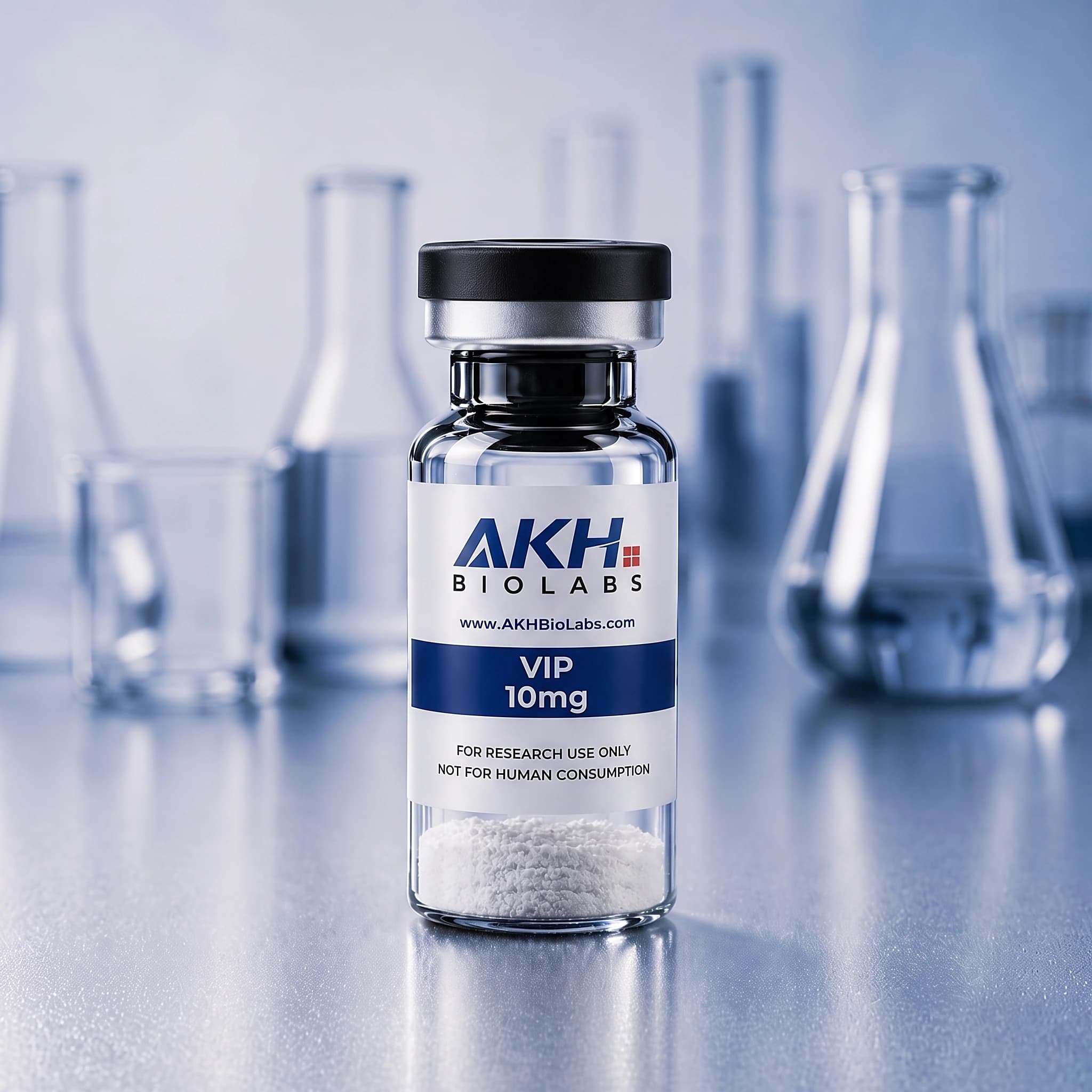
Longevity· Popular
In stockVIP
Vasoactive Intestinal Peptide
Size10mgPurity99.91%FormulaC147H245N43O43S
VIP (Vasoactive Intestinal Peptide) is a 28-amino-acid neuropeptide of the secretin/glucagon family, produced in the gut, pancreas and brain. It is researched for its broad signalling roles in vasodilation, smooth-muscle relaxation, anti-inflammatory cytokine modulation (downregulating TNF-α, IL-6) and neuroimmune crosstalk in laboratory models.
€65
Quantity
HPLC verified
9–14 day shipping
Full COA
Worldwide delivery
About this compound
The research profile.
Vasoactive intestinal peptide is a 28-amino-acid neuropeptide, isolated from porcine small intestine by Said and Mutt in 1970 and named for the vasodilator activity that first identified it. It belongs to the secretin/glucagon superfamily and is now understood to be produced well beyond the gut — in central and peripheral neurons, in the suprachiasmatic nucleus, and by immune cells themselves.
VIP signals through the class B G-protein-coupled receptors VPAC1 and VPAC2, and with lower affinity at PAC1. Receptor engagement raises intracellular cAMP and, in immunology reviews, is described as shifting antigen-presenting cell and T-cell behaviour: reduced production of several pro-inflammatory mediators, altered chemokine expression, and effects on regulatory T-cell populations. The literature treats it as an endogenous anti-inflammatory and homeostatic mediator rather than a single-pathway drug.
Clinical investigation has concentrated on the vascular and pulmonary side of that pharmacology, including work describing reduced VIP in serum and lung tissue in primary pulmonary hypertension alongside upregulated receptor expression. Because the native peptide is short-lived in circulation, inhaled and intranasal delivery both appear in the published work — the route being an attempt to reach target tissue directly rather than a claim of superiority.
Published research
15 peer-reviewed studies on VIP are summarised in our research library, including 9 published since 2023 — with study designs, reported findings and what the evidence does not establish.
Read the VIP evidence baseFor research purposes only. Not for human consumption, diagnosis, treatment, or prevention of any condition.
Categorised as Longevity — Compounds for cellular-ageing and immune research.
Dosing at a glance
What the literature reports.
For research and laboratory use only. Not for human consumption.
Route
Subcutaneous
Frequency
Once daily (study protocols)
Reported range
50–200 mcg
Protocol duration
Short protocols; the cited clinical work ran over weeks to months
50 mcgper administration200 mcg
Intranasal · 1–2x daily (study protocols) · 50–200 mcg per administration, divided between nostrils · Weeks to months in the published clinical work
The 50–200 mcg band reflects the per-administration amounts that recur across published VIP research protocols. The cited studies characterise receptor pharmacology and disease biology rather than establishing a standardised protocol, so the range should be read as descriptive of the literature.
Ranges reflect protocols reported in the published literature on VIP — see research citations.
Calculate a dilutionReconstitution & storage
From powder to solution.
- Step 01
Add 3 ml bacteriostatic water
Aim the stream at the vial wall rather than the powder.
- Step 02
Swirl gently — never shake
Rotate the vial until the solution runs clear. Agitation degrades the peptide.
- Step 03
Refrigerate at 2–8 °C
Reconstituted vials belong in the fridge, protected from direct light.
- Step 04
Use within 28 days
Discard any remainder once the stability window closes.
Lyophilised · −20 °CReconstituted · 2–8 °C, 28 days
Because per-administration amounts sit in the microgram range, a 10 mg vial is taken into 3 ml of bacteriostatic water: that gives 3.33 mg/ml, so 200 mcg measures 0.06 ml — 6 units on a U-100 syringe. VIP is heat- and light-sensitive — keep lyophilised vials at -20 °C and reconstituted solution refrigerated and shielded from light.
Reconstitution calculator
10 mg vialmg
ml
mcg
200 mcg = 0.2 mg
Draw
6units · U-100 insulin syringe
- Concentration
- 3.33 mg/ml
- Draws per vial
- 50
- Cost per draw
- €1.30
For research and laboratory use only. Not for human consumption.
Laboratory arithmetic for VIP — enter the COA-verified vial content for exact figures. Not medical advice.
Effect timeline
Observed across the research window.
Milestones summarise findings reported in the cited studies. Outcomes vary across models and protocols.
Minutes
Receptor engagement and vascular response
The founding isolation work characterised VIP by its rapid vasodilator activity in bioassay, and receptor studies describe cAMP accumulation on the same short timescale.
Hours
Immune-cell signalling changes
Immunology reviews describe VPAC1 and VPAC2 engagement on antigen-presenting cells altering cytokine and chemokine output within hours of exposure in culture.
Days to weeks
Regulatory cell population shifts
Longer in-vivo models report changes in regulatory T-cell populations and in the tolerogenic profile of antigen-presenting cells, effects the reviews frame as accumulating rather than immediate.
Study end point
Haemodynamic measures
The pulmonary hypertension work assessed mean pulmonary artery pressure, cardiac output, and mixed venous oxygen saturation across an eight-patient cohort as its reported end points.
For research and laboratory use only. Not for human consumption.
Scientific research
The published evidence.
The dosing ranges and timeline milestones on this page summarise the peer-reviewed publications below.
References
- 01
Polypeptide with broad biological activity: isolation from small intestine. Science (1970). PubMed · 5450698
- 02
The significance of vasoactive intestinal peptide in immunomodulation. Pharmacol Rev (2004). PubMed · 15169929
- 03
Vasoactive intestinal peptide: a neuropeptide with pleiotropic immune functions. Amino Acids (2013). PubMed · 22139413
- 04
Vasoactive intestinal peptide as a new drug for treatment of primary pulmonary hypertension. J Clin Invest (2003). PubMed · 12727925
Laboratory verification
One Certificate, published unaltered.
The Certificate is a test report from a named laboratory outside AKH, ordered by our manufacturer and shown here exactly as the laboratory issued it. A printed copy ships in every parcel.
- Batch
- 26114
- Test date
- 10 Aug 2026
- Task ID
- #1812410
- Purity
- 99.91%
Results
VIP: 10mg | Purity: 99.91%
Verified by Brown Institute of Biomolecular Research. Scan the full report for every measurement.
Product FAQ
Questions researchers ask.
Pairs well with
Frequently co-studied.
Compounds that appear alongside VIP in the research literature.
For research and laboratory use only. Not for human consumption.
Longevity